
Lingual Braces: Hidden Braces Pros, Cons & Costs
Quick Answer
Lingual braces represent precisely equivalent metallic elements, but the bands and wires tie back to the enamel (lingual elements), making it completely invisible from outward views. The significant execs are total imperceptibility and full orthodontic protection (unlike Invisalign, depending on constant conformity). Disadvantages entail intense tongue irritation, heavy lisp for a number of weeks, larger adjustment times, and heavily expensive price ranges ($8,000 – $13,000).
How Lingual Braces Work
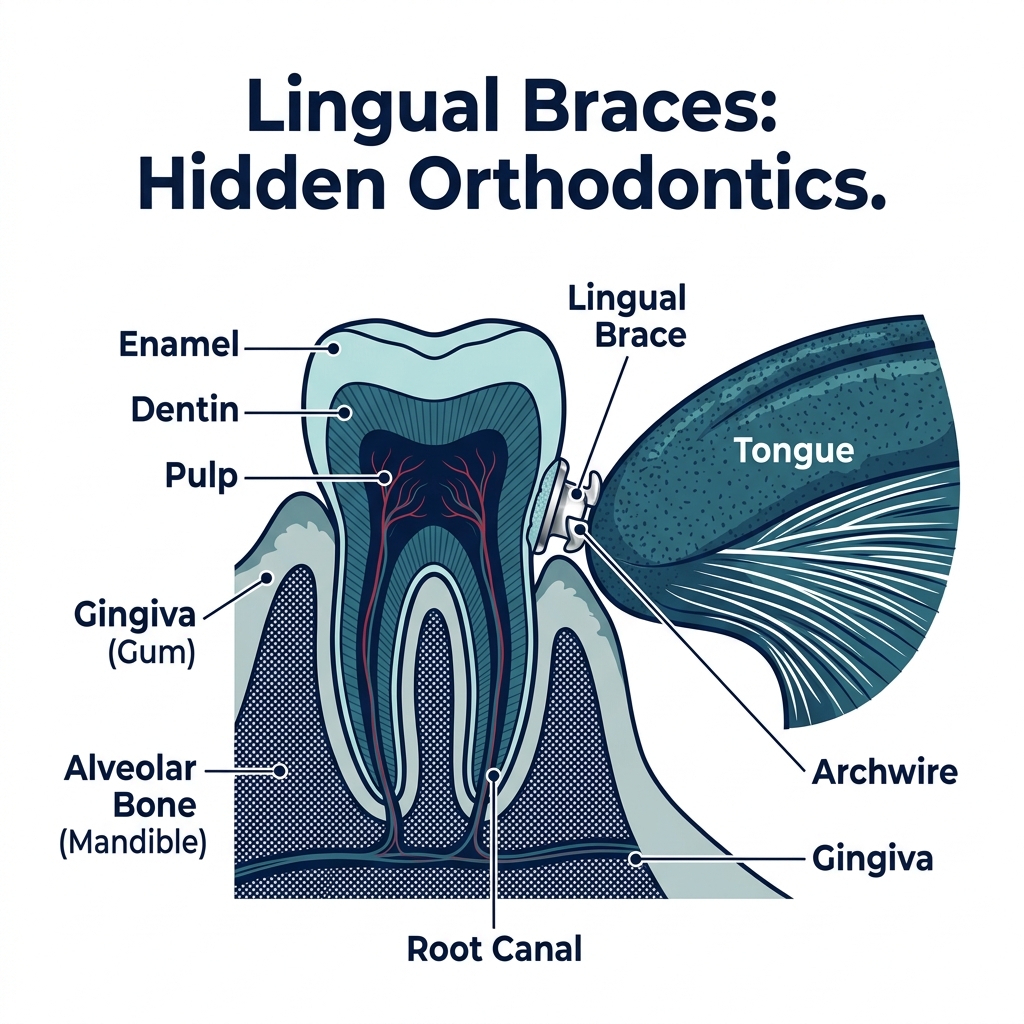
Lingual braces attach custom-cast metallic brackets and archwires to the backside (lingual surface) of teeth. This hidden mechanical setup delivers continuous force to correct complex bite issues while remaining invisible from outward views.
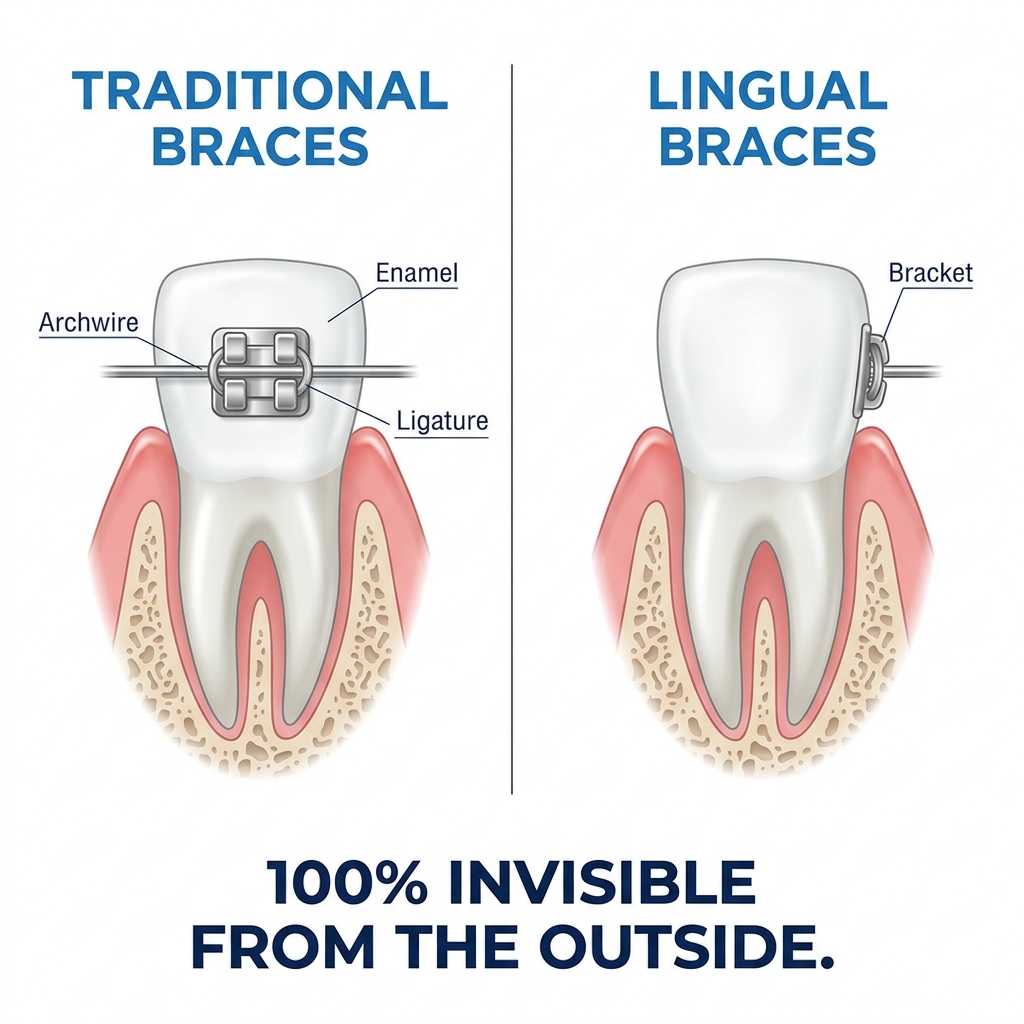
Lingual braces use the same mechanics as traditional labial (front-facing) braces: brackets are glued to the enamel, and an archwire is threaded through them to exert continuous pressure, moving the teeth into alignment.
The major difference is the placement. The back of the teeth (the lingual surface) has a highly irregular, scalloped shape compared to the smooth front surface. Because of this, lingual brackets cannot be mass-produced. A digital scan of your mouth is sent to a lab, and custom brackets (like the Incognito™ system) are cast in gold alloy to fit the exact contours of each individual tooth perfectly.
The Pros of Lingual Braces
The main advantages of lingual braces include true 100% visual invisibility, zero patient compliance requirements, and full mechanical control over complex root movements. Fixed interior brackets eliminate aligner wear discipline while preserving smile aesthetics.
The simplest entirely unnoticeable orthodontic remedy is the lingual brace. Clear aligners (such as Invisalign) require gluing invisible foam "decorations" at the front of the teeth and glowing plastic instances underneath Lingual braces are firmly placed below the tooth
Unlike clear aligners, which you can easily take out and forget to put back in, lingual braces are glued to your teeth. They are working 24/7 without requiring any discipline on your part.
Lingual braces offer the orthodontist the same level of granular root control as traditional braces, making them suitable for severe crowding, deep overbites, and complex extraction cases that clear aligners might struggle to resolve.
The Cons of Lingual Braces
The primary disadvantages of lingual braces are temporary tongue soreness and lisping, difficult oral hygiene maintenance behind teeth, high treatment costs ($8,000 to $13,000), and longer appointment chair times for specialized adjustments.
This is the biggest drawback. Your tongue normally rests against the back of your upper teeth. With lingual braces, your tongue is forced to rest against metal brackets. The first 2 to 4 weeks involve significant tongue soreness, ulcerations, and a pronounced lisp (especially on "S" and "T" sounds) as the tongue learns to navigate the new obstacles.
Cleaning the back of your teeth is hard enough; cleaning around metal brackets on the back of your teeth is an exercise in extreme patience. You cannot see what you are doing, making flossing and brushing very tedious. A water flosser is virtually mandatory.
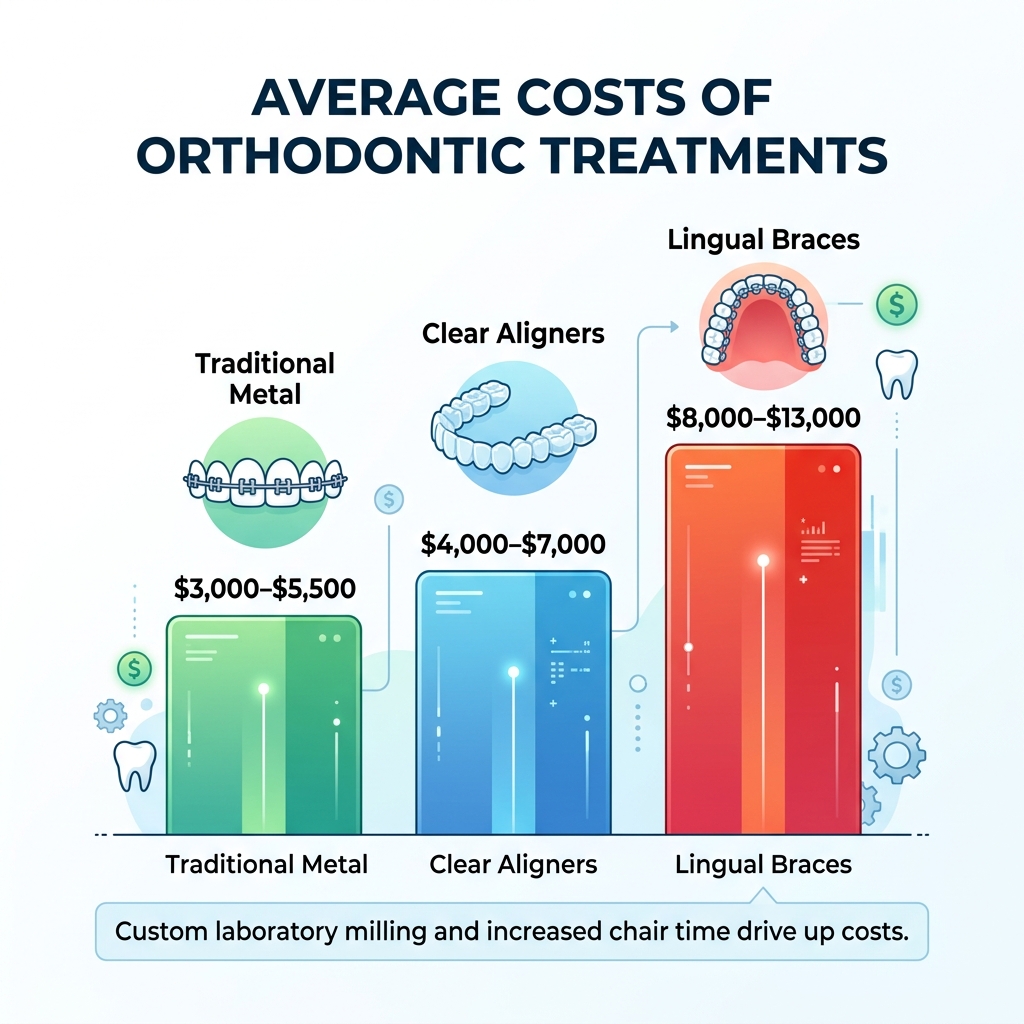
Lingual braces are by far the costliest orthodontic option available for between $8,000 and $13,000. At identically the equal level, they lack sufficient orthodontists. The technical application to master abnormal joint angles entails special constant attention.
Frequently Asked Questions
What are lingual braces?
Lingual braces are fixed orthodontics where metallic brackets and bows are placed behind the enamel (lingual flooring), rather than in front. This makes them completely unnoticeable when you are smiling or talking. They exercise normal mechanical techniques for straightening the tooth, however, materials are individually fabricated to adapt exactly into the specific characteristics of your underlying teeth.
Are lingual braces better than Invisalign?
They are wonderful. The lingual braces are 100% unnoticeable (Invisalign has significant plastic sides and fixtures) and they are stored correctly (Invisalign lets you recognize placing cases at 22 hours per step and daylight) The lingual brace gives the orthodontist deeper root control for complicated chunk situations However, Invisalign may be more comfortable, simple to clear, and costs much less than a standard lingual brace.
Do lingual braces ruin your tongue?
It won't harm your tongue all the time, however, the primary few 2 to 4 weeks will cause intense pain in your tongue. Because brackets take in the place that your tongue occasionally sits and processes, your tongue constantly interacts with the steel. This causes soreness, tearing and temporary lip damage. Orthodontic cream and persistence were necessary till the tongue developed corns and acclimatised
Why are lingual braces so expensive?
Lingual braces normally run $8,000 to $13,000. The hardware is custom milled in the laboratory to accommodate your character lower back tooth placement exactly, unlike the bulk of the main braces Additionally, deploying and operating it calls for specialised classes and takes orthodontists rather more significant extra chair time because of hard admittance positions.
Can you eat normally with lingual braces?
No, you'll want to adhere strictly to the equal diet regimens of classical brackets – no complicated, rough or brittle foods. In fact, consuming braces at first is generally hard, seeing that space on your tongue can be limited and meals will without problems get caught within the brackets across the chunk.