What Happens If You Stop Wearing Your Retainer? (2026 Relapse Timeline)
Quick Answer
Teeth begin shifting within days of stopping retainer wear — not months. The lower front teeth are typically the first to move, as tongue pressure pushes them inward and crowding reappears. In the first 6–12 months after braces, skipping retainer wear for even a week can cause noticeable tightening when you put it back in. After 2+ years, the rate of shifting slows but never stops entirely. Whether relapse is reversible depends on how long you went without wearing and how much movement occurred.
Part of our Alternatives & Aftercare Master Guide.
1. Why Teeth Shift After Braces
Teeth shift after braces because elastic periodontal ligament fibers contract back toward pre-treatment positions, compounded by soft tissue pressures from lips and tongue.
Teeth are not rigidly locked in bone. They sit in the jaw via the periodontal ligament (PDL) — a mesh of collagen fibers connecting each tooth root to the alveolar bone. These fibers have memory: when braces move a tooth, the fibers on one side are stretched and fibers on the other are compressed. After braces come off, those stretched fibers want to contract back to their original length, pulling the tooth back toward its pre-treatment position.
Simultaneously, external pressures — the tongue pushing from inside, the lips and cheeks pushing from outside — apply continuous low-level force to the teeth. Without a retainer providing a counterforce, teeth follow the path of least resistance. This is normal biology, not a sign that the orthodontic treatment failed. Retention is the final phase of orthodontic treatment, not a bonus step.
2. Relapse Timeline: What Happens and When
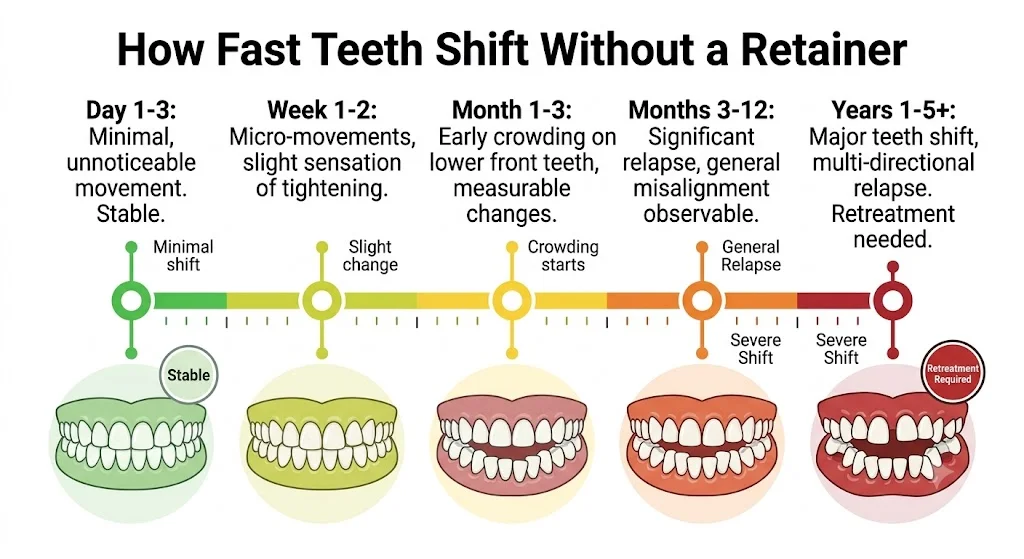
Relapse progresses from slight tightness at 1 week, to visible lower front tooth crowding at 1 month, to permanent structural relapse after several un-retained years.
The table below outlines key comparison data and practical guidelines for what happens if you stop wearing your retainer?.
| Time Without Retainer | What Typically Happens |
|---|---|
| 1–3 days | No visible change; retainer may feel slightly snug when reinserted |
| 1–2 weeks | Retainer noticeably tighter; minor PDL movement has begun |
| 1 month | Visible early crowding returning in lower front teeth in some patients |
| 3–6 months | Measurable relapse in most patients in the 0–12 month post-treatment window |
| 1–2 years | Moderate to significant shifting; retainer likely no longer fits |
| 5+ years | Major relapse possible; retreatment often required to restore original result |
Note: Data reflects typical clinical guidelines and average provider estimates across standard treatment plans.
3. Which Teeth Move First (and Why)
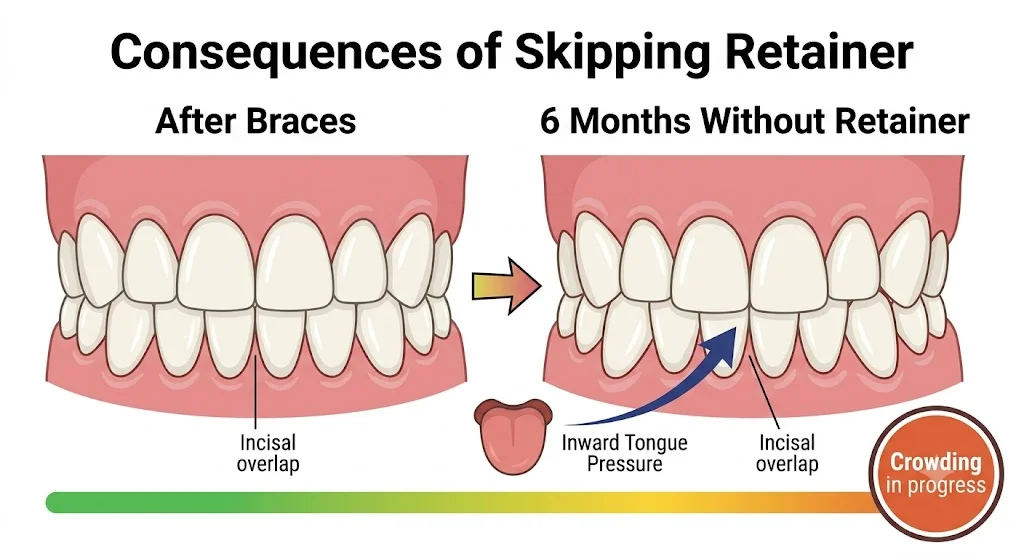
Lower front incisors shift first due to inward tongue resting forces, followed by the reopening of previously closed extraction gaps and arch narrowing.
Lower front teeth are the most common first movers. The tongue rests against the inside surface of these teeth and continuously pushes them inward and together. This re-creates the classic crowding pattern — the straight row of lower front teeth begins to overlap again, often starting with the lateral incisors tucking behind the centrals.
Closed gaps begin to reopen. The gum tissue and bone in the former extraction or spacing site pull adjacent teeth back over time.
The upper arch is generally more stable than the lower arch because the palate provides a rigid surface. However, upper front teeth can flare outward and the arch width can narrow without retention.
4. What To Do If You Have Already Stopped
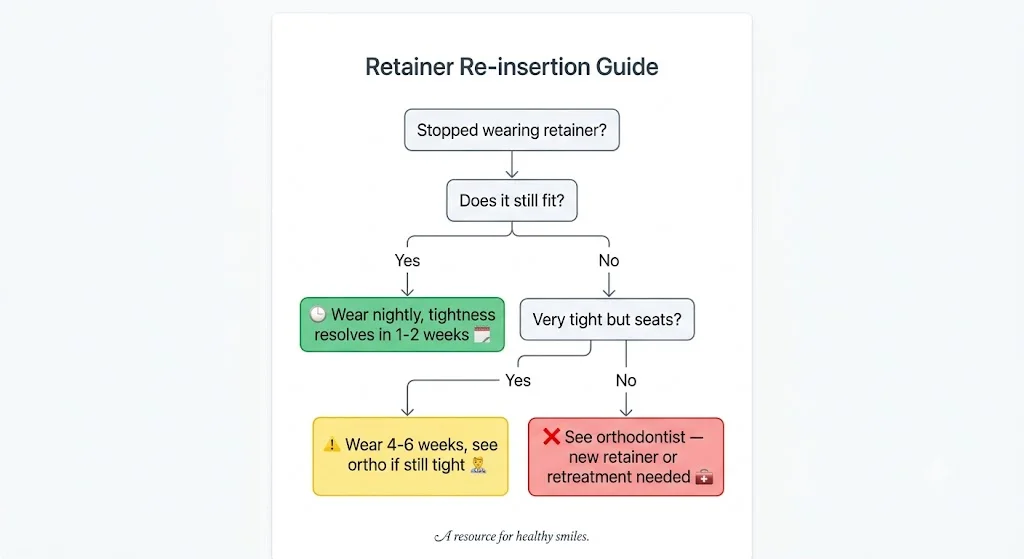
If you stopped wearing your retainer, test its fit gently, resume nightly wear if it seats fully, or seek professional orthodontic evaluation if it no longer fits.
- Step 1 — Try your retainer: Insert it gently. If it seats fully — even with some tightness — wear it nightly and do not skip nights. The tightness should resolve within 1–2 weeks.
- Step 2 — If very tight but seats: Wear it nightly for 4–6 weeks. If still very tight after 4 weeks, see your orthodontist.
- Step 3 — If it will not seat: Do not force it. See your orthodontist. You will need a new retainer made from a scan of your current tooth position. This stabilizes where your teeth are now — it does not correct the relapse.
- Step 4 — To return to original result: That requires retreatment — Invisalign or braces — to move teeth back. After retreatment, strict retention is critical.
Frequently Asked Questions
How long does it take for teeth to shift without a retainer?
Teeth can begin shifting within 24–72 hours, particularly in the first 6 months after braces when bone has not fully mineralized. After consistent retention for a year or two, shifting slows but never stops entirely.
Can teeth shift back after stopping retainer?
Minor shifting can often be reversed by resuming consistent nightly wear. If the retainer will not seat at all, a new retainer captures the shifted position — returning to the original result requires orthodontic retreatment.
What teeth shift first when you stop wearing your retainer?
Lower front teeth typically shift first due to tongue pressure pushing them inward. Closed gaps may reopen, and corrected rotations on premolars and canines can gradually return.
Is it too late to start wearing my retainer again?
If your retainer still fits, it is not too late — resume nightly wear immediately. If it no longer fits, see your orthodontist for a new retainer to at least stabilize the current position.
How much does it cost to fix relapse?
Minor relapse (retainer still fits): free. New retainer for moderate relapse: $150–$300 per arch. Full retreatment for significant relapse: $2,000–$5,000+.