Maintenance & Care
How to Brush Teeth with Braces: The Exact Technique (2026 Guide)
Quick Answer
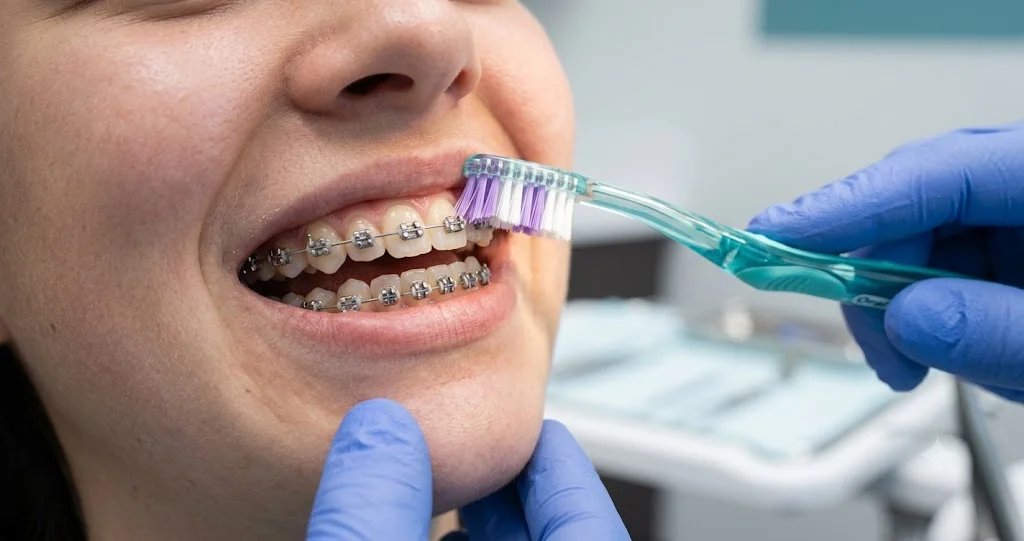
After each meal, brush with a soft-bristled toothbrush angled at 45 degrees — first above each bracket, then below it. This two-angle technique clears plaque from the bracket margins, where decalcification and white spots always begin. Spend at least 2 minutes per session. Electric toothbrushes reduce plaque around brackets by up to 22% compared to manual brushing.
Part of our complete Maintenance & Care Guide.
You just got braces. Your orthodontist handed you a little kit — a toothbrush, some floss threaders, maybe a travel-sized paste — and said "brush well." That was it. No one demonstrated the actual technique. No one told you that the way you have been brushing your whole life is now completely wrong for your new hardware.
Here is the problem: brushing with braces is not just "brush harder." The brackets create new surfaces, new angles, and new food traps that your previous technique misses entirely. The result, for patients who don't adjust, is white spots — permanent enamel damage that shows up the day their braces come off, right where each bracket was.
This guide teaches you the exact technique that prevents that.
Why Brushing Changes with Braces
Brushing with braces requires specialized techniques because brackets and archwires create plaque-trapping margins above and below each bracket. Standard horizontal brushing misses these margins, leading to rapid decalcification.
Before braces, brushing was straightforward. You had four flat surfaces per tooth: front, back, two sides. Plaque accumulated predictably along the gumline.
With braces, each bracket adds two new danger zones:
- The bracket margin above — the thin gap between the top edge of the bracket and the gum
- The bracket margin below — the thin gap between the bottom edge of the bracket and the tooth surface beneath it
These are the margins where plaque accumulates fastest, where the toothbrush reaches least effectively with standard technique, and where white spot lesions begin. Standard horizontal scrubbing misses both margins entirely.
The Two-Angle Brushing Technique
The two-angle brushing technique requires brushing at a 45-degree angle pointing down toward the top of brackets, then at 45 degrees pointing up toward the bottom edge. This two-step pass thoroughly cleans bracket margins.
This is the core of braces brushing: two passes per tooth, two different angles.
Pass 1 — Above the bracket: Hold the toothbrush at a 45-degree angle pointing downward toward the top edge of each bracket. Use small circular motions. You are cleaning the space between the top of the bracket and the gum above it. Work along all upper teeth, then all lower teeth.
Pass 2 — Below the bracket: Angle the toothbrush upward at 45 degrees pointing toward the bottom edge of each bracket. Same small circular motions. You are cleaning the space between the bottom of the bracket and the tooth surface below it.
Pass 3 — The wire: Hold the toothbrush horizontally and brush directly over the archwire and across all bracket faces. This clears food that sits in the wire groove itself.
Pass 4 — Standard surfaces: Brush the back surfaces of all teeth, the chewing surfaces of molars, and along the gumline as you normally would.
Total time: minimum 2 minutes. Most orthodontists recommend 3 to 4 minutes for patients with braces — the increased surface area genuinely requires more time.
How Often to Brush
Brushing with braces must occur after every meal and snack to eliminate acid-producing bacteria within 20 minutes of eating. Rinsing with water provides temporary relief when brushing is impossible.
Before braces: twice a day was the standard recommendation. With braces: brush after every meal and snack.
The reason is plaque kinetics. Oral bacteria begin producing acid within 20 minutes of eating. That acid sits against the enamel surface adjacent to each bracket for hours if not removed. Within 4 weeks of inadequate brushing, irreversible enamel demineralization begins — the first stage of white spot formation.
Minimum schedule:
- Morning (before or after breakfast)
- After lunch or any midday meal
- After dinner
- Before bed — the most important session; no eating after this
When you can't brush (at school, work, or a restaurant): rinse vigorously with water for 30 seconds. Water rinsing alone removes a substantial portion of food debris and disrupts the acid environment. It is not a substitute for brushing, but it significantly interrupts the acid cycle until you can brush properly.
Electric vs. Manual Toothbrush
Electric toothbrushes reduce plaque around braces brackets by up to 21% compared to manual brushes. Oscillating-rotating and sonic models effectively clean narrow bracket margins with minimal pressure.
Both work if the technique is correct. Electric toothbrushes have a documented, measurable advantage with braces.
A 2014 Cochrane systematic review of 56 trials found that oscillating-rotating electric toothbrushes reduced plaque by 21% and gingivitis by 11% over three months compared to manual brushing. The small round head of oscillating-rotating models is especially effective at reaching bracket margins — it works in spaces where a flat manual brush cannot fit.
- Oscillating-rotating (Oral-B): Best for bracket margins. Use the "Sensitive" or "Orthodontic" replacement head if available.
- Sonic (Sonicare): Effective via acoustic fluid dynamics — high-frequency vibration creates turbulence that disrupts plaque slightly beyond where the bristles make contact. A strong all-around choice.
- Manual: Completely adequate if the two-angle technique is correct and you brush for the full 2 to 3 minutes. Use soft bristles — medium or hard bristles risk loosening bracket adhesive over time.
The Right Toothpaste
Fluoride toothpaste with 1,000 to 1,500 ppm fluoride is essential during braces treatment to remineralize enamel. Whitening toothpastes must be avoided because they leave dark unwhitened squares under brackets.
Use fluoride toothpaste — every time, no exceptions.
Fluoride at concentrations of 1,000 to 1,500 ppm (standard in all US over-the-counter toothpastes — Crest, Colgate, Sensodyne) remineralizes enamel by replacing calcium and phosphate ions that acid removes. This directly counteracts early-stage decalcification.
Do not use:
- Whitening toothpaste: Whitening agents only reach exposed enamel. The enamel under each bracket is sealed by the bonding composite and stays untouched. Result: when braces come off, the exposed enamel is lighter while the area under each bracket retains its original shade — visible as dark squares on each tooth.
- Highly abrasive toothpastes: Some whitening and charcoal toothpastes are abrasive enough to scratch the composite resin brackets and weaken the bond over time.
Optional upgrade: High-fluoride prescription toothpaste (5,000 ppm, brand name PreviDent) is available through your dentist and provides stronger remineralization for patients at high risk of white spots. Worth asking about at your next appointment if you have noticed any early white spot formation.
Interdental Brushes: The Tool Most Patients Skip
Interdental brushes (proxy brushes) slide under archwires to clean plaque from between adjacent brackets and around molar bands. Daily proxy brush use cleans areas unreachable by standard toothbrush bristles.
Interdental brushes (also called proxy brushes or interproximal brushes) look like tiny pipe cleaners — small cylindrical brushes on a wire handle that fit between the bracket and the archwire.
They reach areas the two-angle technique misses: under wires, between adjacent brackets, and around molar bands. They take about 60 seconds to use and clean areas that are genuinely unreachable with a standard toothbrush.
How to use: Slide an interdental brush under the archwire between each pair of adjacent brackets. Move it gently back and forth a few times. Work across all teeth, and rinse the brush between each insertion.
These are available at any pharmacy (GUM, Oral-B, and Platypus all make them). They are inexpensive and one of the most underused tools in braces hygiene.
Fluoride Mouthwash: The Final Layer
Alcohol-free fluoride mouthwash used nightly for 60 seconds provides continuous enamel remineralization in hard-to-reach bracket crevices. Alcohol-free formulas preserve natural saliva flow to combat acid.
Rinse with alcohol-free fluoride mouthwash (ACT Fluoride Rinse, Colgate Fluoride Guard, or any alcohol-free fluoride rinse) for 60 seconds after your last brushing session of the day. Do not eat or drink for 30 minutes afterward.
Mouthwash reaches microscopic areas between brackets and teeth that a toothbrush cannot physically contact. The fluoride deposits directly onto enamel surfaces and provides continuous remineralization between brushing sessions.
Always choose alcohol-free. Alcohol-based mouthwashes dry out the oral mucosa and reduce saliva flow — which actually increases acid accumulation between meals.
White Spots: What They Are and How to Prevent Them
White spot lesions (WSLs) are permanent chalky enamel demineralization spots caused by prolonged plaque accumulation around brackets. Prevention requires rigorous two-angle brushing, proxy brushes, and nightly fluoride.
White spot lesions (WSLs) are the most common, most preventable complication of orthodontic treatment. Studies estimate that 13 to 75% of orthodontic patients develop at least one WSL during treatment — the wide range reflects how dramatically oral hygiene habits affect outcomes.
What causes them: Plaque sitting against enamel for extended periods produces lactic acid, which dissolves calcium and phosphate from the enamel crystal lattice (hydroxyapatite). The demineralized area scatters light differently than intact enamel — it appears chalky white.
When they form: Visible WSLs can develop within 4 weeks of inadequate oral hygiene.
How to prevent them:
- Two-angle brushing technique after every meal
- Fluoride toothpaste — every brush, every session
- Interdental brush under the archwire daily
- Alcohol-free fluoride mouthwash nightly
- Limit sugar and acidic drinks between meals
If they develop: Options after braces removal include remineralization with MI Paste (GC America), Icon resin infiltration (DMG), microabrasion, or veneers for severe cases. None are as effective as prevention — WSLs severe enough to require treatment represent permanent structural changes to enamel.
The Travel Kit
A portable braces travel kit containing a travel toothbrush, fluoride paste, proxy brushes, floss threaders, and wax allows prompt 90-second cleaning after away-from-home meals.
Build a small pouch to carry every day:
- Travel-sized soft toothbrush
- Travel toothpaste (fluoride)
- A few interdental brushes
- Floss threaders or orthodontic flossers
- A small tin of orthodontic wax
Every restaurant meal, every school lunch, every work meeting — a 90-second brush afterward is what separates patients who finish treatment with clean enamel from those who don't. Next, read our guide on How to Floss with Braces to complete your daily hygiene routine.