How to Stop Braces Pain Fast: What Actually Works (2026 Guide)
Quick Answer
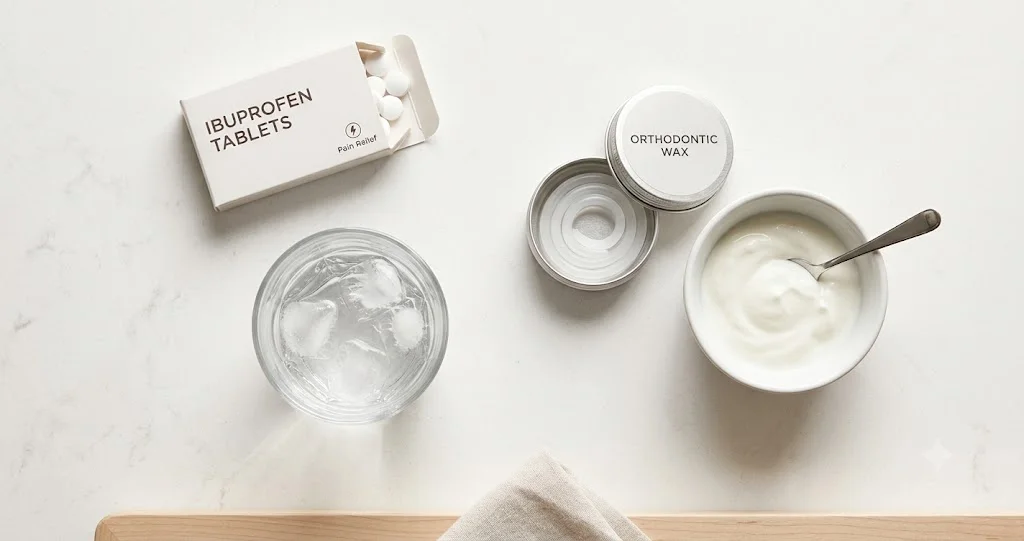
The fastest braces pain relief: take 400 mg of ibuprofen before soreness peaks, not after. Cold water and cold soft foods numb the area immediately. Saltwater rinses reduce gum inflammation. Orthodontic wax eliminates cheek and lip friction sores. For most patients, combining ibuprofen with cold reduces peak soreness from Day 2 to manageable within 2 hours.
Part of our Pain & Discomfort Guide.
You woke up on Day 2 of braces and your teeth hurt more than they did yesterday. You can barely bite into a piece of bread. You Googled "how to stop braces pain fast" at 7 in the morning with your jaw aching, and here you are.
This guide gives you the actual science-based answer — not a vague list of tips. You will know exactly what to take, when to take it, what to eat, and what is happening inside your jaw. Most importantly, you will know which approaches work and which are a waste of time.
Why Your Braces Actually Hurt
Braces apply continuous, controlled force to your teeth. That force compresses the periodontal ligament (PDL) — the thin layer of connective tissue between your tooth root and the surrounding bone. When the PDL is compressed:
- Blood vessels inside the compressed zone temporarily collapse
- Your immune system detects the stress and releases inflammatory chemicals (prostaglandins and cytokines)
- Osteoclasts — bone-dissolving cells — activate to clear a path for the tooth to move
- You feel this entire process as soreness and pressure
The soreness is not damage. It is the biological mechanism that makes braces work. The inflammatory chemical release peaks at 24 to 48 hours — which is why Day 2 is always worse than Day 1.
Method 1: Ibuprofen — The Fastest Relief
Most people make a critical mistake: they wait until they are in pain before taking ibuprofen. By then, the prostaglandin cascade is already at peak concentration in the tissue. You are playing catch-up against a process that has been building for 24 hours.
The Right Approach
- Take 400 mg of ibuprofen approximately 1 hour before your bonding or adjustment appointment
- Continue with 400 mg every 6 to 8 hours for the first 48 hours if needed
- Do not exceed the dosage on the label (typically 1,200 mg per day for OTC use)
Taking ibuprofen before soreness starts intercepts the inflammatory pathway before it builds up. Clinical research on orthodontic pain shows that preemptive ibuprofen reduces peak pain scores by 30 to 40% compared to reactive dosing.
Why not Tylenol? Acetaminophen blocks pain signals at the brain level — it doesn't reduce the inflammation causing the pain. For braces soreness, which is driven by prostaglandin-mediated inflammation at the PDL, ibuprofen is significantly more effective. If you cannot take NSAIDs due to health conditions, acetaminophen still provides meaningful relief. Check with your doctor or pharmacist first.
Method 2: Cold — Immediate Short-Term Numbing
Cold provides immediate relief by numbing the nerve endings in the gum tissue and reducing blood flow to the inflamed PDL. The effect lasts 15 to 30 minutes per application, but it is significant enough to get you through a meal, a work meeting, or falling asleep.
Cold water
Sip continuously. The contact is brief but cumulative throughout the day.
Cold smoothies
Thick enough to coat gum tissue, cold enough to numb, soft enough not to hurt sore teeth.
Fridge-cold yogurt
Same benefit. The texture also provides light gum stimulation.
Cold washcloth on jaw
Applied externally, reduces the aching sensation that radiates into the jaw.
Avoid anything you have to bite hard into even if it is cold — the cold helps, but the biting force makes the soreness worse.
Method 3: Saltwater Rinse — The Overlooked Tool
Saltwater rinse is one of the most evidence-backed home remedies for oral inflammation, and almost every braces patient underuses it.
How to Make and Use It
Mix: half a teaspoon of table salt dissolved in 8 oz of warm (not hot) water.
Use: Rinse gently for 30 seconds. Spit. Repeat 2 to 3 times per day, especially after meals.
The salt solution is slightly hypertonic — it has a higher salt concentration than your tissue fluid. This osmotic difference draws excess fluid out of swollen tissue, reducing inflammation. It also kills anaerobic bacteria that thrive in inflamed gum tissue and create additional irritation. Used consistently, saltwater rinse visibly accelerates healing of cheek sores within 24 hours.
Method 4: Orthodontic Wax — For Cheek and Lip Sores
Braces soreness comes in two forms: tooth and jaw soreness from bone remodeling, and cheek and lip sores from bracket friction. Orthodontic wax only helps with the second type — but that second type can be more immediately painful in the first week than the tooth soreness itself.
How to Apply Wax Correctly
- Wash and dry your hands
- Pinch off a pea-sized piece of wax
- Roll it between your fingers for 10 seconds to soften it
- Dry the offending bracket with a tissue — wax sticks better to dry metal
- Press the wax firmly over the bracket, molding it to the shape
The wax creates a smooth surface that eliminates friction. It typically stays in place for 4 to 6 hours. Remove before eating, reapply after. Most patients use wax heavily in weeks 1 and 2, then rarely after week 3 as the cheeks and lips naturally toughen to the brackets.
Method 5: Bite Wafers — Speed Up the Healing
This one surprises people. Chewing on a bite wafer — a soft, pliable rubber device your orthodontist can provide — actually reduces the duration of braces soreness.
The mechanism: gentle, rhythmic chewing motion increases blood circulation through the periodontal ligament. More blood flow means more osteoclasts and osteoblasts delivered to the remodeling site, which speeds up the bone remodeling cycle. Faster remodeling means the tooth reaches its new position sooner, and the compressive force on the PDL decreases.
Use the wafer on Day 2 and Day 3 when soreness peaks. Chew gently — the goal is circulation, not force. Five to ten minutes of light chewing, two to three times per day. Bite wafers are available from your orthodontist or at most pharmacies.
The Complete Relief Comparison
The table below outlines key comparison data and practical guidelines for how to stop braces pain fast: what actually works.
| Method | Onset | Duration | Best For |
|---|---|---|---|
| Preemptive ibuprofen | 1 hour (before soreness) | 6–8 hours per dose | Preventing peak soreness |
| Reactive ibuprofen | 30–60 min after taking | 6–8 hours per dose | Managing ongoing soreness |
| Cold water/food | Immediate | 15–30 minutes | Getting through meals |
| Saltwater rinse | 24 hours (cumulative) | All-day with regular use | Cheek sores, gum inflammation |
| Orthodontic wax | Immediate | 4–6 hours per application | Bracket friction sores |
| Bite wafer | Shortens soreness cycle | Cumulative over 2–3 days | Reducing total soreness duration |
Note: Data reflects typical clinical guidelines and average provider estimates across standard treatment plans.
When to Call Your Orthodontist
Braces soreness that is diffuse, bilateral, and fades over 3 to 5 days is normal bone remodeling. These are not:
- Sharp, stabbing pain that does not respond to ibuprofen — could indicate a bracket or wire in the wrong position
- Pain localized to a single tooth that is significantly worse than surrounding teeth — possible root or nerve involvement
- Swelling of gum tissue that gets larger over several days rather than smaller
- A poking wire you cannot cover with wax and that is cutting your cheek — an orthodontist can clip it in 5 minutes
- Soreness that is worsening after Day 5 rather than improving
Never hesitate to call your orthodontic office. A 2-minute phone call can confirm whether what you're feeling is normal or requires an urgent appointment.
Not sure what to eat while dealing with soreness? Our Braces Diet Guide has the full breakdown of safe foods throughout your entire treatment. And if you haven't gotten braces yet and want to know what the bonding appointment actually feels like, read Do Braces Hurt to Get Put On?