Do Braces Hurt to Get Put On? What to Expect (2026 Guide)
Quick Answer
Getting braces put on does not hurt during the appointment. The bonding procedure is painless — no needles, no drilling. Soreness starts 4 to 6 hours after you leave the chair and peaks at 24 to 72 hours. The discomfort is pressure and tenderness, not sharp pain. Most patients rate it a 3 out of 10.
Part of our Pain & Discomfort Guide.
You have an appointment in two days. Your orthodontist said it takes 90 minutes and you don't need to do anything to prepare. But you have been down a Reddit rabbit hole at midnight reading horror stories, and now you are wondering if you should eat a big meal first in case you can't eat for a week.
Here is the honest answer: getting braces put on does not hurt. The bonding appointment has no injections, no drilling, and no cutting. What catches most people off guard is not the appointment — it is what happens 4 to 6 hours later when the soreness begins. This guide maps it out hour by hour so nothing surprises you.
What Actually Happens During the Bonding Appointment
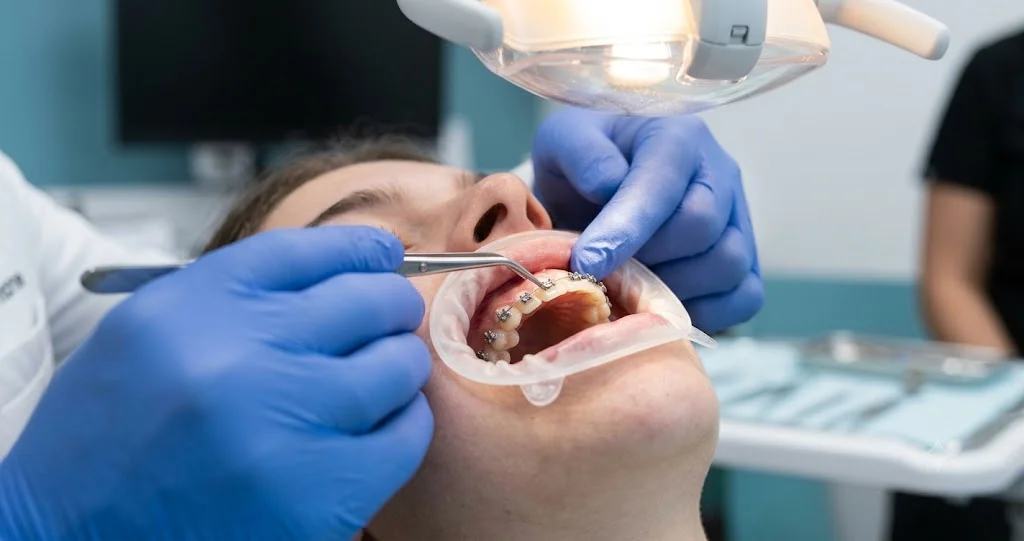
The bonding appointment takes 45 to 90 minutes. Here is what happens at each step and what it feels like:
Step 1
Tooth Cleaning & Drying
Your teeth are polished and then completely dried with air. You will feel the suction. No discomfort.
Step 2
Etchant Application
A mild phosphoric acid gel is applied for 15–30 seconds, then rinsed. You may taste something slightly acidic. No pain.
Step 3
Bonding Agent
A thin primer is painted onto each tooth and light-cured with a blue LED. You may feel mild warmth. No pain.
Step 4
Bracket Placement
Composite resin is placed on each bracket and pressed precisely onto the tooth. You will feel pressure and hear a clicking sound. No pain.
Step 5
Archwire Placement
The first NiTi archwire is threaded through the bracket slots and secured with elastic ligatures. You will feel a light squeezing sensation — this is the first moment of force on your teeth.
When you walk out, your teeth will feel "full" — heavier than normal and slightly awkward. Your bite may feel different. This is completely normal as your brain registers the new hardware.
The Soreness Timeline: Hour by Hour
The table below outlines key comparison data and practical guidelines for do braces hurt to get put on? what to expect.
| Timeframe | What You Feel | What to Do |
|---|---|---|
| Hours 0–4 | Nothing or very mild heaviness | Eat normally if you want — this is your window |
| Hours 4–8 | Tenderness begins, teeth feel sensitive | Switch to softer foods, take ibuprofen now |
| Hours 8–24 | Soreness increases, biting feels uncomfortable | Soft food only: yogurt, soup, mashed potatoes |
| Hours 24–72 | Peak soreness — Day 2 and Day 3 are the worst | Saltwater rinses, cold water, ibuprofen as directed |
| Days 4–5 | Soreness fades significantly | Soft foods still recommended |
| Day 5–7 | Near-normal eating for most patients | Avoid very hard or crunchy foods for another week |
Note: Data reflects typical clinical guidelines and average provider estimates across standard treatment plans.
Why Day 2 and Day 3 Are the Worst
This surprises most people. You leave the appointment feeling fine, go to sleep, and wake up the next morning barely able to chew soft bread. Why does it peak on Day 2 instead of Day 1?
The answer is the inflammation cascade. When your periodontal ligament (PDL) — the soft tissue between your tooth root and the surrounding bone — is compressed by the archwire, your immune system begins releasing prostaglandins and cytokines. This process takes 12 to 24 hours to ramp up to its peak.
This is also why timing your ibuprofen matters. Ibuprofen works by blocking the prostaglandin pathway. If you take it 1 hour before your appointment, you intercept the inflammatory cascade before it builds. If you wait until Day 2, you are playing catch-up.
The Second Type of Discomfort: Cheek and Lip Sores
Tooth soreness from bone remodeling is one type of discomfort. The second type comes from your lips and cheeks rubbing against the metal brackets — surfaces they have never encountered before.
Your cheeks and lips will likely develop small sore spots in the first 1 to 2 weeks. These are friction sores, not cuts. Orthodontic wax is the fix. Roll a pea-sized piece of wax, dry the bracket causing irritation with a tissue, and press the wax firmly over it. The wax creates a smooth surface that eliminates the friction.
Most patients use wax heavily in week 1, significantly less by week 2, and barely at all by week 3 as the cheeks and lips naturally toughen.
What the First Adjustment Feels Like (And Why It's Easier)
At your first adjustment appointment — usually 4 to 6 weeks later — your orthodontist changes your wire or places bends in the existing one. This reintroduces force to your teeth and starts the soreness cycle again.
The good news: the second soreness cycle is noticeably milder than the first for two reasons:
- Your teeth have already begun remodeling — the periodontal ligament has adapted to sustained pressure.
- You know what is coming and can use ibuprofen proactively.
Most patients describe adjustment soreness as lasting 1 to 2 days instead of 3 to 5, and rating it 1–2 out of 10 instead of 3–4. Learn more in our guide on how often braces are tightened.
What to Eat the First Week
✓ Safe Foods
- Mashed potatoes
- Yogurt (cold from fridge)
- Soft pasta, well-cooked
- Smoothies
- Scrambled eggs
- Soup (broth or blended)
- Ripe banana
- Soft tofu
✗ Avoid
- Apples, raw carrots
- Crusty bread
- Chips or crackers
- Gummies or chewy candy
- Bagels
- Anything requiring a hard bite
Check our full braces diet guide for a complete breakdown of what you can and cannot eat throughout your entire treatment.
What You Don't Need to Worry About
- The blue LED light during bonding is a curing light, not a laser. It does not damage your eyes or your teeth.
- The clicking sounds during bracket placement are normal — that is excess adhesive being snapped off after curing.
- Feeling your teeth shift in the first few days is normal and a sign the wire is working.
- A slight gap opening between front teeth in the first 1 to 2 weeks is common when a crowded arch is leveling — it closes again as alignment progresses.
Pain Relief Summary
- Ibuprofen (best): 400 mg taken 1 hour before appointment. Continue every 6–8 hours for 48 hours if needed.
- Cold water and cold soft foods: Numbs nerve endings; drink cold water throughout Day 1 and Day 2.
- Saltwater rinse: Half a teaspoon of salt in 8 oz warm water. Rinse 2–3 times daily. Reduces inflammation and heals cheek sores faster.
- Orthodontic wax: For cheek and lip friction sores only — not for tooth soreness.
- Topical numbing gel (Orajel): Applied directly to a cheek sore for 15–30 minutes of localized relief.
For a complete pain relief breakdown with the science behind each method, read our guide on how to stop braces pain fast.