How Long Do Braces Hurt After Tightening? (Hour-by-Hour Timeline)
Quick Answer
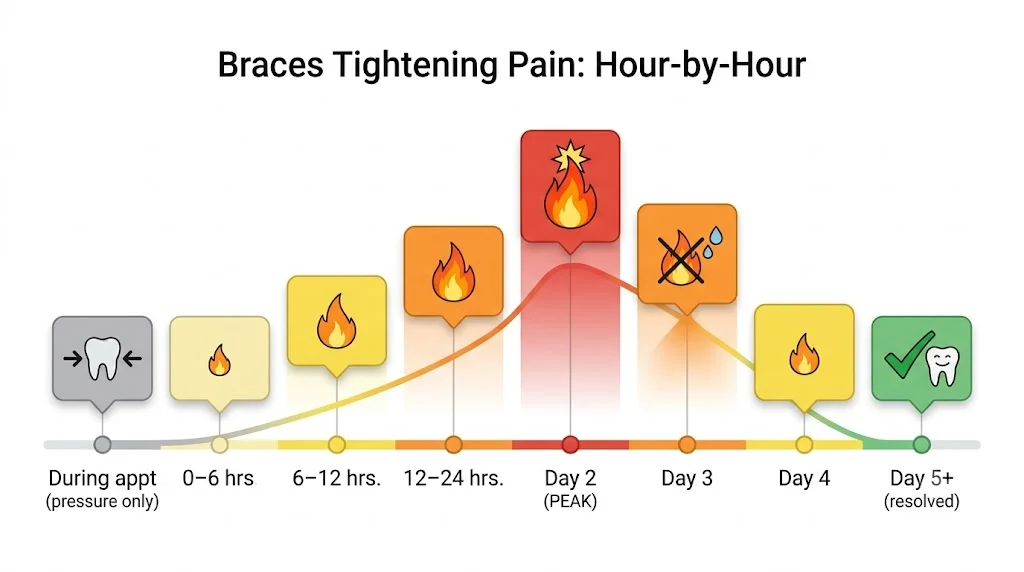
Soreness after a braces tightening appointment typically lasts 3 to 5 days. Pain peaks between 24 and 72 hours after the adjustment — not during the appointment itself. The day of the appointment you feel pressure, not pain. Day 2 is usually the worst. By day 4 or 5, most patients are back to eating normally. This pattern repeats after every adjustment throughout treatment.
Part of our Pain & Discomfort Guide.
1. The Hour-by-Hour Soreness Timeline
The table below outlines key comparison data and practical guidelines for how long do braces hurt after tightening?.
| Time After Adjustment | What You Feel |
|---|---|
| During appointment | Pressure, not pain |
| 0–6 hours after | Mild pressure, teeth feel "different" |
| 6–12 hours after | Soreness starts building |
| 12–24 hours after | Noticeable soreness, sensitivity to biting |
| 24–48 hours (Day 2) | Peak soreness — worst day for most patients |
| 48–72 hours (Day 3) | Soreness begins to ease |
| Days 4–5 | Most patients comfortable eating normally |
| Day 5+ | Soreness resolved for majority of patients |
Note: Data reflects typical clinical guidelines and average provider estimates across standard treatment plans.
2. What Is Actually Happening in Your Teeth
When the orthodontist adjusts the archwire, it applies tension to the brackets in the direction of planned tooth movement. This compresses the periodontal ligament (PDL) on one side of each tooth and stretches it on the other.
The compression side triggers an inflammatory response: blood flow increases, inflammatory mediators (prostaglandins, interleukins) are released, and osteoclast cells begin breaking down the bone ahead of the tooth's movement path. This inflammation is what causes the soreness — the same cellular process as any other inflammatory pain response, localized to the PDL around each tooth root.
The inflammation is temporary and necessary. Without it, bone would not remodel and teeth would not move. This is also why ibuprofen (an anti-inflammatory) is more effective than acetaminophen for post-adjustment soreness — it targets the source of the pain, not just the pain signal.
3. Why Day 2 Hurts More Than Day 1
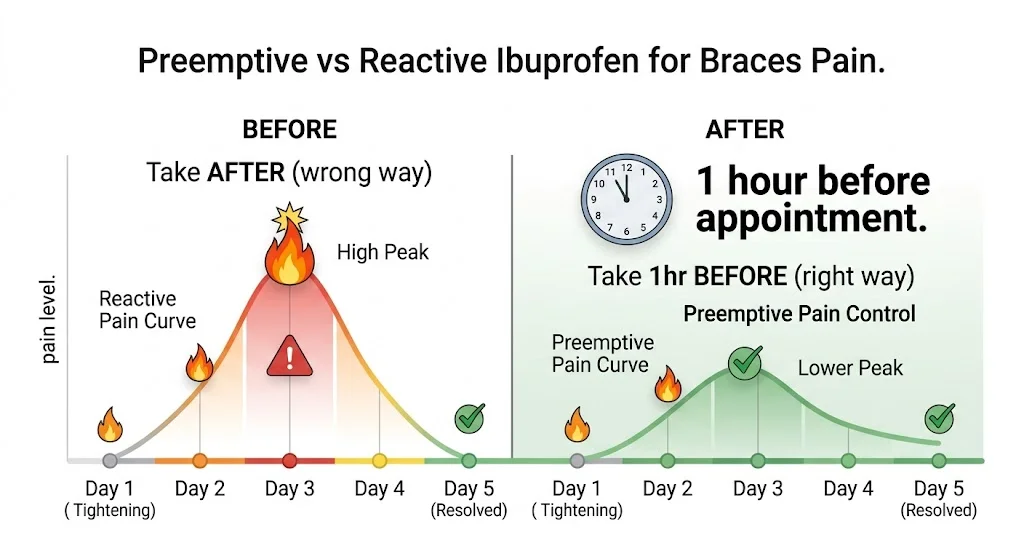
This surprises most patients. You leave the appointment feeling fine, go to sleep, and wake up on Day 2 barely able to bite into soft bread. The reason: inflammatory chemicals (prostaglandins and cytokines) take 6–12 hours to accumulate at the PDL. The appointment applies force immediately, but the pain response builds overnight. This is exactly why taking ibuprofen before the appointment — before the cascade starts — reduces peak pain far more effectively than waiting until Day 2 when you are already hurting.
4. Does It Hurt More Every Time?
No — most patients find it gets easier as treatment progresses. Early wires (NiTi) move teeth rapidly from their starting positions, causing more PDL disruption. Later in treatment, stiffer wires apply smaller corrective forces on teeth already close to their final positions. By the final few appointments, many patients report only mild sensitivity for 24 hours rather than the 3–5 day soreness window of early treatment.
Some adaptation in the periodontal ligament also occurs across repeated loading cycles throughout the treatment course, meaning the tissue responds with progressively less acute inflammation.
5. The Fastest Ways Through the Sore Window
- Preemptive ibuprofen (most effective)Take 400–600mg 1 hour before the appointment — before the inflammatory cascade starts. This reduces peak soreness significantly more than waiting until you are already in pain. Continue every 6–8 hours for the first 48 hours. Do not take on an empty stomach.
- Cold foods and cold packsCold constricts blood vessels, slows inflammatory mediator release, and numbs the area. Cold yogurt, smoothies, and ice cream serve double duty as food and pain relief. A cold pack held against the cheek for 15–20 minutes also helps.
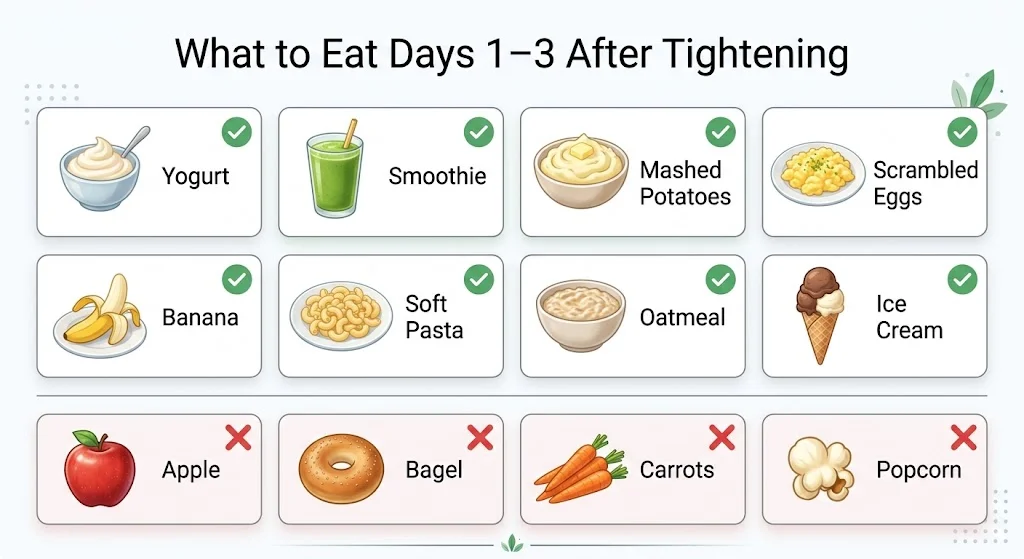
- Avoid hard foods for 2–3 daysBiting into hard food during peak soreness is the most common way patients amplify their own discomfort. Chewing forces on inflamed PDL fibers are very painful. Soft food for the first 3 days after each adjustment makes the experience significantly more manageable.
- Saltwater rinsesHalf a teaspoon of salt in 8oz of warm water, rinsed for 30 seconds two to three times a day. Saltwater reduces oral inflammation and soothes irritated gum tissue around recently adjusted brackets.
Frequently Asked Questions
How long do braces hurt after tightening?
3 to 5 days for most patients, peaking on Day 2. By day 4 or 5, most patients can eat normally again. The soreness is caused by periodontal ligament inflammation as the bone remodels in response to new wire tension.
Why do braces hurt more the day after tightening than the day of?
The force is applied immediately at the appointment, but the inflammatory response (prostaglandins, cytokines) takes 6–12 hours to build. You feel relatively fine when you leave, then wake up on Day 2 significantly more sore.
Does it hurt more every time braces are tightened?
No — the first few adjustments are typically the most uncomfortable. Soreness decreases as treatment progresses because later wires apply smaller forces on teeth closer to their final positions.
What can I eat when my braces hurt after tightening?
Soft foods only for the first 2–3 days: yogurt, scrambled eggs, mashed potatoes, smoothies, soup, soft pasta, bananas, rice, oatmeal. Cold foods provide additional numbing relief.
Should I take ibuprofen before or after a braces tightening appointment?
1 hour before the appointment, not after. Preemptive ibuprofen blocks the inflammatory cascade before it builds, reducing peak soreness significantly more than waiting until Day 2.