Self-Ligating Braces (Damon Braces): Are They Worth the Extra Cost? (2026)
Quick Answer
Self-ligating braces — most commonly marketed as Damon braces — use a built-in sliding clip to hold the archwire instead of elastic ligatures (rubber bands). This reduces friction between the wire and bracket. They cost $500 to $1,500 more than traditional braces and may require slightly fewer adjustment appointments. Clinical evidence shows they produce equivalent long-term results to conventional braces — not faster, not better. The main practical benefit is no elastic ligatures, which eliminates the staining issue that affects ceramic braces.
Part of our Braces Types & Colors Master Guide.
1. Self-Ligating vs Conventional: What’s Actually Different
Self-ligating braces use built-in sliding clips instead of elastic ligatures to retain the archwire. This eliminates rubber band staining and reduces friction, though clinical trials show overall treatment times remain equivalent to conventional braces.
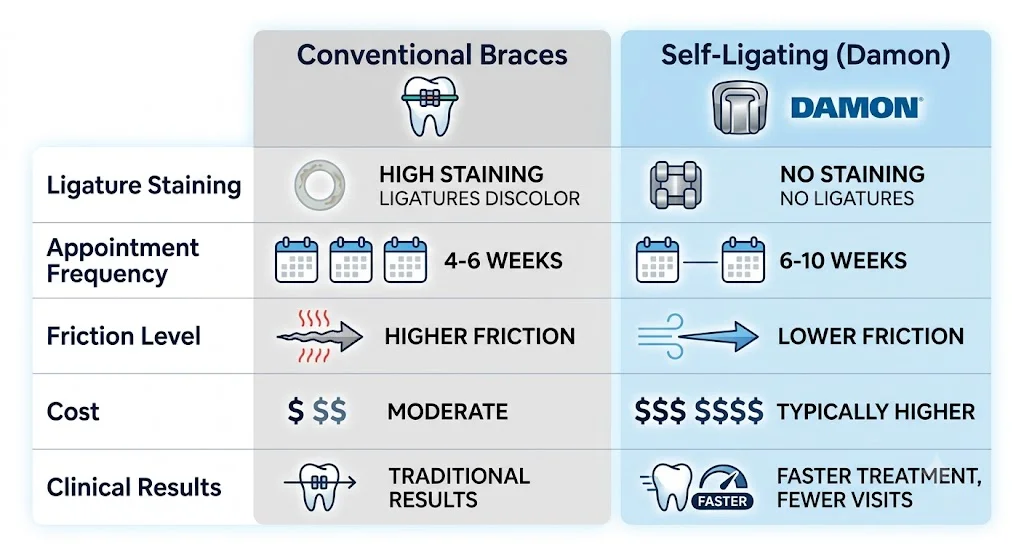
The table below outlines key comparison data and practical guidelines for self-ligating (damon) braces: are they worth the extra cost?.
| Feature | Conventional Braces | Self-Ligating (Damon) |
|---|---|---|
| Wire retention | Elastic ligatures (rubber bands) | Built-in clip or sliding gate |
| Ligature staining | Yes — replaced every 4–8 weeks | No ligatures to stain |
| Friction | Higher | Lower |
| Adjustment appointments | Every 4–8 weeks | Every 6–10 weeks (potentially fewer) |
| Appointment length | Standard | Slightly shorter (no ligature changes) |
| Cost premium | — | $500 – $1,500 more |
| Treatment speed | Standard | Clinical evidence: same |
| Results quality | Excellent | Equivalent |
Note: Data reflects typical clinical guidelines and average provider estimates across standard treatment plans.
2. How Self-Ligating Brackets Work
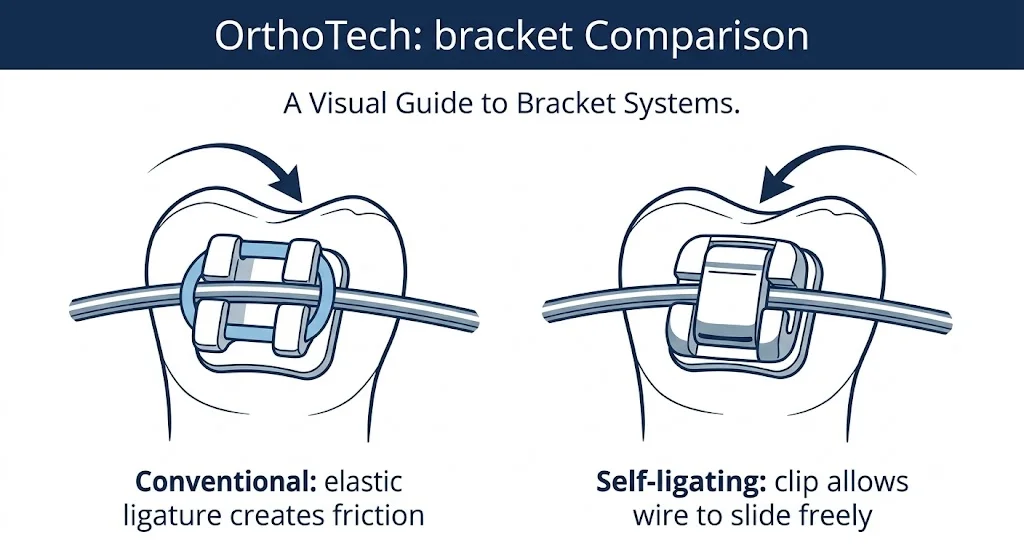
Self-ligating brackets utilize an integrated metal door or clip to secure the archwire inside the bracket slot. This low-friction design allows the wire to slide freely as teeth align, avoiding the binding forces caused by traditional elastic o-ties.
A conventional bracket has a narrow slot where the archwire sits. Tiny elastic ligatures are stretched over the bracket wings to hold the wire in place. This elastic grip creates friction — when the wire tries to slide through the slot as teeth move, it has to overcome the elastic force holding it.
A self-ligating bracket has the same slot, but instead of elastic ligatures, a small metal door or spring clip holds the wire. The clip creates a low-friction environment where the wire can slide more freely through the slot as teeth move. In passive self-ligating brackets (like Damon), the clip simply contains the wire without gripping it. In active self-ligating brackets (like Speed), the clip presses lightly against the wire. The reduced friction theoretically allows the wire to apply lighter forces, which some researchers hypothesize produces less soreness and potentially faster initial alignment — though clinical evidence on both points is mixed.
3. What the Evidence Actually Says
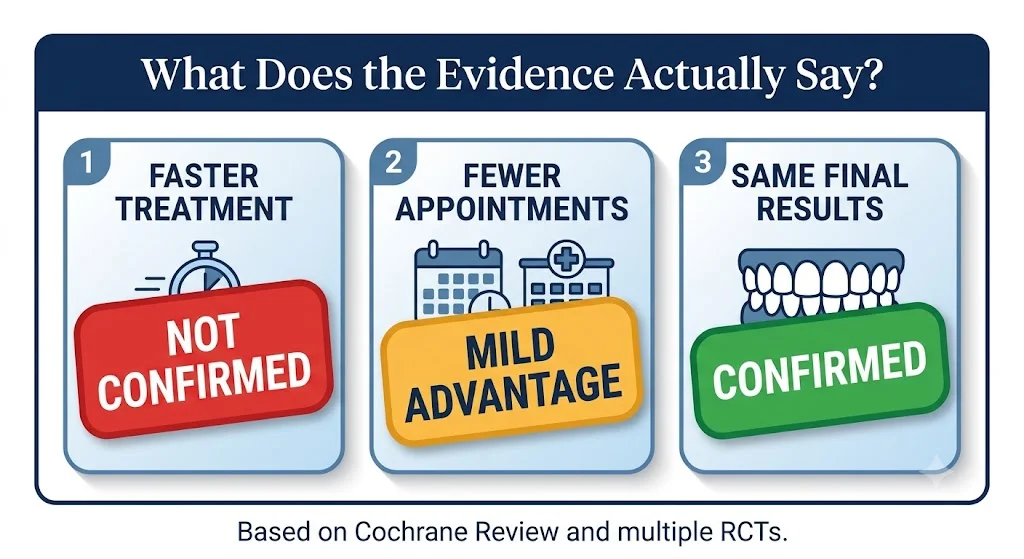
Systematic clinical reviews demonstrate that self-ligating braces do not significantly reduce overall treatment duration compared to conventional braces. However, they consistently shorten appointment times and extend intervals between office visits.
The marketing behind Damon braces and other self-ligating systems has often outrun the clinical evidence. Claims of “25% faster treatment,” “less pain,” and “fewer extractions” were prominent in early marketing but have not been consistently supported in controlled trials.
- Treatment duration: Multiple systematic reviews find no statistically significant reduction in overall treatment time between self-ligating and conventional braces.
- Fewer extractions: Early Damon marketing suggested the low-friction system reduced the need for tooth extractions. Subsequent studies have not confirmed this as a systematic advantage.
- Pain reduction: Some studies show marginally less soreness in the early alignment phase; others show no difference. Patient-reported pain is highly variable regardless of bracket type.
- Fewer appointments: This is where self-ligating brackets show the most consistent practical advantage — no ligature changes mean slightly fewer total appointments over treatment.
4. The Ceramic Self-Ligating Option
Ceramic self-ligating brackets combine tooth-colored bracket aesthetics with clip-based wire retention, completely eliminating elastic band staining. This combination allows adult patients to maintain a clear smile without discoloration from coffee or food pigments.
One genuinely useful application of self-ligating technology: ceramic self-ligating brackets. These give you the aesthetic benefit of ceramic (tooth-colored) brackets without the elastic ligature staining problem. Since the clip is integrated into the bracket, there are no elastic bands to discolor between appointments. This is a meaningful practical advantage for patients who want clear brackets and regularly drink coffee, tea, or other staining beverages. Ceramic self-ligating brackets cost more than both conventional ceramic and conventional metal, but eliminate the most common complaint about ceramic braces.
5. Who Should Consider Self-Ligating Braces
Adults seeking shorter appointment times, individuals wanting stain-free clear brackets, and busy professionals should consider self-ligating braces. The absence of rubber bands reduces office visit frequency and simplifies daily oral hygiene.
- Patients who value fewer and shorter adjustment appointments — good for adults with demanding schedules
- Patients choosing ceramic brackets who want to eliminate ligature staining entirely
- Patients whose orthodontist has strong experience with self-ligating mechanics and recommends them based on the specific case
- Patients who want fixed appliances but want the least traditional-braces appearance possible
6. Who Probably Does Not Need the Upgrade
Budget-conscious patients and younger children who enjoy selecting colorful elastic bands do not need the self-ligating upgrade. Conventional metal braces deliver identical alignment results without the $500 to $1,500 system premium.
- Patients whose primary concern is cost — the clinical outcome does not justify the $500–$1,500 premium for most standard cases
- Children and younger teens who enjoy choosing colored bands at every adjustment appointment
- Patients choosing metal braces regardless — the practical difference between conventional metal and self-ligating metal is largely a matter of orthodontist preference
Frequently Asked Questions
What are self-ligating braces?
Self-ligating braces hold the archwire using a built-in clip or gate on the bracket itself, rather than small elastic bands (ligatures) used in conventional braces. The sliding mechanism reduces friction between wire and bracket. The most well-known brand is Damon braces (Ormco). Both metal and ceramic self-ligating brackets are available.
Are Damon braces faster than regular braces?
Clinical studies do not support this claim. A 2014 Cochrane systematic review and multiple subsequent studies found no significant difference in treatment duration between self-ligating and conventional braces. Appointment frequency may be slightly lower, but total treatment length is similar.
Do self-ligating braces hurt less?
Some patients report less discomfort early in treatment, and lighter forces during initial alignment may produce less acute soreness. However, the clinical evidence on pain reduction is mixed, and individual pain experience varies widely regardless of bracket type.
Are Damon braces worth the extra cost?
For most patients, the clinical outcome is the same as conventional braces — the premium does not buy better results. The clearest case for the upgrade: patients choosing ceramic brackets who want to avoid ligature staining, or patients who place high value on fewer appointments. The decision should come from your orthodontist based on your case, not from marketing.
What is the difference between Damon braces and regular braces?
Regular braces use elastic ties that grip the wire, creating friction. Damon braces use a passive sliding door that contains the wire without gripping it, reducing friction and allowing the wire to slide freely as teeth move. Both systems use the same archwire sequence, and the end clinical result is equivalent.