Invisalign vs Braces: Which Is Faster, Cheaper & More Effective? (2026)
Quick Answer
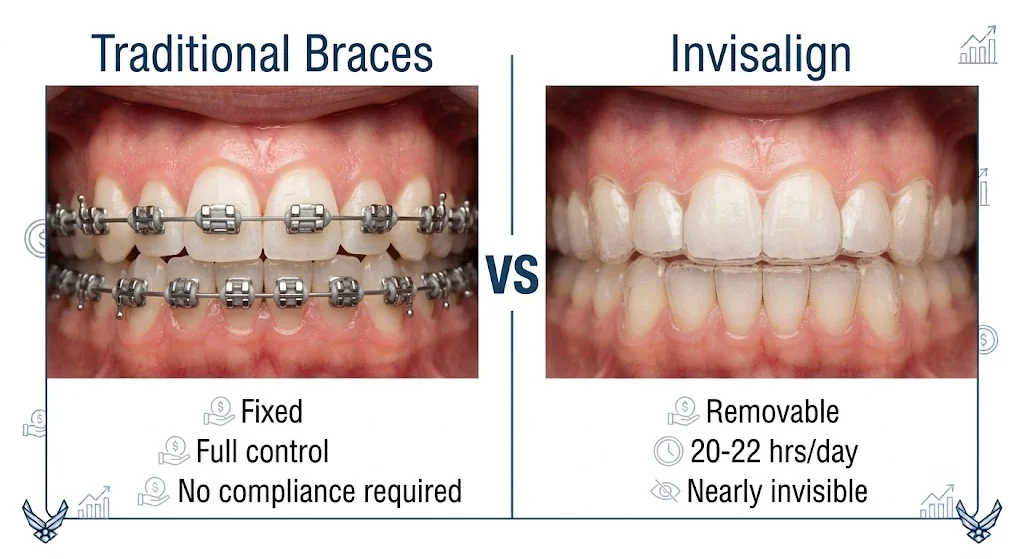
Invisalign and traditional braces cost roughly the same for most cases — $3,000 to $8,000 for both. For mild to moderate crowding and spacing, Invisalign is equally effective and more convenient. For complex bite correction (overbite, underbite, crossbite), tooth rotations, or vertical tooth movements, braces outperform aligners because they provide more mechanical control. Treatment time is similar for equivalent cases. The biggest practical differences: Invisalign requires 20–22 hours of wear per day, is much easier to keep clean, and is nearly invisible at conversational distance.
Part of our Braces Types & Colors Master Guide.
1. The Full Side-by-Side
Invisalign and traditional braces cost between $3,000 and $8,000 depending on case complexity. While braces excel at complex bite correction, clear aligners offer removable convenience and near invisibility for mild to moderate alignment issues.
The table below outlines key comparison data and practical guidelines for invisalign vs braces: which is faster, cheaper & more effective?.
| Feature | Traditional Braces | Invisalign |
|---|---|---|
| Cost (mild cases) | $3,000 – $5,500 | $3,000 – $4,500 (Lite) |
| Cost (complex cases) | $4,000 – $7,000 | $5,000 – $8,000 (Comprehensive) |
| Visibility | Clearly visible | Nearly invisible |
| Removability | Fixed — cannot remove | Removable |
| Food restrictions | Many (no hard/sticky foods) | None — remove to eat |
| Cleaning teeth | Harder (around brackets) | Easy — remove aligners, brush normally |
| Discipline required | None | 20–22 hours/day wear |
| Best for | Complex cases, bite correction | Mild-moderate, lifestyle flexibility |
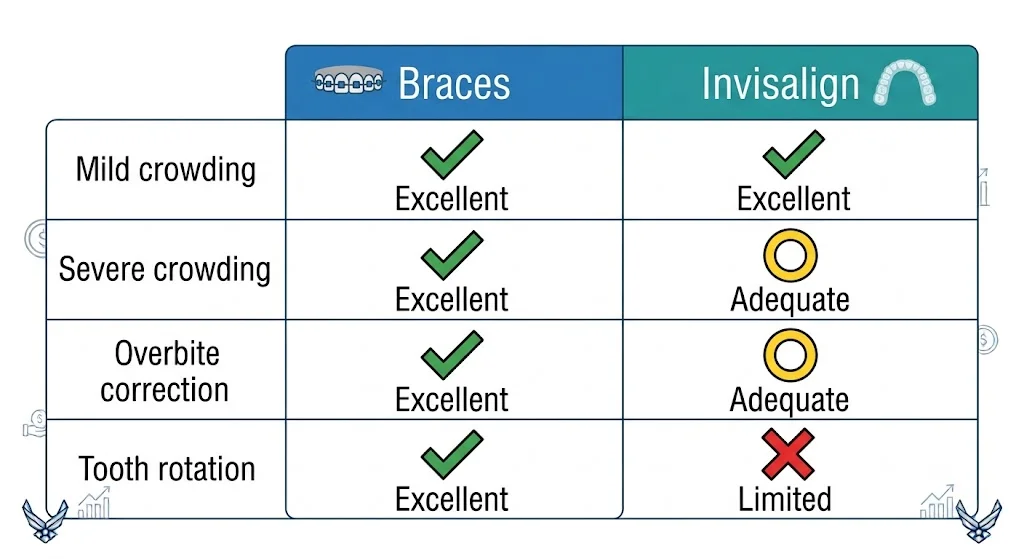
| Effectiveness: alignment | Excellent | Excellent |
| Effectiveness: bite/rotation | Excellent | Limited for complex cases |
Note: Data reflects typical clinical guidelines and average provider estimates across standard treatment plans.
2. How Each Works
Traditional braces rely on fixed brackets and continuous wire pressure 24 hours a day to reposition teeth. In contrast, Invisalign utilizes a series of removable clear plastic trays replaced every 1 to 2 weeks to shift teeth in 0.25mm increments.
Braces bond metal or ceramic brackets directly to each tooth. An archwire connects all brackets and is changed progressively from flexible to stiff across the treatment. The force is continuous and constant — the wire exerts pressure 24 hours a day, every day. The orthodontist has precise control over the direction and magnitude of force on each individual tooth.
Invisalignuses a series of clear plastic trays (aligners), each moving teeth 0.15 to 0.25mm from the previous tray’s position. A new tray is typically worn every 1 to 2 weeks. The force is only active while the aligner is seated — remove it for a meal, and tooth movement pauses. Tooth-colored attachments (small resin bumps) bonded to certain teeth give the aligner more grip for rotations, extrusions, and complex movements.
3. Where Braces Win
Traditional braces outperform clear aligners in complex skeletal bite corrections, severe tooth rotations, and severe crowding requiring extractions. Fixed brackets provide multi-point mechanical control that does not rely on patient wear compliance.
Complex bite correction. Skeletal overbites, underbites, crossbites, and open bites require applying force in three dimensions simultaneously. Braces with rubber bands (Class II or Class III elastics) and additional appliances like a Herbst or palatal expander can apply forces that clear aligners structurally cannot match.
Severe tooth rotations.Rotating a tooth — particularly a premolar or canine — requires grabbing it from multiple angles. Brackets give the archwire four points of contact per tooth. Aligners contact the tooth’s crown surface only, making full rotations slower and less predictable even with attachments.
Extraction cases. When teeth need to be removed to create space, closing the extraction gap requires strong, controlled retraction forces. Braces apply these forces more efficiently than aligners.
Patient compliance. With braces, the orthodontist controls every variable. With Invisalign, the patient controls wear time — a critical variable. Teenagers and patients who are likely to remove aligners frequently achieve better results with fixed braces.
4. Where Invisalign Wins
Invisalign excels in aesthetic appearance, oral hygiene ease, and dietary freedom during mild to moderate orthodontic alignment. Removing aligners allows uninhibited brushing and flossing without bracket-related decalcification risks.
Mild to moderate cases. For spacing, mild crowding, and minor bite issues, Invisalign produces outcomes equivalent to braces with no visible hardware.
Food freedom. No brackets means no restrictions. Remove the aligners to eat anything — popcorn, apples, nuts, gum, corn on the cob.
Oral hygiene. Remove the aligners, brush and floss normally with full access to every tooth surface, and reinsert. Patients on Invisalign have consistently lower rates of white spot lesions (decalcification) than braces patients because hygiene is not complicated by brackets and wires.
Appearance. At normal conversational distance, clear aligners are nearly invisible. For adults in professional or social settings, this is often the deciding factor.
Comfort. No brackets poking the cheeks or wires poking the gums. Discomfort from a new aligner tray typically resolves in 24 to 48 hours.
5. The 20–22 Hour Rule: Why Compliance Breaks Invisalign Cases
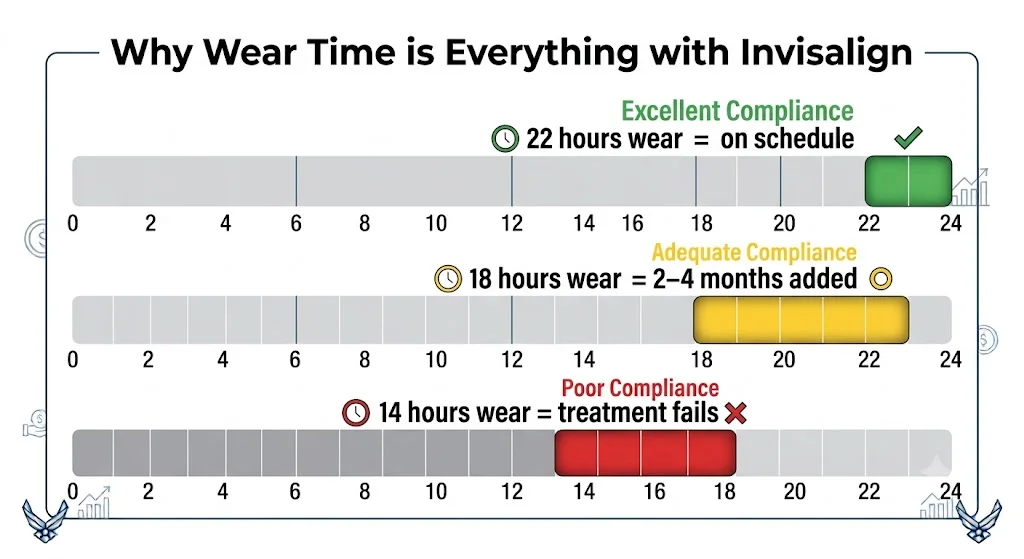
Invisalign treatment requires strict adherence to the 20-to-22-hour daily wear rule to ensure teeth track properly with each consecutive tray. Falling below 20 hours of daily wear causes tray tracking failure, extending overall treatment duration.
Invisalign works precisely because each tray builds on the last. Remove trays for meals, drinks (anything other than water), and tooth brushing — then reinsert immediately. Most patients can manage 20 to 22 hours of daily wear.
The most common compliance failure: removing trays for “just a few hours” repeatedly, not tracking total wear time, and finding that each new tray fits too tightly or not at all. When this happens, the orthodontist must either go back to a previous tray or order refinement aligners — adding months and potentially hundreds of dollars to treatment.
If you are considering Invisalign, be honest with yourself about discipline. Patients who are consistent achieve excellent results. Patients who treat the aligners as optional rarely finish on schedule.
6. The Hybrid Option
A hybrid orthodontic treatment uses clear aligners during the initial alignment phase followed by brief fixed braces for complex bite finishing. This combination optimizes both aesthetic discretion and precise occlusal alignment.
Some orthodontists run a hybrid treatment: Invisalign for the alignment phase (where it excels and is nearly invisible), then brief finishing with braces or retainer-style appliances for precise bite finishing. Ask your orthodontist if this approach makes sense for your case.
Frequently Asked Questions
Is Invisalign better than braces?
It depends on the case. For mild to moderate crowding, spacing, and some bite issues, Invisalign is equally effective to braces. For complex cases — significant overbite, underbite, crossbite, severe rotations, or extraction cases — traditional braces give orthodontists more mechanical control and typically produce better results. Invisalign also underperforms when patients do not wear aligners for 20–22 hours per day.
Is Invisalign cheaper than braces?
Not reliably. For simple cases, Invisalign Lite runs $3,000 to $4,500, similar to metal braces. For complex cases requiring Invisalign Comprehensive, costs reach $5,000 to $8,000 — more expensive than metal braces for the same complexity. The lab fee Align Technology charges orthodontists is built into the Invisalign price, leaving less room to discount.
Is Invisalign faster than braces?
For equivalent cases, treatment time is similar — 12 to 18 months for mild cases, 18 to 36 months for complex cases. For complex bite correction, braces are often faster. Missing aligner wear time adds directly to total treatment length.
Can Invisalign fix an overbite?
Invisalign can treat mild to moderate overbites using precision bite ramps and rubber bands attached via hooks on the aligners. For significant skeletal overbites, traditional braces with Class II elastics or a Herbst appliance are more effective and predictable.
What happens if you don't wear Invisalign enough?
Missing wear time causes the current aligner to seat poorly and the next tray not to fit. This requires going back to a previous tray or ordering refinement aligners ($200–$500 per round), adding months to treatment. Patients who consistently wear aligners fewer than 20 hours per day rarely finish on schedule.