What Are the Alternatives to Braces? (2026 Guide)
For many years, traditional metal braces were the most effective option for crooked teeth, for correcting final gaps, and for correcting block problems. Although steel braces are particularly powerful, many young adults and adults are hesitant to decide on two years of metal brackets and wires.
Fortunately, modern dentistry offers a great range of invisible, faster and more painful alternatives. Whether you want a big bite cleaning or just need to straighten unmarried teeth for wedding photos, designing to your special needs can be a present day occasion
Here's a complete, unbiased guide to high-quality alternatives to conventional steel braces in 2026, comparing fees, effectiveness and remedy timelines
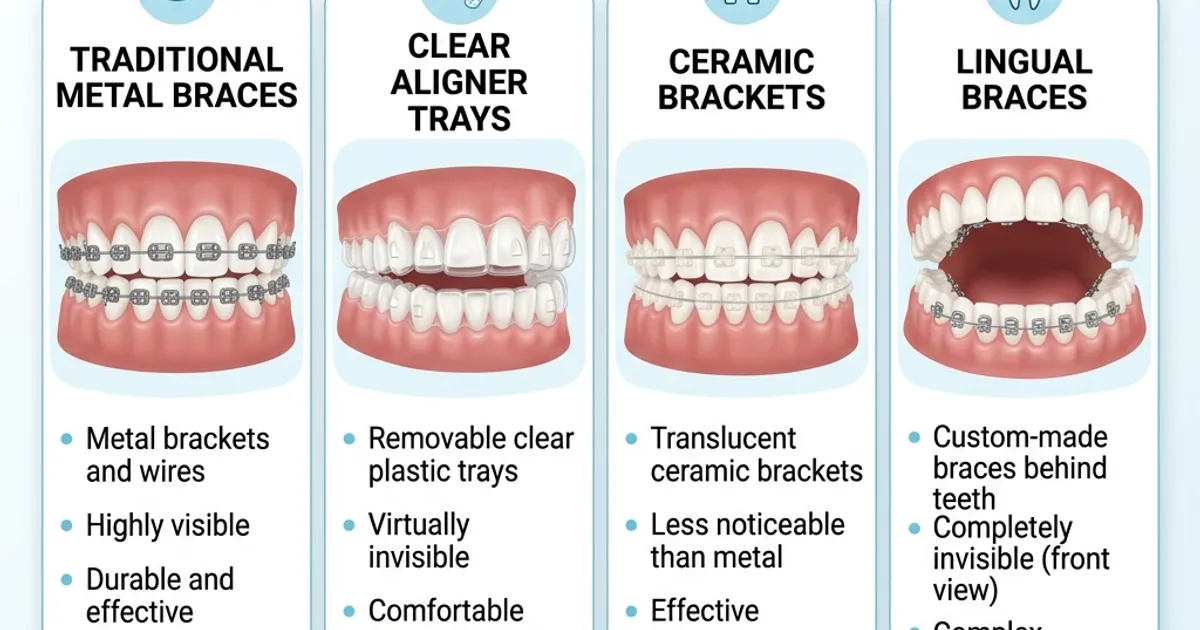
1. Clear Aligners (Invisalign & Competitors)
Clear aligners are the most well-known opportunity to internationalize standard braces. More than 15 million humans have used Invisalign, and this generation has advanced so rapidly that aligners can now restore 90% of teeth alignment troubles that previously required steel braces
How they work
Instead of pulling brackets for your teeth, clean aligners use a series of custom-illuminated, scientific-grade plastic trays to push your enamel into alignment You leave each tray for 1 to 2 weeks before swapping back and forth between ends of the series. Small, tooth-colored bumps (called "attachments") are glued to your tooth to offer the aligners something to grab onto.Prof
- Almost Invisible: Most people won't know you're playing them unless they're inches from your face.
- Removable: You take them out to eat, drink (anything but water), brush and floss. There are no dietary regulations.
- More Comfortable: No sharp metal wire procedures and exponentially less cheek wounds and cuts.
Cons
- Extreme discipline required: You must wear it for 22 hours in the afternoon. If you don't, your enamel won't make music, the tray won't be in shape, and your approach will fail.
- Lost Trays: Wrapping them in serviettes in a restaurant and accidentally throwing them away is totally normal and can stop healing.
Average cost: $three,500 to $7,000 Best For: Responsible adults and older teens with mild to moderate crowding, spacing and biting issues.
2. Ceramic (Clear) Braces
If you already know that you may not be able to maintain clear alignment for 22 hours in the afternoon, yet you continue to need a discreet alternative, ceramic braces are the perfect middle ground
How they work
Ceramic braces use the exact same biomechanical principles as conventional metal braces. The arch wire is fastened to the brackets that are glued to the front of your tooth. The easiest difference is the fabric: the brackets are translucent, enamel-colored polycrystalline alumina products that blend in with your natural toothProf
- Extremely Effective: They can repair serious, complex teeth-crowding difficulties that clean aligners cannot cope with.
- Discretionary: are very difficult to see from a distance or in photographs.
- Passive Compliance: Because they are glued to your enamel, you don't have to remember to put them away after dinner.
Cons
- STAINS: The clear elastic fasteners that maintain the twine to the bracket can stain quickly if you eat espresso, tea, red wine or curry. (Brackets alone do not stain).
- Fragility: Ceramic is more brittle than metal. Brackets are more prone to chipping or breaking if you roast hard materials.
- Removal Process: They can be barely more difficult and uncomfortable to stop the remedy at a stop compared to metal brackets.
Average cost: $four,000 to $eight,000 (a thousand more than the usual $500-$metal bracelets). Best For: Patients with complex cases who need a cultured alternative yet do not need the hassle of tray removal.
3. Lingual (Inside) Braces
If you want opportunity, which is obviously 100% invisible, language bracelets are the most effective answer.
How about those pictures
Language braces are traditional steel braces that can be solid to suit the exact contours of your enamel and fixed back (on the lingual side) to your teeth, editing your tongue. Since they’re hidden behind your teeth, no one can see them when you’re smiling, talking, or breathing loudly at night.Prof
- Completely invisible: Maximum beauty option available on the market.
- Custom Fit: Brands like Incognito use the CAD/CAM era for certain D-print brackets that perfectly shape your unique dental anatomy.
- No Front Enamel Damage: If you fight with oral hygiene, you will have no decalcification (white dots) on the bottom back of your tooth, not the front.
Cons
- Speech Barriers: Because they sit right where your tongue rests, they argue quite a lisp (especially with the sounds "S" and "T") for the primary month.
- Tongue Inflammation: Your tongue may revel in asymmetric pain and reduction even as it adapts.
- High Cost: They require specialized schooling for the dentist and custom fabrication, making them the most high-priced option.
Average price: $8,000 to $thirteen,000 Best For: Actors, newscasters, fashionistas, professionals who want absolute invisibility and can cash in at top fee rates.
4. At-Home / Direct-to-Consumer Aligners
Companies like SmileDirectClub (now bankrupt), Byte, and AlignerCo pioneered the "teledentistry" version.
How they work
Instead of going to the dentist, you get a domestic (or visit a testing center) tooth mold. The remote health practitioner gives an opinion of the experiment and mails you all clear aligners immediately. You complete remedy from domestic.Prof
- Convenience: No monthly dental appointments.
- Low Cost: Significantly less expensive than a comprehensive office approach.
Cons
- High Risk: It is inherently dangerous to move enamel without taking character x-rays to check bone soundness.
- Limited Scope: They can perform the best restorations and very minor cosmetic issues (relocating the front 6 teeth). They cannot restore your bite.
- Lack of monitoring: If a tooth stops monitoring or shifts your chewing poorly, there is no doctor actively monitoring your case to intervene.
Average Cost: $1,500 to $2,500 Best For: Patients who had braces beyond, had a very minor recurrence, and don't get paid for workplace contacts. (Note: The American Association of Orthodontists strongly advises against unsupervised treatment).
5. Dental Veneers (The "Instant Orthodontics" Illusion)
If your tooth is just barely crooked, or you've got a small hole, and you need results tomorrow preferably over the next 12 months, then cosmetic dentistry is an opportunity.
How they work
Veneers don’t go on your teeth. Instead, the cosmetic dentist shaves off a small layer of your natural tooth and bonds a custom-made porcelain shell to the tip of the enamel This immediately creates the illusion of a better straight white smile.Prof
- IMMEDIATE RESULTS: The system takes about 2 visits in weeks, compared to two years of braces.
- Fixes shape and color: Veneers can simultaneously repair crookedness, permanent stains, chips, and oddly shaped teeth.
Cons
- Irreversible: Once your herb teeth are shaved, you can have veneers for the rest of your existence.
- Life: Veneers generally need to be replaced every 10 to fifteen years.
- Doesn't fix the bite: Veneers can't restore the underlying skeletal hardness if you've got an underbite or a severe overbite.
Average cost: $1,000 to $2,500 depending on the tooth. Best For: Adults with very minor discrepancies who also need a complete exchange of tooth shade and size.
Frequently Asked Questions
Can I switch from metal braces to Invisalign halfway through? Yes, it will cost you anyway. Many dentists offer "hybrid" approaches, however due to the fact there are lab costs associated with printing custom aligners, it usually costs a vast more to switch midway
Are clear aligners faster than braces? It depends on the case. For simple crowding, clear aligners are often faster because the plastic tray applies force to the entire surface area of the tooth simultaneously. For complex bite issues (like pulling down an impacted canine), metal braces are much faster.
Do ceramic braces take longer than metal braces? Historically, yes. Because the ceramic brackets create extra friction against the steel arch wire, the teeth would slide more slowly. However, ceramic braces are currently relatively polished, and healing time is now about the same as metal braces.