
How Long Does Invisalign Take? (2026)
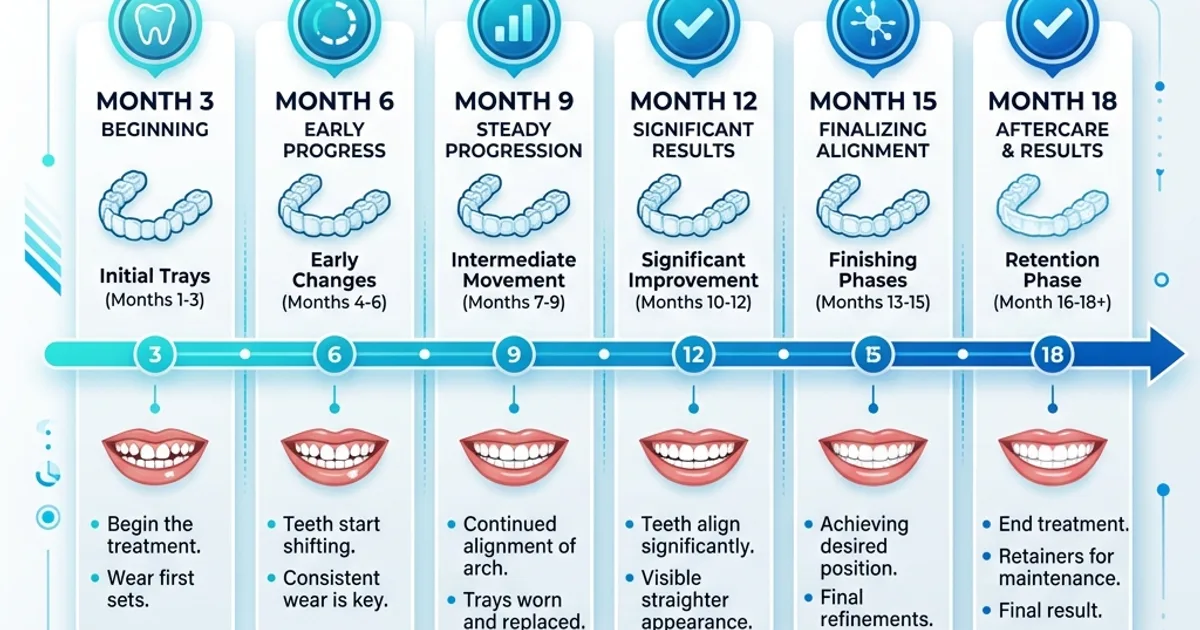
Quick Answer
Invisalign treatment time depends on the complexity of your case. For very mild cases (minor crowding or spacing), Invisalign Lite runs 3–6 months with 7–14 aligner sets. For moderate cases — the most common — treatment takes 12–18 months. Severe crowding or bite correction can run 18–24 months, though the most complex cases are typically better suited to braces. The single biggest factor in your treatment time is compliance: aligners must be worn 20–22 hours per day to stay on schedule.
Part of our Alternatives & Aftercare Master Guide.
Invisalign Treatment Time by Case Type
Average Invisalign treatment duration ranges from 3 to 6 months for mild cases up to 12 to 18 months for complex adult malocclusions requiring multiple tray refinements.
The table below outlines key comparison data and practical guidelines for how long does invisalign take?.
| Case Type | Product | Trays | Duration |
|---|---|---|---|
| Very mild (minor spacing/crowding) | Invisalign Go / Lite | 7–14 | 3–6 months |
| Mild (one arch, limited movement) | Invisalign Lite | 14–20 | 6–10 months |
| Moderate (typical adult case) | Invisalign Comprehensive | 20–40 | 12–18 months |
| Complex (bite correction, multiple arches) | Invisalign Comprehensive | 40–60+ | 18–24 months |
Note: Data reflects typical clinical guidelines and average provider estimates across standard treatment plans.
The #1 Factor That Determines Your Timeline: Compliance
Aligner wear compliance of 20 to 22 hours daily is the single most critical factor determining whether your treatment finishes on schedule without extra refinement trays.
Unlike braces, which work 24/7 whether you want them to or not, aligners only work when you wear them. The prescribed wear time is 20–22 hours per day. That leaves 2–4 hours for eating, drinking anything other than water, and cleaning your teeth.
Every hour an aligner sits in its case instead of on your teeth is an hour of no tooth movement. Patients who consistently under-wear aligners by even 2–3 hours per day can fall significantly behind their treatment plan, leading to refinement trays and extended timelines.
Frequently Asked Questions
How long does Invisalign take on average?
The average full Invisalign case takes 12–18 months for adults and 6–18 months for teens. Mild cases (Invisalign Lite or Invisalign Go) can complete in as few as 3–6 months. Cases involving significant crowding, bite correction, or multiple arch movements run toward 18–24 months. Your orthodontist will give you an estimated tray count at the start of treatment — dividing by your tray change interval gives you a rough timeline.
Is Invisalign faster than braces?
Not inherently. The biology of tooth movement is the same whether force comes from aligners or wires. For mild cases, Invisalign plans are often shorter. For moderate to complex cases, treatment times are similar. Some studies show Invisalign takes slightly longer for equivalent tooth movements because aligner fit provides less precise force control than a fixed archwire.
What makes Invisalign take longer?
The biggest factors: not wearing aligners 20–22 hours daily (the single most common reason for delays), needing refinement trays mid-treatment, complexity of the original malocclusion, and number of arches being treated simultaneously. Missed check-up appointments also delay progress.
How many trays does Invisalign typically involve?
Mild cases (Invisalign Lite): 7–14 trays. Moderate cases: 20–40 trays. Full cases: 40–60+ trays. Most patients change trays every 1–2 weeks as specified by their orthodontist. Dividing your tray count by the change interval gives you a rough estimated timeline.
Can Invisalign be faster with refinements?
Refinements extend treatment time, not shorten it. A refinement is an additional set of aligners ordered mid-treatment when teeth have not tracked perfectly with the original plan. Most full Invisalign cases require at least one refinement. This is normal and should be factored into your overall timeline estimate from the start.