Does TRICARE Cover Braces for Dependents? (2026 TOP Guide)
Quick Answer
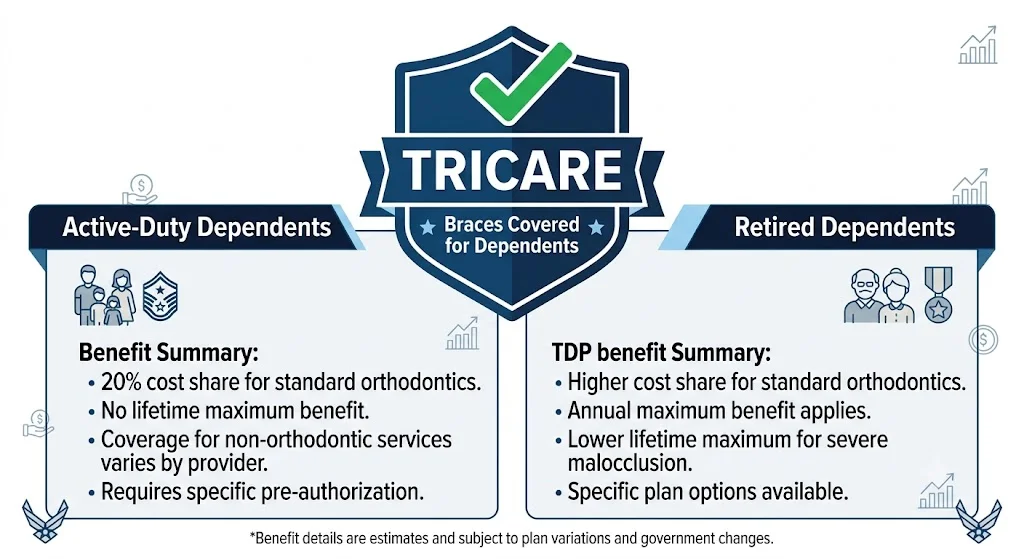
Yes — TRICARE covers orthodontics for eligible dependents through the TRICARE Orthodontic Program (TOP). Dependents of active-duty service members enrolled in TRICARE Prime pay the lowest cost share (typically 20%). Dependents of retired service members access orthodontic benefits through the TRICARE Dental Program (TDP) at a higher cost share. Active-duty service members themselves are covered through military treatment facilities (MTFs), not TOP. The key step: find a TOP-participating orthodontist and get pre-authorization before treatment starts.
Part of our Braces Cost & Insurance Master Guide. Also see: Will the Military Pay for Braces?
1. Who Qualifies for TRICARE Orthodontic Coverage
TRICARE orthodontic benefits differ significantly based on the sponsor’s status and which TRICARE plan the family is enrolled in:
Active-duty family members (TRICARE Prime)
The most comprehensive orthodontic coverage. Dependents — children and spouses — enrolled in TRICARE Prime can access the TRICARE Orthodontic Program (TOP). Coverage is broad, cost shares are low, and both elective and medically necessary treatment qualifies.
National Guard and Reserve dependents
Eligible for TOP when the service member is on Title 10 federal orders for more than 30 consecutive days. When not on active orders, dependents use the TRICARE Reserve Select (TRS) plan, which has different orthodontic benefit structures.
Retired service member dependents
Covered through the TRICARE Dental Program (TDP) rather than TOP. TDP is a voluntary enrollment plan with a monthly premium — it is not automatic. Orthodontic coverage under TDP typically has higher cost shares and lower annual maximums than TOP.
Active-duty service members themselves
Not covered through TOP. Active-duty members receive dental care through military treatment facilities (MTFs). Orthodontic treatment at MTFs requires a referral and is subject to mission requirements — treatment may be interrupted or delayed if the member deploys.
2. How the TRICARE Orthodontic Program (TOP) Works
TOP is the TRICARE benefit that covers orthodontic care for eligible dependents. Here are the steps to use it:
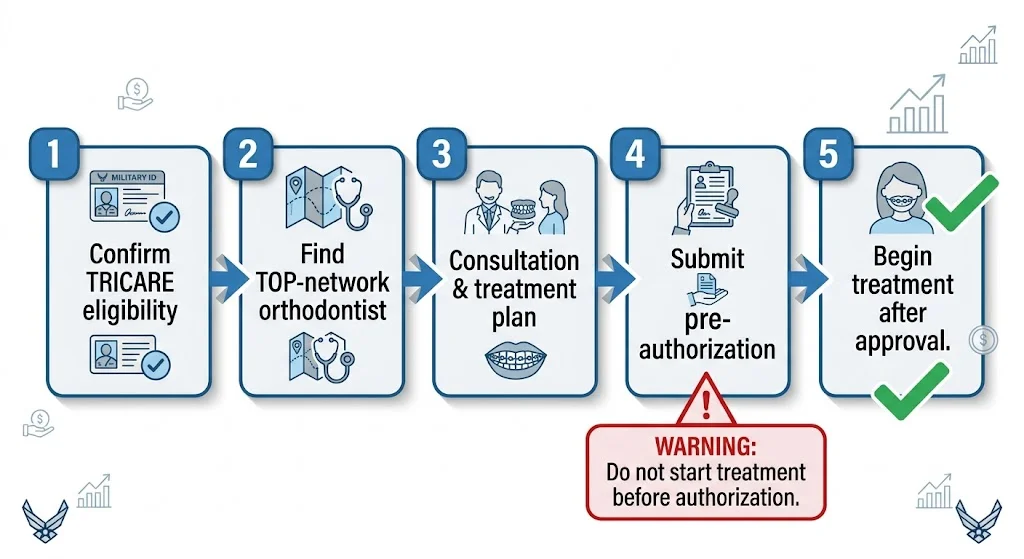
- Confirm eligibility: Verify that your dependent is enrolled in a qualifying TRICARE plan — typically TRICARE Prime or TRICARE Prime Remote for active-duty families.
- Find a TOP-participating orthodontist: Use the TRICARE provider directory at tricare.mil. Only TOP-network providers will bill TRICARE directly. Non-network providers require you to pay in full and seek reimbursement, which is rarely complete.
- Schedule a consultation: The orthodontist assesses the case and develops a treatment plan, including total cost.
- Pre-authorization: The orthodontist submits a pre-authorization request to TRICARE with the treatment plan, X-rays, and photographs. TRICARE reviews and approves eligible cases before treatment begins. Do not start treatment before authorization is confirmed.
- Begin treatment: Once authorized, the orthodontist places braces and TRICARE pays the covered portion directly. You pay your cost share at each appointment or as billed by the office.
Warning: TRICARE will not pay retroactively for treatment that began before pre-authorization was granted. Always wait for written authorization before the orthodontist bonds brackets.
3. Cost Share: What You Pay Out of Pocket
Under TOP for active-duty family members (TRICARE Prime):
- In-network providers: You pay approximately 20% of the TRICARE-allowable charge after your annual deductible.
- Deductible: $150 per individual or $300 per family for most active-duty families.
- Example: If the TRICARE-allowable charge for a $5,000 braces case is $4,200, your cost share is approximately $840 after the deductible.
Under TDP for retired service member dependents:
- Cost shares are higher and annual orthodontic maximums apply (typically $1,500–$2,000 per person per plan year)
- Monthly TDP premiums apply ($13–$40/month depending on coverage tier)
4. TRICARE vs. Civilian Insurance: Key Differences
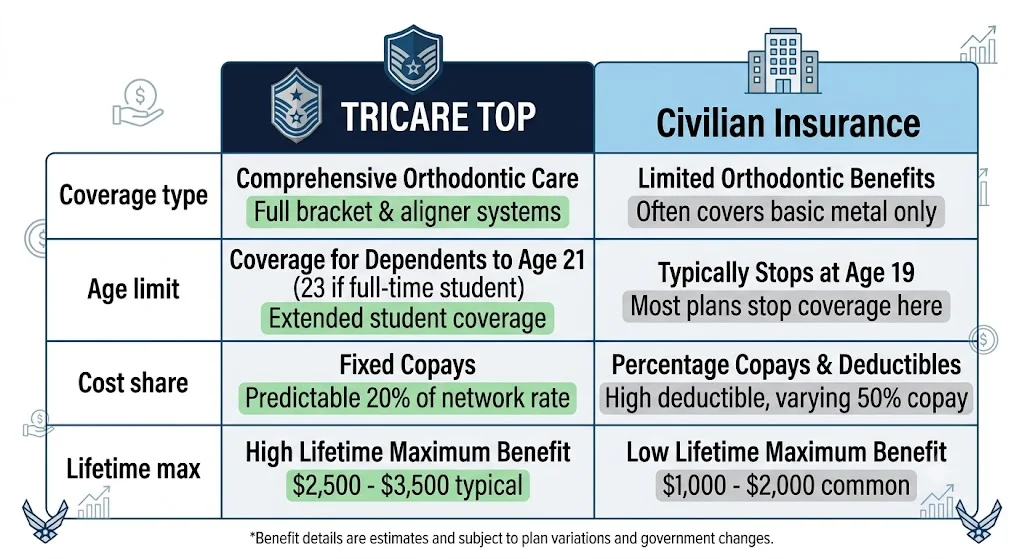
The table below outlines key comparison data and practical guidelines for does tricare cover braces for dependents? top coverage explained.
| Feature | TRICARE TOP (Active-Duty Dependents) | Typical Civilian Insurance |
|---|---|---|
| Coverage type | Both elective and medically necessary | Medically necessary only (many plans) |
| Age limit | Under 21 (primarily) | Typically under 18–19 |
| Network requirement | Must use TOP-participating provider | Must use in-network provider |
| Pre-authorization | Required before treatment | Required for most plans |
| Cost share | ~20% after deductible | Typically 50% up to lifetime max |
| Lifetime maximum | No fixed lifetime max under TOP | $1,000–$2,000 lifetime max typical |
Note: Data reflects typical clinical guidelines and average provider estimates across standard treatment plans.
The absence of a fixed lifetime maximum under TOP is a significant advantage over most civilian plans, which cap orthodontic benefits at $1,000 to $2,000 regardless of total treatment cost.
5. Common Mistakes That Delay or Deny TRICARE Orthodontic Coverage
- Starting treatment before pre-authorization: TRICARE will not pay retroactively for treatment that began before authorization was granted. This is the most costly mistake families make.
- Using a non-participating provider: Even if the provider accepts most insurance, they must specifically participate in TOP. Verify network status at tricare.mil before scheduling.
- Missing TDP enrollment windows: For retired dependents using TDP, there are open enrollment periods. Enrolling late means waiting until the next open season.
- Not confirming sponsor's active status: For Guard and Reserve families, coverage depends on the sponsor being on active orders. Confirm eligibility with your regional TRICARE contractor before scheduling.