How Much Do Braces Cost for Adults? (2026 Full Price Breakdown)
Quick Answer
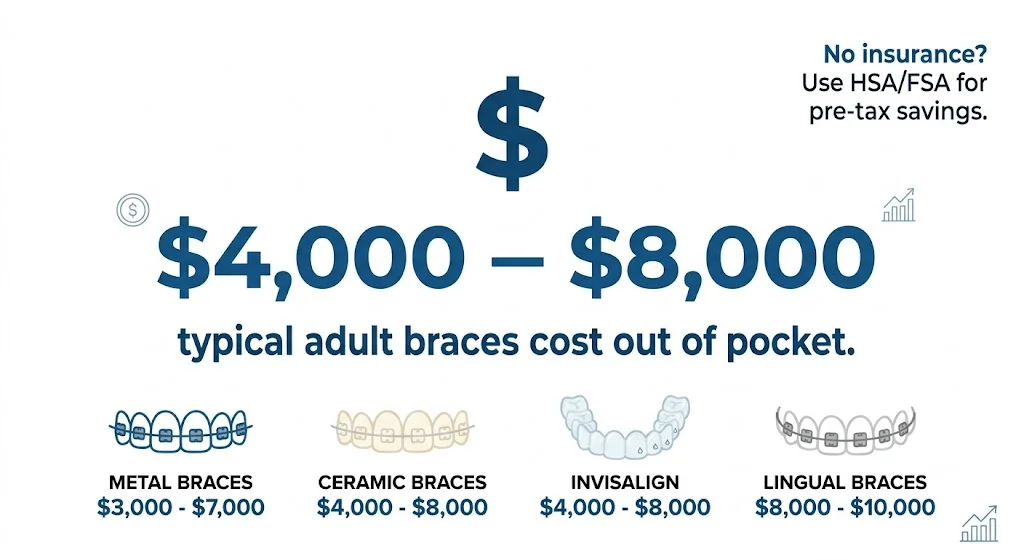
Adult braces cost $4,000 to $8,000 out of pocket for most cases, since the majority of dental insurance plans stop covering orthodontics at age 18 or 19. Clear ceramic braces ($4,000–$7,000) and Invisalign ($3,000–$8,000) are the most popular choices for adult patients. Treatment typically runs 18 to 36 months — longer than teen cases because adult bone is denser and does not remodel as quickly. Most orthodontists offer in-house payment plans at 0% interest, and HSA and FSA accounts can be used to pay with pre-tax dollars.
Part of our Braces Cost & Insurance Master Guide.
1. Adult Braces Cost by Type
The table below outlines key comparison data and practical guidelines for how much do braces cost for adults? full 2026 price breakdown.
| Braces Type | Total Cost Range | Best For |
|---|---|---|
| Metal braces | $3,000 – $5,500 | Complex cases, budget-conscious patients |
| Ceramic braces | $4,000 – $7,000 | Aesthetics with full bracket control |
| Invisalign (clear aligners) | $3,000 – $8,000 | Mild to moderate cases, lifestyle flexibility |
| Lingual braces | $8,000 – $10,000 | Completely hidden treatment |
Note: Data reflects typical clinical guidelines and average provider estimates across standard treatment plans.
Most adults choose ceramic braces or Invisalign for aesthetic reasons. Metal braces are less common among adults but remain the most cost-effective option for complex cases that require precise control over tooth movement and bite correction.
2. Why Adult Cases Often Cost More Than Teen Cases
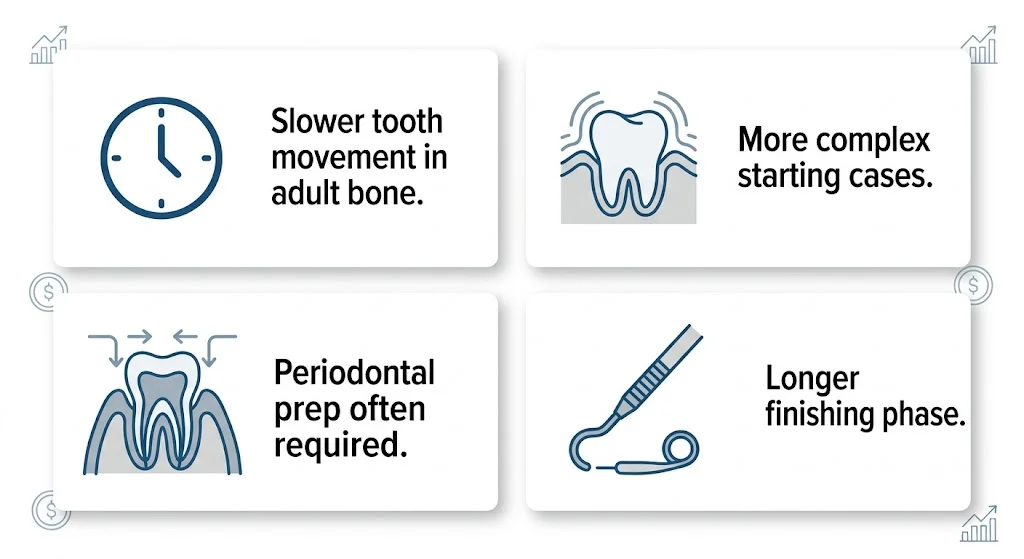
Several factors push adult orthodontic costs above the teen average:
Denser bone, slower movement
Adult bone has finished growing, making it more resistant to remodeling. Teeth still move — orthodontics works at any age — but the biological process is slower. More adjustment appointments over a longer treatment period adds to the total cost.
More complex starting points
Many adult patients have alignment issues that were not treated in adolescence and have worsened over decades. Significant crowding, large overbites, or bite collapse from missing teeth take longer to correct than mild teen-stage crowding.
Periodontal prerequisites
Adults with a history of gum disease or bone loss must often complete periodontal treatment before orthodontics can begin. A periodontist visit and any scaling/root planing required is a separate cost that teens rarely face.
Longer finishing phase
Adult cases often require extended refinement at the end of treatment to achieve the same precision that develops naturally in younger patients whose teeth are in a more mobile phase.
3. Insurance Options for Adults
Most adults are on their own when it comes to orthodontic costs. Key facts:
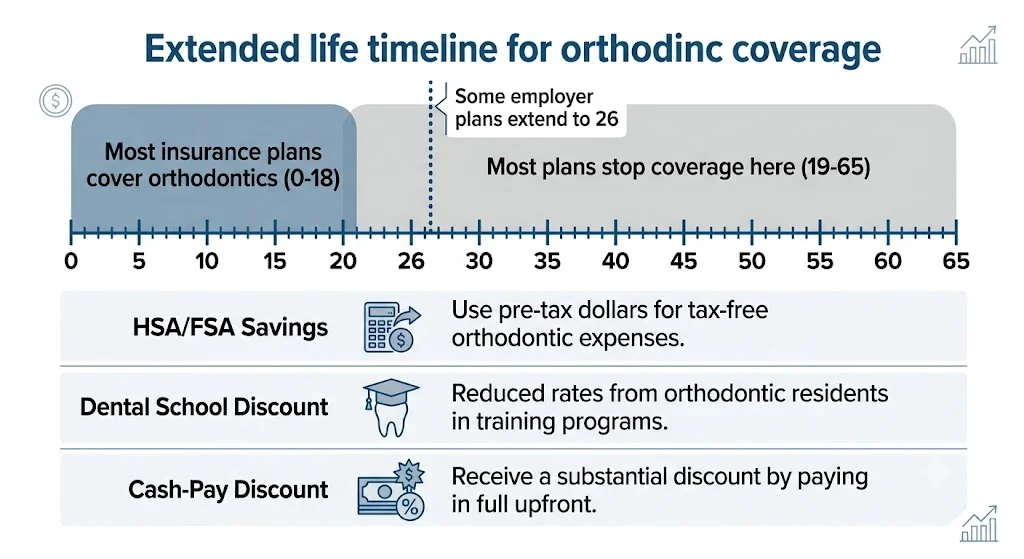
- Age cutoffs: Most dental plans cover orthodontics only through age 18 or 19. Some employer-sponsored plans extend coverage to age 26 for dependents.
- Adult orthodontic riders: Some plans offer optional add-on coverage for adult orthodontics at an additional monthly premium. Check your plan’s Summary of Benefits and Coverage or call member services.
- CHIP and Medicaid: Do not cover orthodontics for adults in most states — only for children under 21 through EPSDT.
- No insurance: Use HSA or FSA funds to pay with pre-tax dollars — effectively a 15–30% discount depending on your tax bracket.
4. How to Pay for Adult Braces Without Insurance
- HSA and FSA funds: Orthodontic treatment is an IRS-qualified medical expense. Any HSA or FSA balance can be used to pay the down payment, monthly installments, or the full balance. This is the single most effective way to reduce out-of-pocket cost.
- In-house payment plans: Most orthodontists offer 0% interest installment plans matching the treatment period (18–36 months for adults). No application, no credit check.
- Cash-pay discount: Paying the full balance at the start of treatment often earns a 5–10% discount. On a $6,000 treatment, that is $300–$600 off.
- Dental schools: Accredited dental school orthodontic clinics provide braces at 40–60% below private practice rates. Treatment is supervised by licensed faculty. Appointments take longer and progression is slower, but the clinical quality is equivalent.
- Flexible spending coordination: If both you and your spouse have FSA accounts, both can contribute the annual maximum ($3,300 each in 2026) and both can spend on the same qualifying orthodontic expense, effectively doubling the pre-tax benefit.
5. Adult Braces Timeline and What It Means for Cost
Adult orthodontic treatment typically runs:
- Mild cases (minor crowding, small gaps): 12–18 months
- Moderate cases (significant crowding, overbite correction): 18–24 months
- Complex cases (bite correction, significant spacing, extraction cases): 24–36 months
Longer treatment means more adjustment appointments and a higher total cost. When getting estimates from orthodontists, ask specifically about expected treatment length for your case and how the quote changes if treatment runs longer than projected.