Can You Get Braces With Missing Teeth? What Orthodontists Actually Do (2026)
Quick Answer
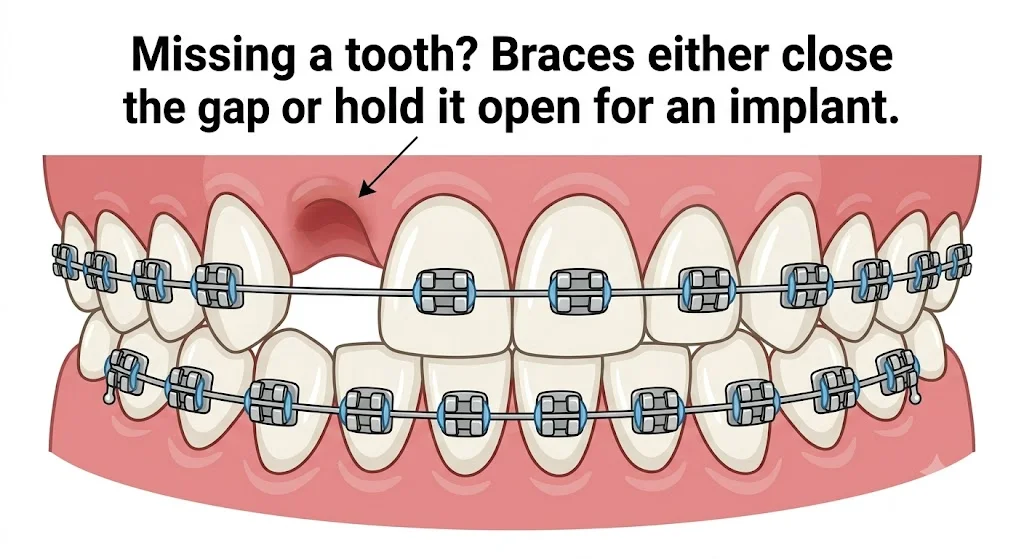
Yes — you can get braces with missing teeth. In many cases, braces are specifically used to manage the space left by a missing tooth. There are two main approaches: space closure (shifting teeth together to eliminate the gap) and space maintenance(holding the gap open and aligning teeth for a future implant or bridge). Which approach your orthodontist recommends depends on which tooth is missing, the patient’s age, and overall treatment goals.
Part of our Demographics & Eligibility Master Guide.
1. The Two Approaches: Close the Space or Hold It Open
Orthodontists manage missing teeth by either closing the gap with adjacent teeth or holding the space open to prepare for future dental implants or bridges.
When a tooth is missing, adjacent teeth naturally begin to drift into the gap within weeks to months. Orthodontic treatment addresses this in one of two ways:
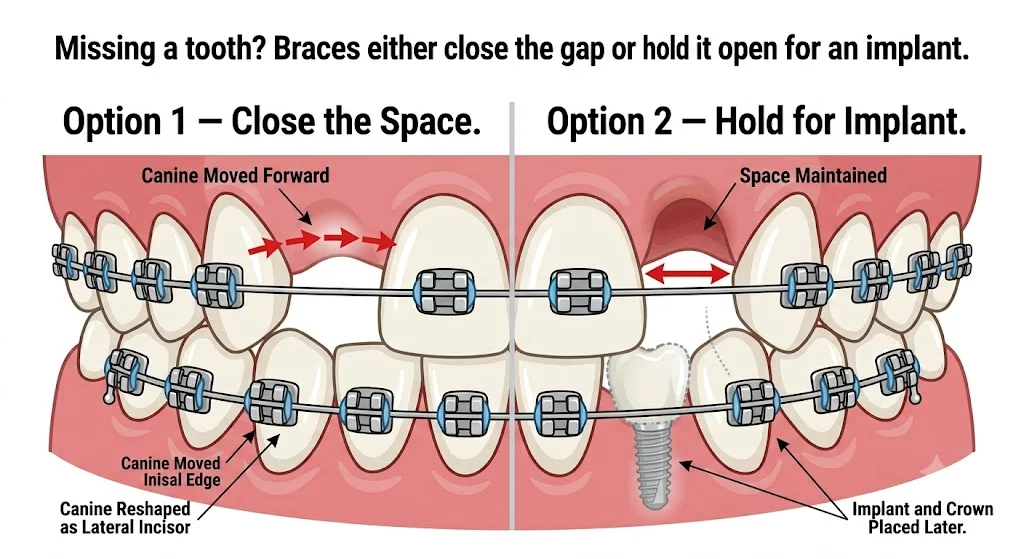
Space closure: Braces move adjacent teeth into the gap until it closes. This works best for smaller gaps when teeth on either side are proportionally appropriate. The most common example is canine substitution for a missing upper lateral incisor — the canine moves forward to fill the space and is later reshaped by a dentist using bonding or a veneer to mimic the expected lateral incisor shape.
Space opening/maintenance: If the goal is a future implant or bridge, braces move any drifted teeth back to their correct positions and hold the space open at the correct width for the restoration. A placeholder (small piece of wire or temporary pontic) maintains the gap between appointments.
2. Timing: Braces Before or After an Implant?
Braces must always precede dental implants because implants fuse to bone and cannot move. Orthodontics first aligns roots and opens precise space for optimal implant placement.
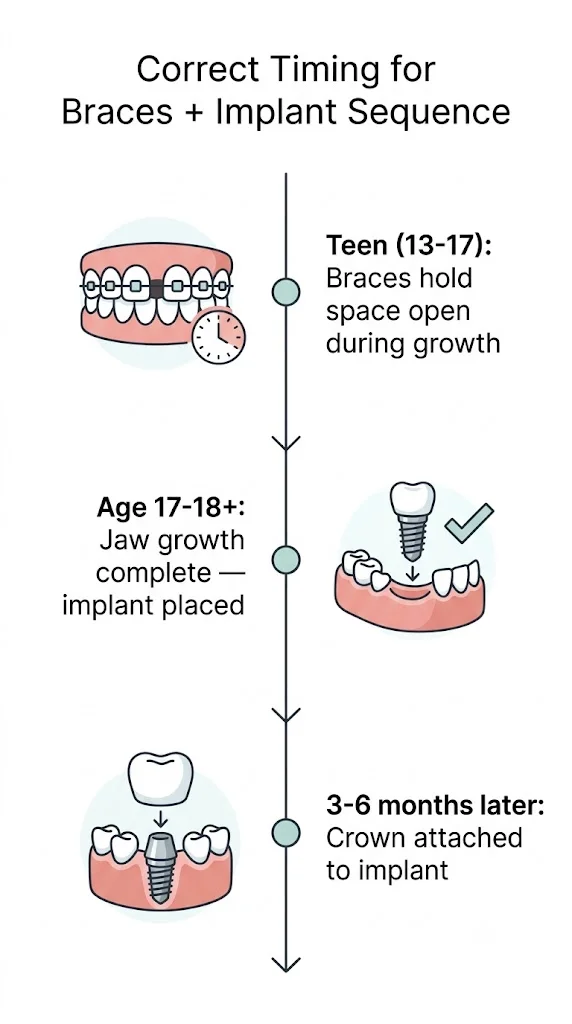
Implants cannot be placed until jaw growth is complete — typically age 17–18 for most patients. For adolescents with a missing permanent tooth, braces hold the space open while the jaw finishes developing, then the implant is placed after growth completion.
Adults who have already lost a tooth and had adjacent teeth drift should have orthodontic space preparation first, then the implant. Placing an implant in a drifted space creates a restoration that looks out of place — and implants are ankylosed (fused) to bone, so they cannot be moved with orthodontic forces after placement.
The correct sequence: orthodontic preparation → implant placement → 3–6 month integration period → crown attachment.
3. Congenitally Missing Teeth
Congenitally missing teeth like upper lateral incisors or premolars are managed by canine substitution or long-term space maintenance for post-growth dental restoration.
The most commonly missing teeth by congenital absence (never developing):
- Third molars (wisdom teeth) — extremely common, rarely clinically significant
- Upper lateral incisors — the teeth on either side of the two front upper teeth
- Lower second premolars — the second small tooth behind the lower canine
- Upper second premolars
For lateral incisors and premolars, the orthodontist and patient must decide at the start of treatment: close the space, or hold it for an implant? Both are valid. The decision depends on arch spacing, the size and shape of adjacent teeth, the patient’s age, and the long-term cost comparison (implants are expensive; closing the space avoids implant cost but requires reshaping adjacent teeth).
Frequently Asked Questions
Can you get braces if you have missing teeth?
Yes — missing teeth change how treatment is planned, not whether it can be done. The orthodontist either closes the space or holds it open for a future implant, depending on your goals and which tooth is missing.
Can braces close a gap from a missing tooth?
Yes, in many cases. Braces move adjacent teeth into the gap. The most common example: canine substitution for a missing upper lateral incisor, where the canine moves forward and is later reshaped to match the expected lateral incisor appearance.
Do I need braces before getting a dental implant?
If adjacent teeth have drifted into the implant space, orthodontic preparation first is essential. An implant placed in a drifted space cannot be moved later and will look misaligned. Sequence: braces → implant → integration → crown.
What if I am missing back teeth — can I still get braces?
Yes. Missing molars or premolars are common and do not prevent braces. The missing space may be closed, held for an implant, or left as-is depending on your bite and alignment needs.
Can children get braces if they have missing teeth?
Yes. Children routinely undergo orthodontic treatment in mixed dentition (some baby, some adult teeth). A space maintainer may be placed for an early-lost baby tooth. Congenitally missing permanent teeth are addressed collaboratively between orthodontist and family.