Are Braces Worth It as an Adult? Honest Cost-Benefit Breakdown (2026)
Quick Answer
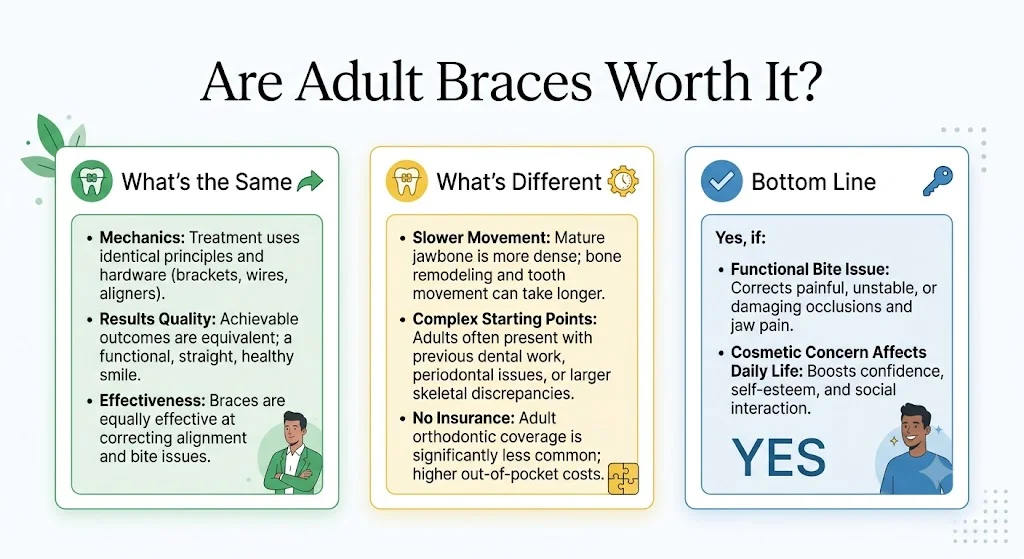
Braces work just as effectively in adults as in teenagers — the mechanics are identical. The differences: adult bone is denser so tooth movement is slower, adult cases often have more complex starting points, and most insurance plans stop covering orthodontics at age 18–19. Cost runs $4,000–$8,000 out of pocket. If you have a functional bite problem (pain, wear, difficulty chewing), the clinical case for treatment is clear. If your concern is primarily cosmetic, the decision comes down to how much it affects your daily life.
Part of our Demographics & Eligibility Master Guide.
1. What Is the Same as Teen Treatment
The underlying biological mechanics of tooth movement in adults are identical to teen treatment. Alveolar bone remodels under controlled force, yielding clinically equivalent alignment results at any age.
The orthodontic mechanics are identical. Brackets bond to teeth, wires apply force, bone remodels, and teeth move through alveolar bone into new positions. The biology of tooth movement — PDL compression on the pressure side, bone resorption, PDL tension on the tension side, bone deposition — works the same in a 40-year-old as in a 14-year-old. Adult treatment is not a compromise. Orthodontists achieve results in adult patients that are clinically indistinguishable from teen treatment.
2. What Is Different in Adult Treatment
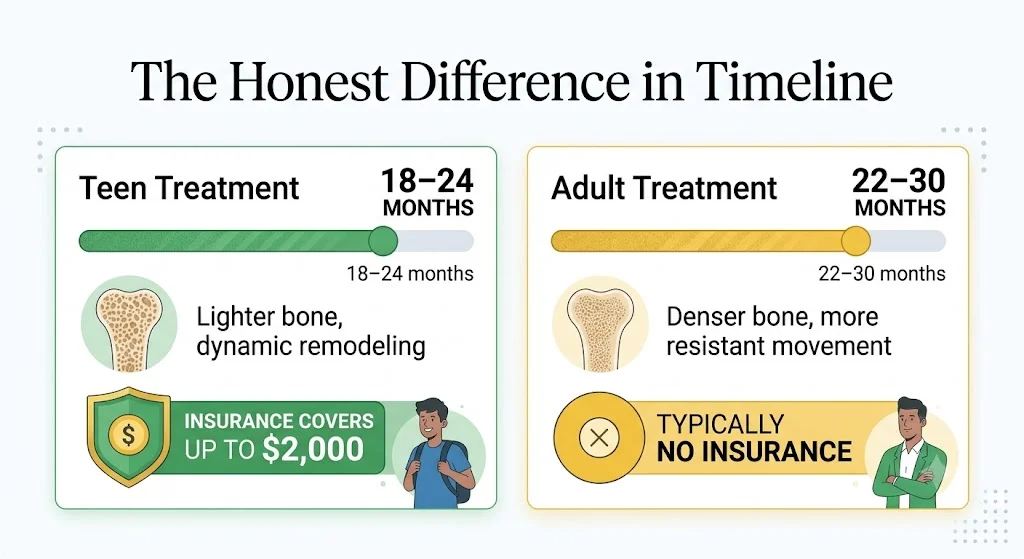
Adult treatment differs through 15–25% slower bone remodeling, denser bone, lack of skeletal growth guidance, and higher prevalence of existing dental work or past gum inflammation.
- Slower tooth movement: Adult bone is denser and has a lower metabolic rate. Most orthodontists plan adult cases with 15–25% more time than equivalent teen cases.
- More complex starting points: Adults often have existing crowns, bridges, worn teeth, or early periodontal bone loss. Crowns and bridges cannot move like natural teeth; implants cannot move at all.
- Periodontal prerequisites: Active gum disease must be treated and stable before orthodontic forces are applied. Patients with a history of gum disease need periodontist clearance and more frequent monitoring during treatment.
- No growth advantage: Teen treatment can harness active jaw growth for bite correction. Adults cannot. Significant skeletal discrepancies (severe overbite, underbite, asymmetry) often require jaw surgery rather than orthodontics alone.
3. The Insurance Gap
Most employer dental insurance policies cap orthodontic benefits at age 18 or 19. Adults typically pay full treatment costs out-of-pocket using FSAs, HSAs, or provider payment plans.
Most dental insurance plans cover orthodontics only up to age 18 or 19, with a lifetime maximum of $1,000–$2,000. Adult patients typically pay the full $4,000–$8,000 out of pocket. HSA and FSA funds can be used, dental schools offer discounted treatment ($1,500–$3,000 range), and most practices offer in-house payment plans. See our full guide on adult braces cost for detailed payment options.
4. Functional vs Cosmetic: How to Think About It
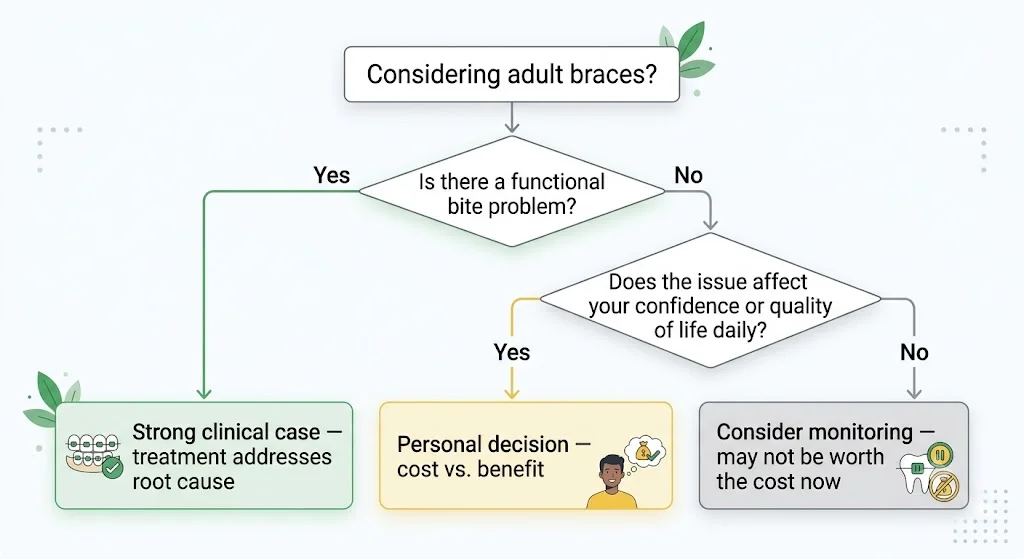
Adult braces provide essential functional value for bite issues, jaw pain, and tooth wear. For purely cosmetic alignment, the investment depends on personal confidence goals.
If you have a functional problem — bite-related jaw pain, TMJ discomfort, difficulty chewing, accelerated tooth wear, or gum recession from tooth position — orthodontic treatment addresses the underlying cause. The clinical benefit justifies the cost independently of cosmetic concerns.
If your concern is primarily cosmetic — mild crowding that does not affect your bite or oral health — the question is personal: does the issue affect your confidence or quality of life enough to justify $4,000–$8,000 and 18–30 months of treatment? There is no clinical answer to this. Many adults decide yes. Many decide no. Both are valid.
The oral health argument — straight teeth are easier to clean — is real but often overstated. Mild crowding does not dramatically increase cavity risk for patients with good hygiene. The argument is stronger for severe crowding where tooth surfaces are genuinely inaccessible to brushing and flossing.
Frequently Asked Questions
Are braces worth it for adults?
For most adults with functional bite problems, yes — the clinical results are equivalent to teen treatment. For cosmetic concerns, it depends on how much the issue affects your daily life. The main barrier is cost: $4,000–$8,000 out of pocket since insurance typically cuts off at age 18–19.
Do braces work the same on adults as on teenagers?
Yes — identical mechanics. The differences are slower tooth movement (20–30% slower in denser adult bone) and more complex starting points (existing dental work, possible gum issues). The final result is clinically equivalent.
Is it too late to get braces at 30, 40, or 50?
No age upper limit exists for adults with healthy teeth and gums. The prerequisites are the same: no active gum disease, no untreated cavities, adequate bone support. Adults with controlled gum disease can be treated with periodontist clearance and closer monitoring.
Do braces hurt more for adults?
Adults and teens experience similar soreness levels after adjustments. Adults may notice slightly longer recovery (3–4 days vs 2–3 days) reflecting slower bone remodeling. Preemptive ibuprofen before adjustments is effective for both groups.
What is the fastest way for adults to straighten teeth?
Invisalign Lite for mild-moderate cases can show results in 6–12 months. Propel and AcceleDent are add-on acceleration tools with mixed clinical evidence. There is no reliable shortcut — treatment length is determined by case complexity.