What Age Should Kids Get Braces? The Orthodontist’s Answer (2026)
Quick Answer
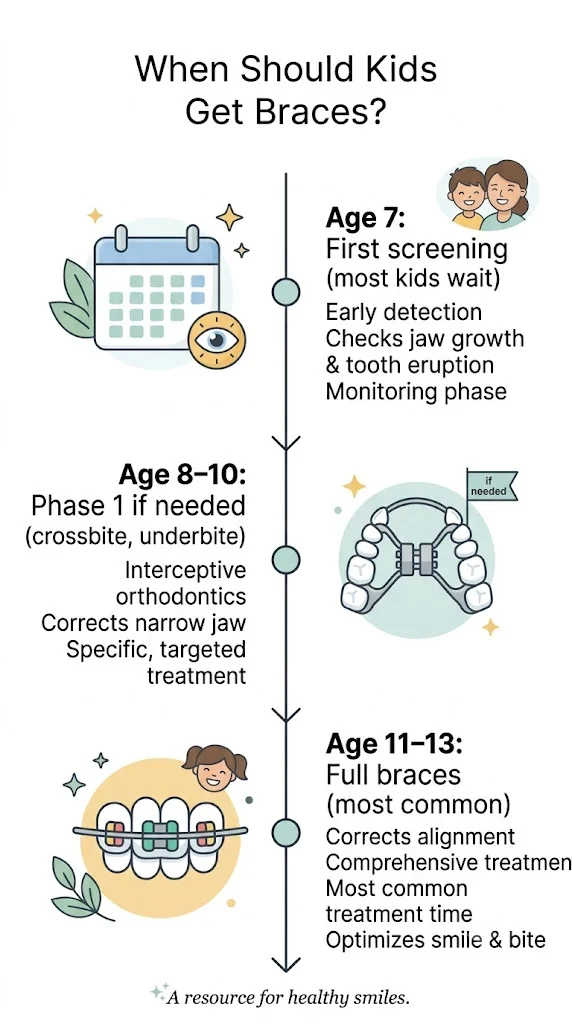
Most children start braces between ages 11 and 13, when most permanent teeth have erupted but jaw growth is still active. However, the American Association of Orthodontists (AAO) recommends a first orthodontic screening by age 7 — not because treatment starts then, but because some problems (crossbites, underbites, severe crowding, harmful habits) are far easier to treat during active jaw growth. Whether your child needs braces at 8 or 13 depends entirely on their specific bite and development.
Part of our Demographics & Eligibility Master Guide.
1. The AAO Age 7 Screening: What It Is and Is Not
An age 7 orthodontic screening evaluates jaw growth and eruption patterns while baby teeth are still present. It identifies skeletal issues early without necessarily placing full braces immediately.
The AAO recommends a first orthodontic evaluation by age 7. This is not a recommendation to start braces at 7. At age 7, most children have a mix of baby and permanent teeth. An orthodontist uses this visit to assess how permanent teeth are developing, identify crossbites or underbites that benefit from early correction, evaluate jaw width, detect habits affecting jaw development, and establish a monitoring schedule.
The majority of children seen at age 7 are told to return annually and start full treatment at 11–13. Only those with specific skeletal problems that benefit from early intervention are treated in Phase 1.
2. Phase 1 vs Phase 2: What Each Does
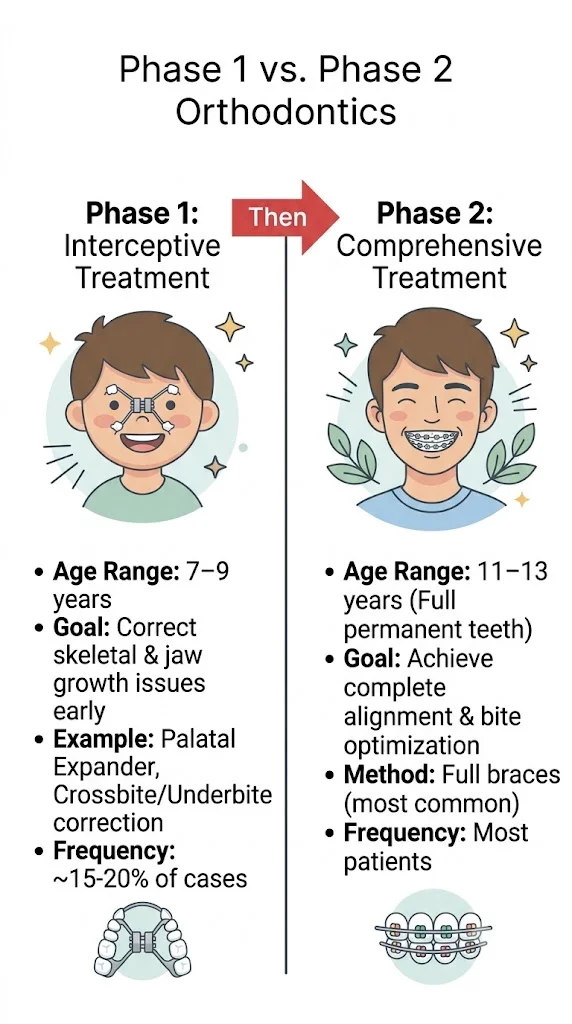
Phase 1 interceptive treatment (ages 7–9) guides jaw growth using expanders or partial braces. Phase 2 (ages 11–13) uses full braces to align all permanent teeth into final positions.
The table below outlines key comparison data and practical guidelines for what age should kids get braces?.
| Feature | Phase 1 (Age 7–9) | Phase 2 (Age 11–13) |
|---|---|---|
| Goal | Correct jaw development, prevent worsening | Align permanent teeth, correct bite |
| Tools | Expanders, partial braces, functional appliances | Full braces or Invisalign Teen |
| Teeth present | Mix of baby and permanent | Mostly or all permanent |
| Duration | 9–18 months | 18–30 months |
| Who needs it | ~15–20% of children | Most orthodontic patients |
| Cost | $1,500 – $3,000 | $3,000 – $6,000 |
Note: Data reflects typical clinical guidelines and average provider estimates across standard treatment plans.
3. Problems That Benefit From Early Treatment (Phase 1)
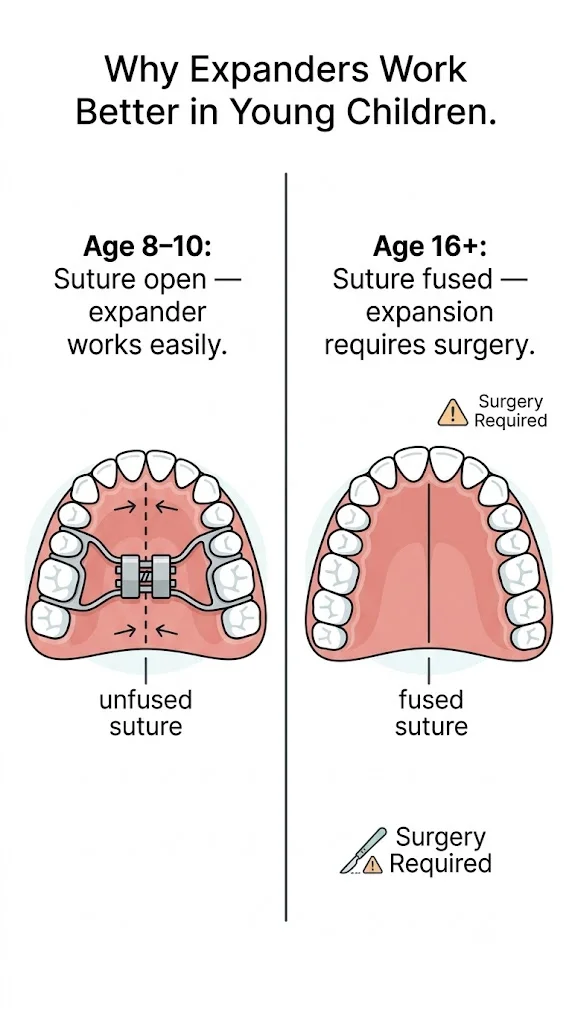
Early Phase 1 treatment effectively addresses skeletal crossbites, underbites, severe crowding, and thumb-sucking habits while midpalatal sutures remain flexible and open for expansion.
Crossbite: When upper teeth sit inside lower teeth during biting. A palatal expander used at age 8–9 widens the upper arch while the midpalatal suture is still open (unfused) and easily expandable. By the mid-teens the suture fuses, making expansion significantly more difficult and sometimes requiring surgery.
Underbite (Class III): When the lower jaw protrudes forward. Functional appliances (facemask, reverse-pull headgear) can redirect jaw growth when used between ages 7–10. After growth slows, surgical correction becomes the primary option for significant underbites.
Severe crowding: Early extraction of strategic baby teeth or limited expansion can guide permanent teeth into better eruption paths, potentially reducing the need to extract permanent teeth later.
Harmful habits: Prolonged thumb-sucking or tongue-thrusting past age 5 can reshape the arch and the bite. Habit appliances (cribs or rakes bonded to upper teeth) break the habit and allow recovery before permanent teeth complete eruption.
4. Why Waiting Is Fine for Most Kids
For children with simple crowding or spacing, waiting until age 11–13 for full Phase 2 braces achieves identical aesthetic and functional results while saving significant time and expense.
For children with straightforward alignment needs — crowded teeth, mild spacing, rotations — waiting until age 11–13 for full braces achieves the same result at lower total cost. Phase 1 provides a genuine advantage specifically when the problem involves the jaw skeleton and when the active growth window provides a biological leverage point. Ask your orthodontist what specific advantage early treatment provides that waiting would not achieve — if the answer is vague, it may not be necessary.
Frequently Asked Questions
What is the best age to get braces for a child?
Most children start full braces at 11–13 when most permanent teeth have erupted. The AAO recommends a first evaluation by age 7 to catch skeletal problems (crossbite, underbite) that benefit from early intervention during active jaw growth.
What is Phase 1 orthodontic treatment for kids?
Phase 1 is early interceptive treatment at ages 7–9 using expanders, partial braces, or functional appliances to correct jaw skeletal problems. It is followed by monitoring, then full Phase 2 braces at 11–13. Only about 15–20% of children need Phase 1.
Can a 7-year-old get braces?
Full braces at 7 are uncommon since most permanent teeth have not erupted. Age 7 is a screening age — the orthodontist assesses development and may use expanders or limited appliances if needed, but full braces wait until 11–13 for most children.
How do I know if my child needs early orthodontic treatment?
Signs to watch for: upper teeth sitting inside lower (crossbite), lower jaw protruding forward (underbite), severe crowding with baby teeth, prolonged thumb-sucking past age 5, or a jaw that shifts to one side when biting. An evaluation at age 7 catches these early.
Do all kids need Phase 1 treatment?
No — only about 15–20% of children. Phase 1 is specifically for skeletal problems during active jaw growth. For purely dental alignment (crowding, spacing, rotations), waiting for Phase 2 at 11–13 achieves the same result at lower total cost.