Can You Chew Gum with Braces? (No — Here’s Why and What to Use Instead)
Quick Answer
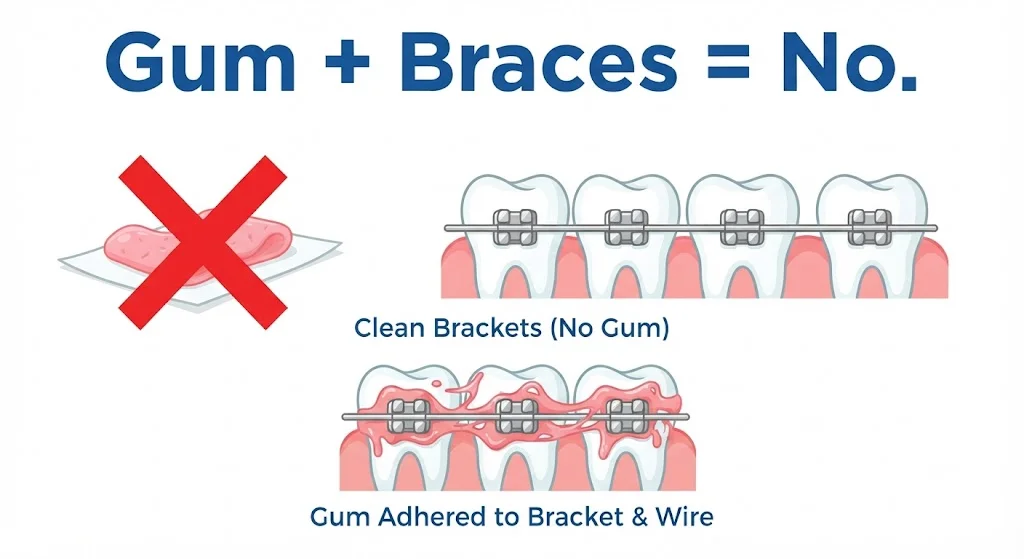
No — gum is not recommended with braces, including sugar-free gum. Gum belongs in the sticky food category: it clings to brackets and wires, wraps around hardware as you chew, and is difficult to remove completely. This can pull brackets loose and leave residue in bracket margins that feeds bacteria. Some orthodontists make an exception for very soft sugar-free gum in the final months of treatment — but the blanket rule is to avoid it.
Part of our Diet & Eating Guide. Also see: Complete Braces Food Guide.
What Actually Happens When Gum Meets Braces
Chewing gum with braces is dangerous because elastic polymers wrap around bracket slots and archwires. The constant stretching creates peel-off force that easily dislodges bonded brackets.
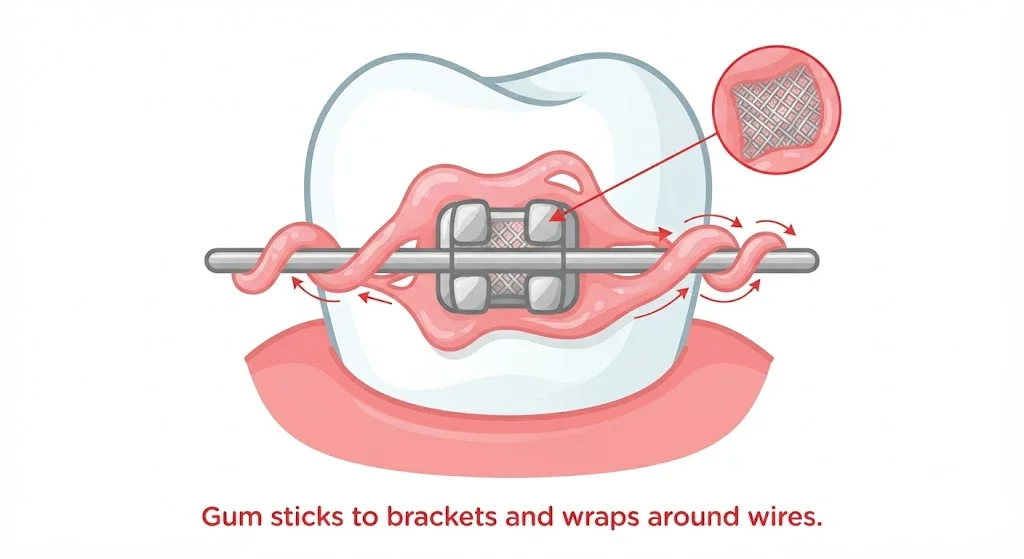
Gum is a viscoelastic polymer — it stretches, deforms, and re-forms. When it contacts a bracket, it does not simply sit there. The polymer bonds to surface features of the bracket (the mesh pad, slot edges, ligature ties) and as you chew, the gum stretches away from the bracket and pulls back in a continuous cycle.
The bond between a bracket and enamel is designed to resist normal chewing forces applied perpendicular to the tooth surface. It is much less resistant to peel-off force — the force created when something pulls the bracket face outward and away from the tooth. This is the mechanical reason gum (and all sticky foods) is specifically prohibited, while hard foods are prohibited for a different reason (shear force).
Does Sugar-Free Gum Make It Safer?
Sugar-free gum does not eliminate the mechanical risk to braces. While xylitol prevents sugar-fed bacteria, the physical pulling action on bracket adhesive remains identical to sugary gum.
Sugar-free gum removes the bacterial acid problem — the sugar feeds bacteria that damage enamel. But it does not eliminate the mechanical adhesion risk. The repeated stretching and pulling motion against brackets is identical to regular gum. Xylitol-sweetened gum can actually be slightly firmer in some formulations, which increases — not decreases — adhesion to bracket surfaces.
Sugar-free xylitol gum has documented cavity-reduction benefits for patients without braces (chewing after meals stimulates saliva flow and xylitol inhibits bacteria). For braces patients, the mechanical risk is the primary concern — and sugar-free does not reduce it.
What Orthodontists Actually Say
Orthodontists strictly prohibit chewing gum during braces treatment to avoid emergency repairs. Only a tiny minority approve specialized ultra-soft sugar-free gums under strict supervision.
The vast majority of orthodontists include gum in the standard prohibited food list given to patients at the bonding appointment. The clinical reasoning is consistent: gum falls in the adhesion risk category alongside caramel and taffy — with the additional wire-entanglement risk that comes from its elastic properties.
A small minority of orthodontists allow very soft sugar-free gum (brands like Biotène or Spry) specifically because these products are formulated to be significantly softer than standard gum. If you want to chew gum during treatment, ask your specific orthodontist — what works for someone else may not be appropriate for your hardware configuration.
Removing Gum from Braces: Step by Step
Removing stuck gum from braces requires rinsing with cold water to harden the polymer, then gently peeling it off bracket surfaces with fingers or a soft toothbrush. Avoid aggressive yanking.
- Do not panic or yank. Pulling hard on stuck gum can dislodge the bracket.
- Rinse with cold water. Cold temperatures make the gum more brittle and less adhesive.
- Work slowly and carefully. Use your fingers or a soft-bristled toothbrush to peel the gum from the bracket surface in small sections.
- Use a toothpick for wire entanglement. If the gum is wrapped around the wire, carefully thread the toothpick through and use a sawing motion to cut through the gum.
- Call your orthodontist if you cannot remove it cleanly or if the bracket feels loose after you finish.
What to Use Instead
Safe alternatives to chewing gum with braces include dissolving mints, sugarless breath strips, cold water rinses, and therapeutic fluoride mouthwashes for instant breath freshening.
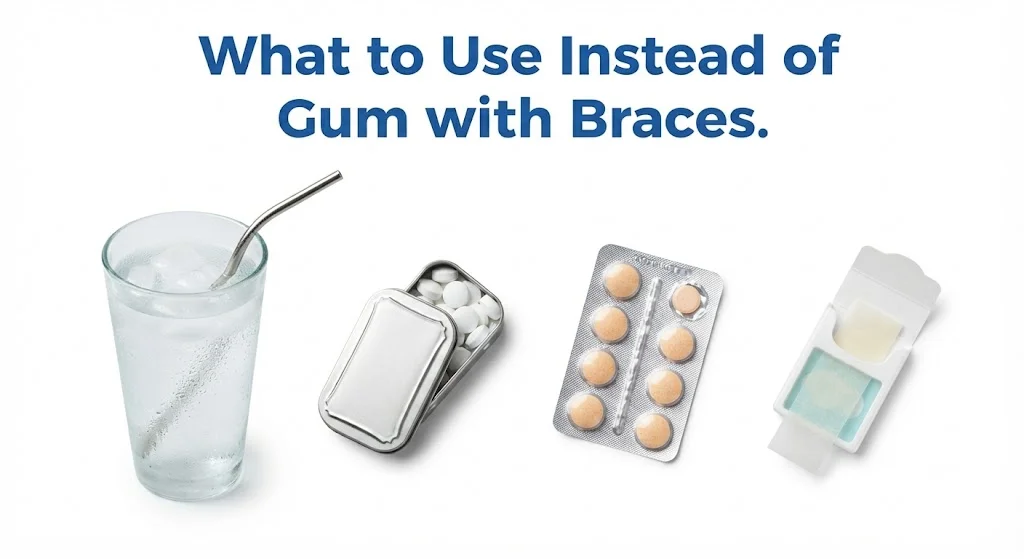
- Dissolving mints: Satisfy the breath-freshening need without any sustained chewing
- Cold water: Naturally refreshing after meals, rinses bracket surfaces
- Sugarless breath strips: Dissolve immediately, no chewing required
- Mouthwash after meals: Fluoride mouthwash freshens breath and provides additional enamel protection around brackets