What Happens If You Don’t Clean Your Braces? (The Real Consequences)
Quick Answer
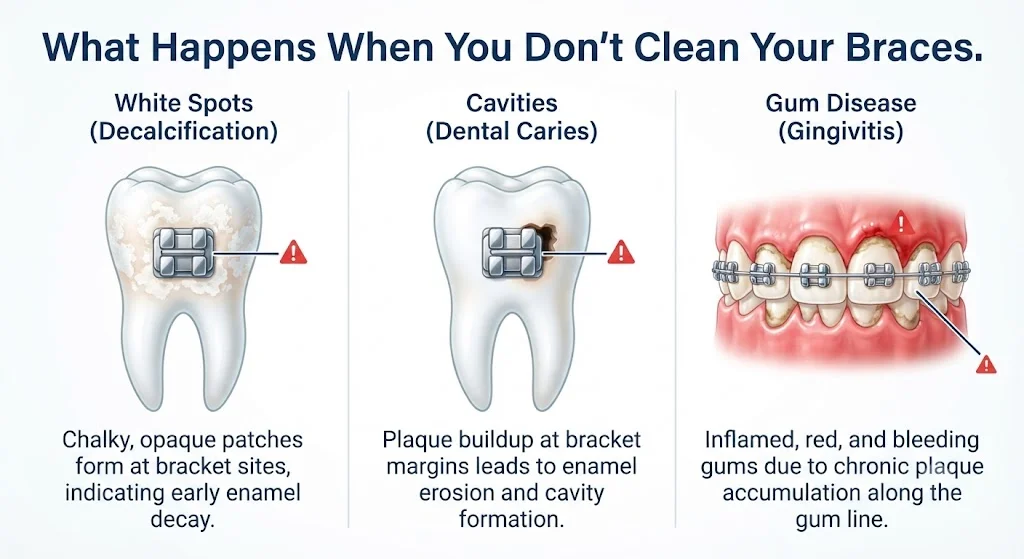
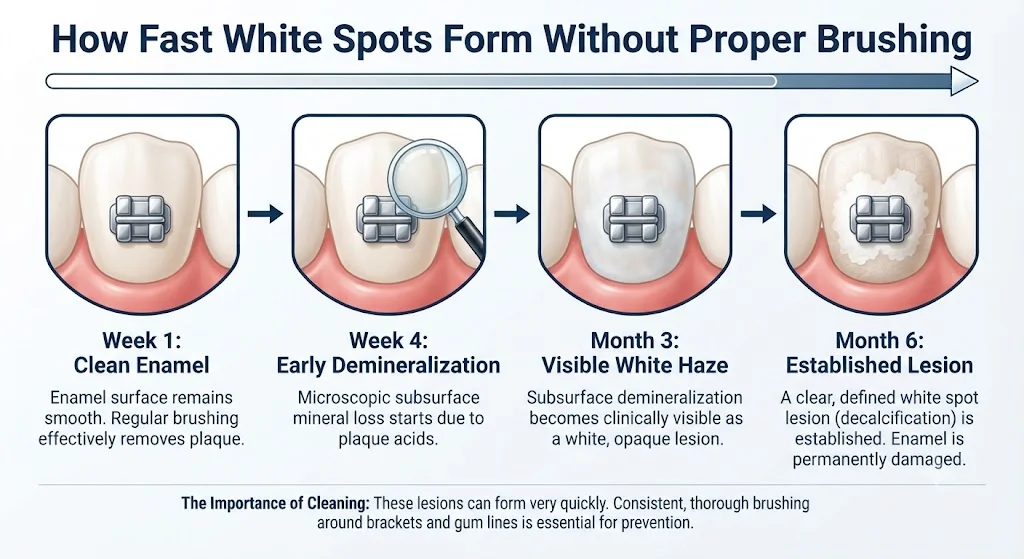
Not cleaning your braces consistently causes three main problems: white spot lesions (permanent enamel damage around bracket sites), cavities (especially at bracket margins), and gum disease (gingivitis progressing to bone loss). White spot lesions can begin forming in as little as 4 weeks of poor hygiene. They are permanent. Prevention costs nothing — treatment costs hundreds to thousands of dollars.
Part of our Maintenance & Care Guide.
1. What Plaque Does Around Braces
Failing to clean braces allows bacterial plaque to build up around bracket margins, generating concentrated acid. This constant acid exposure demineralizes tooth enamel, leading to irreversible white spots and decay.
Dental plaque is a biofilm of bacteria that forms on tooth surfaces constantly. Normally, brushing twice daily removes it before it causes significant damage. With braces, the situation changes: brackets, wires, and adhesive margins create dozens of new surfaces and recesses where plaque adheres and is protected from brushing.
The bacteria in plaque produce acid as a byproduct of metabolizing sugars. That acid dissolves the mineral content of enamel — demineralization. With braces, this acid is concentrated at bracket margins, creating damage in exactly the areas that will be most visible when brackets are removed.
2. Consequence 1 — White Spot Lesions
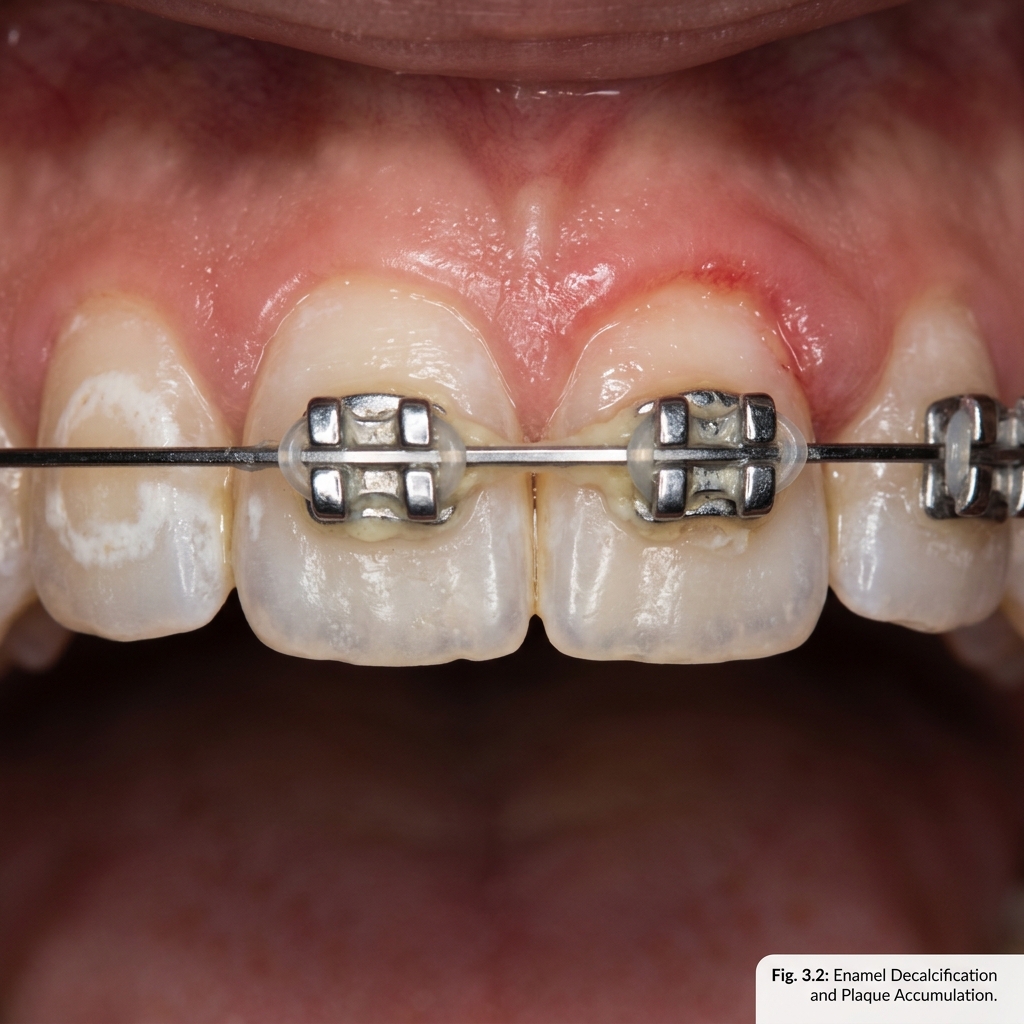
White spot lesions are permanent chalky demineralization rings that appear around bracket sites when oral hygiene is neglected. Resolving them after treatment requires specialized resin infiltration or professional remineralization.
The most common consequence of poor braces hygiene. White spots appear as chalky white or dull patches directly around each bracket site after brackets are removed.
They form because plaque acid attacks the enamel at the bracket margin where the adhesive meets the tooth surface. The area directly under the bracket is protected — only the exposed margin is attacked. When brackets come off, the bracket site is relatively darker, surrounded by a lighter demineralized ring.
White spot lesions are permanent. They do not fade on their own. Treatment (Icon resin infiltration, remineralization, microabrasion) can reduce their appearance significantly but comes at significant cost — $100–$300 per tooth for Icon infiltration. Prevention is free.
3. Consequence 2 — Cavities
Demineralization from poor braces hygiene frequently turns into active cavities at bracket margins and between teeth. Treating interproximal cavities often requires bracket removal and rebonding, adding months to treatment.
Cavities (dental caries) form when demineralization progresses from the enamel surface into the dentin beneath. With braces, the highest-risk sites are:
- Bracket margins: Where plaque concentration is highest — the same location as white spots, but progressing deeper
- Interproximal surfaces (between teeth): Flossing difficulty during treatment increases risk here significantly
- Along the gumline: Food debris and plaque accumulate where wire meets gum
A cavity discovered during orthodontic treatment must be treated before treatment can continue. If it is on a bonded tooth, the bracket may need to be removed, the cavity filled, and the bracket rebonded — adding appointments and potentially extending treatment significantly.
4. Consequence 3 — Gum Disease
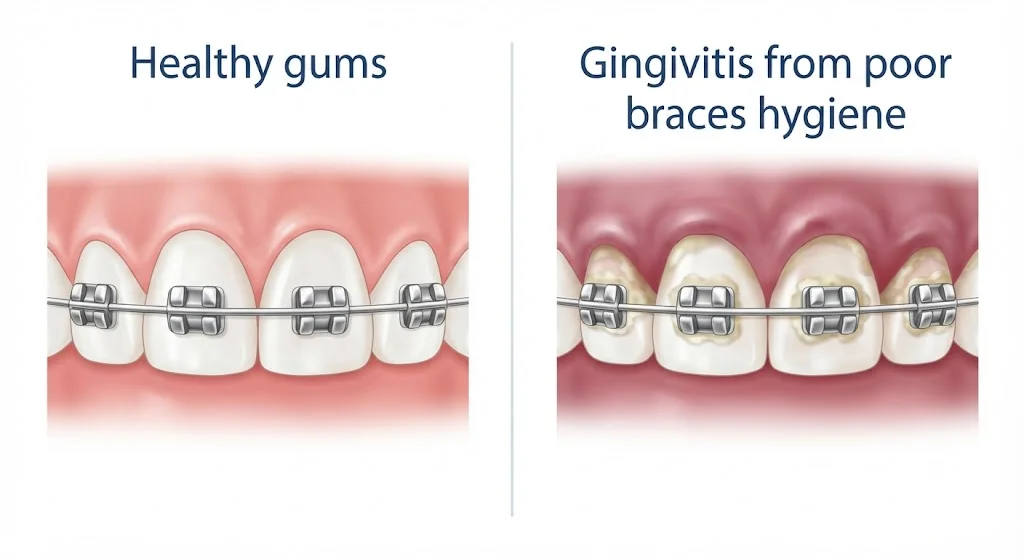
Plaque buildup causes gingivitis, marked by swollen, bleeding gums around bracket bases. Untreated inflammation can progress to periodontitis, forcing orthodontists to pause treatment to avoid severe bone loss.
Gingivitis (gum inflammation) is common during orthodontic treatment — the hardware makes perfect plaque removal at the gumline difficult. Mild gingivitis (red, slightly puffy gums that bleed when flossed) is reversible with improved hygiene and does not cause permanent damage.
Periodontitis is different. If chronic gum inflammation persists throughout treatment, the supporting bone around teeth can begin to resorb. Orthodontic tooth movement in the presence of active periodontal infection accelerates this bone loss. Orthodontists can and will pause treatment if significant gum disease is present — applying force to already-compromised bone causes further irreversible damage.
5. Will Your Orthodontist Notice?
Orthodontists immediately identify poor oral hygiene by inspecting swollen gum margins, visible plaque deposits, and early decalcification. Persistent hygiene failure leads to suspended treatment until oral health recovers.
Yes — every time. Red or swollen gum tissue, visible plaque at bracket margins, calculus deposits, and early white spot lesions are all immediately visible to an orthodontist at every appointment. Orthodontists will counsel you directly and, in cases of severe hygiene failure, pause treatment entirely. Continuing to apply orthodontic force to teeth with active gum disease causes accelerated bone loss. Hygiene is not optional during treatment — it is a precondition for continuing it.
Frequently Asked Questions
What happens if you don't brush with braces?
Plaque builds at bracket margins within days, acid demineralization begins within weeks, and white spot lesions, cavities, or gum inflammation can develop within months. All three consequences are permanent or require expensive professional treatment.
Can you get cavities with braces?
Yes — braces patients are at higher risk. Brackets and wires create additional plaque traps that are harder to clean. Cavities at bracket margins may require removing the bracket, filling the cavity, and rebonding — extending treatment.
How quickly do white spots form from not cleaning braces?
Early white spot formation can begin in as few as 4 weeks of inadequate hygiene. Visible white spots are common by 3 months of poor oral care. They are permanent once established.
Can gum disease happen with braces?
Yes. Up to 70% of braces patients have some gum inflammation during treatment. Mild gingivitis is reversible with better hygiene; periodontitis (bone loss) is not reversible and causes orthodontists to pause treatment.
Will my orthodontist know if I am not cleaning my braces properly?
Yes — every appointment. Red gums, plaque at bracket margins, calculus, and early white spots are all visible. Severe hygiene failure can cause orthodontists to pause treatment until the patient's oral health is restored.