
How Often Are Braces Tightened? What Really Happens at Every Adjustment Appointment (2026 Guide)

Quick Answer
Braces are tightened every 4 to 8 weeks — most patients are on a 6-week schedule. The interval matches one complete bone remodeling cycle. Missing appointments adds 4 to 6 weeks of treatment per missed visit. In the finishing phase, one missed appointment can push debonding back 6 to 12 weeks.
Part of our Complete Braces Timeline & Process Guide.
You go to an adjustment appointment and leave feeling fine. The morning after, you cannot bite into toast without flinching. You survive on yogurt through day three. By day five everything is back to normal — and you go another six weeks without thinking about your braces at all.
That cycle repeats twelve to eighteen times throughout your treatment, and almost nobody explains why it happens, what your orthodontist is actually doing during those 20-minute appointments, or why the interval between visits is not just a scheduling convenience but a hard biological limit set by your own bone cells.
How Often Are Braces Tightened?
The standard interval is every 4 to 8 weeks. Most patients land at 6 weeks. The exact schedule depends on where you are in treatment:
The table below outlines key comparison data and practical guidelines for how often are braces tightened? what really happens at every adjustment appointment.
| Treatment Phase | Appointment Interval | Why |
|---|---|---|
| Early leveling and aligning (months 1–3) | Every 4–5 weeks | Rapid alignment changes need more frequent wire swaps |
| Mid-treatment space closure (months 4–10) | Every 6 weeks | Slower biological process; heavy forces need full time to work |
| Finishing phase (months 11–end) | Every 6–8 weeks | Minor torque corrections; bone remodeling is slower at this stage |
Note: Data reflects typical clinical guidelines and average provider estimates across standard treatment plans.
That 4-to-8-week window is not a guess. It matches the length of one complete bone remodeling cycle — which is the real reason you cannot simply tighten braces every two weeks to finish faster.
The Biology Behind the Interval (What Nobody Tells You)
When your orthodontist inserts or activates a wire, it begins pressing your teeth with measurable force — typically between 50 and 150 grams depending on the wire and the stage of treatment. This pressure compresses the periodontal ligament (PDL) on one side of the root and stretches it on the other.
The bone remodeling sequence that follows has two distinct actors:
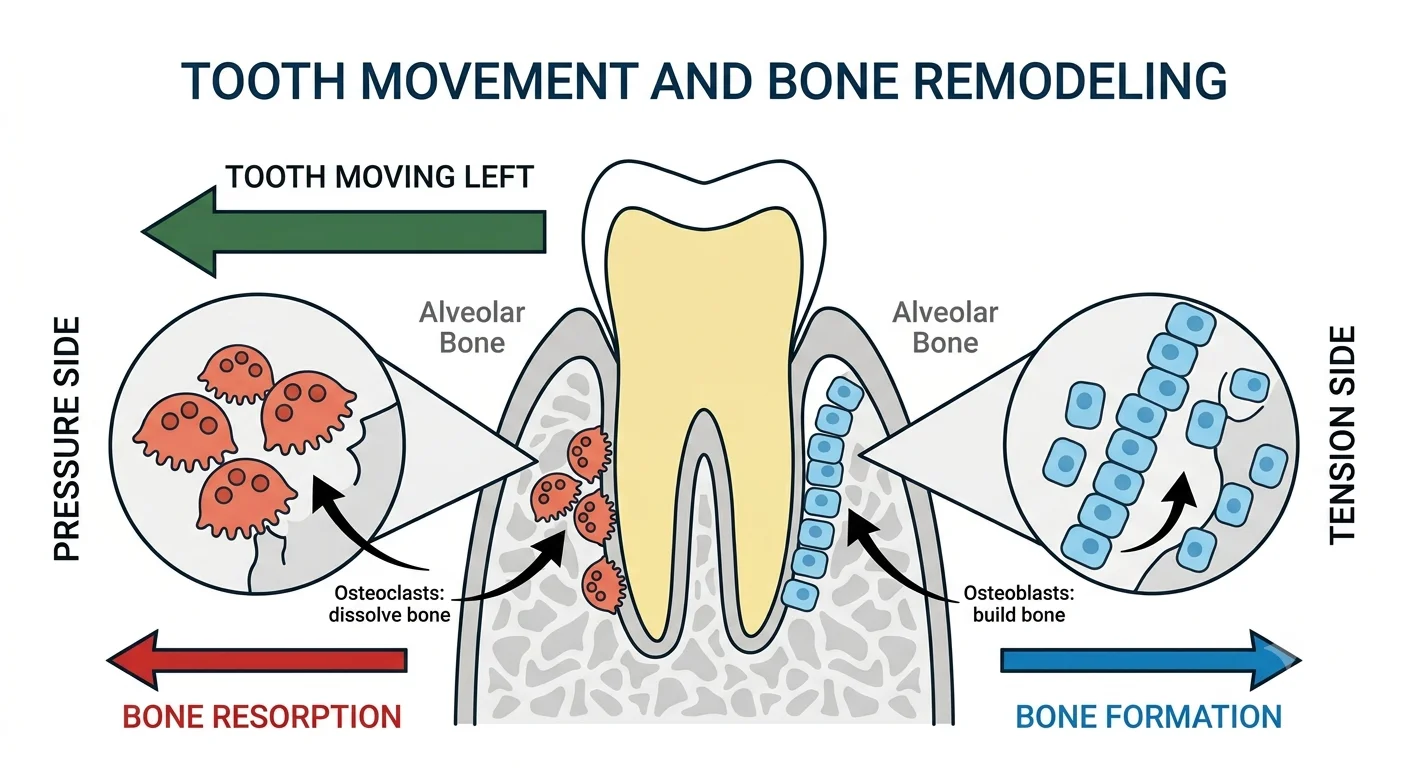
Osteoclasts dissolve bone on the compression side, clearing a path for the tooth to move. They activate within 24 to 48 hours of sustained pressure and work hardest for the first two to three weeks.
Osteoblasts lay down new bone on the tension side, filling in the space the tooth just vacated. This lags behind the osteoclasts by approximately two to three weeks — which is why newly moved teeth feel unstable for weeks after each adjustment.
Why the wire “deactivates” between appointments
Archwires deliver force by being deflected away from their resting shape. As your teeth actually move into alignment with the wire, that deflection decreases and the force output drops toward zero. By week four to six, a wire sitting in a well-aligned arch is delivering almost no force at all. You need the appointment not to “tighten a bolt,” but to reintroduce deflection — either with a new wire or precisely placed bends in the existing one.
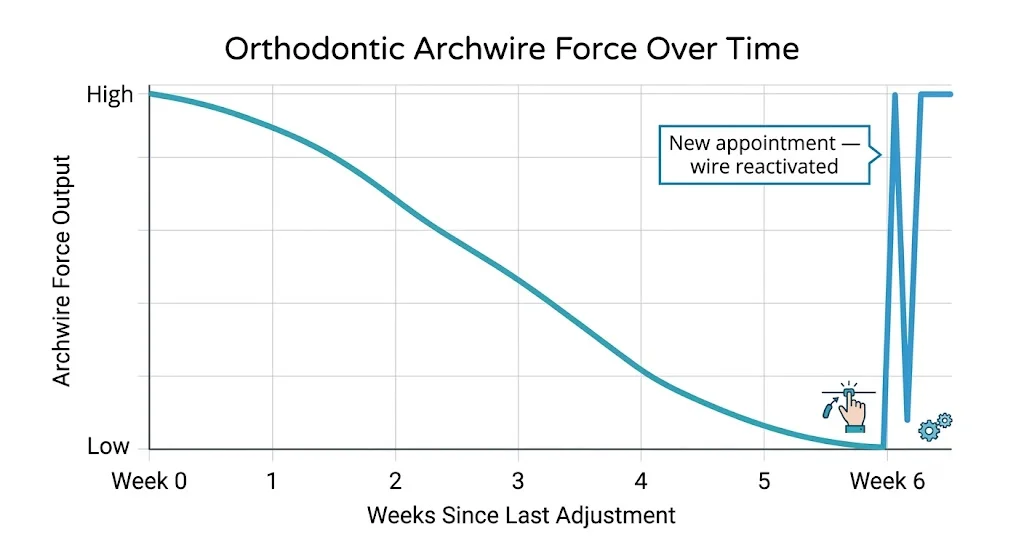
Trying to accelerate treatment by coming in every two weeks would skip the osteoblast infilling cycle, leaving soft, unmineralized bone behind each moved tooth. This dramatically increases the risk of relapse and reduces the long-term stability of your final result. Your bone biology sets the speed limit — not your orthodontist's schedule.
What Your Orthodontist Actually Does During the Appointment
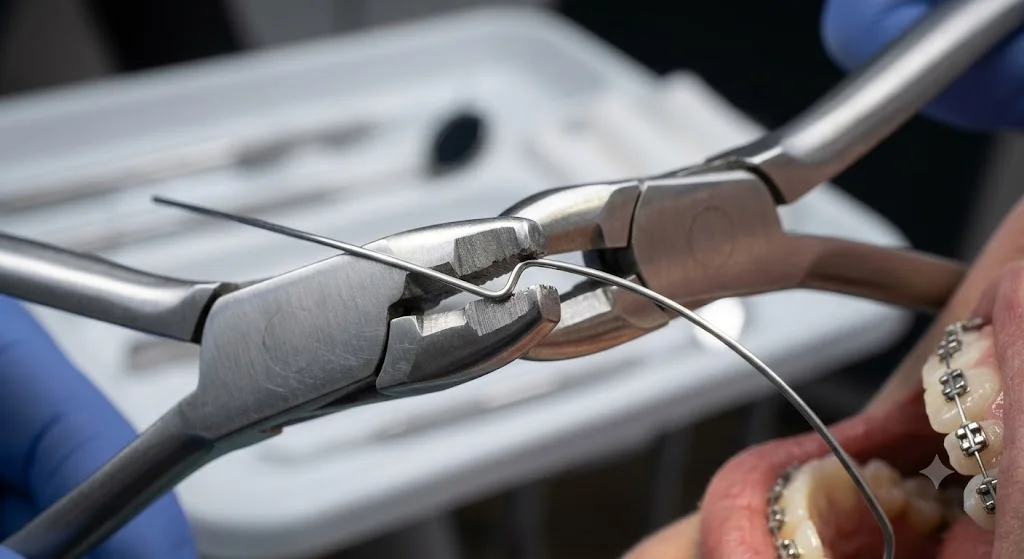
A standard adjustment runs 15 to 25 minutes. Most patients sit there seeing nothing but a blur of tools and feeling occasional pressure. Here is exactly what is happening in sequence:
Step 4 — the wire selection — is where the real work happens. Most of the appointment chair time is the orthodontist evaluating which adjustment will produce the most efficient movement at the next stage of your treatment, not the mechanical act of swapping the wire itself.
In the finishing phase, detailing bends become increasingly precise. An orthodontist chasing the correct axial inclination of a single molar may spend more time bending one section of wire at this step than the entire rest of the appointment combined.
Do Braces Hurt When Tightened?
Yes — but the timing is counterintuitive and almost every guide gets this wrong. You will feel almost nothing walking out of the adjustment appointment. The forces are fresh but your bone has not started responding yet. Here is the real soreness timeline:
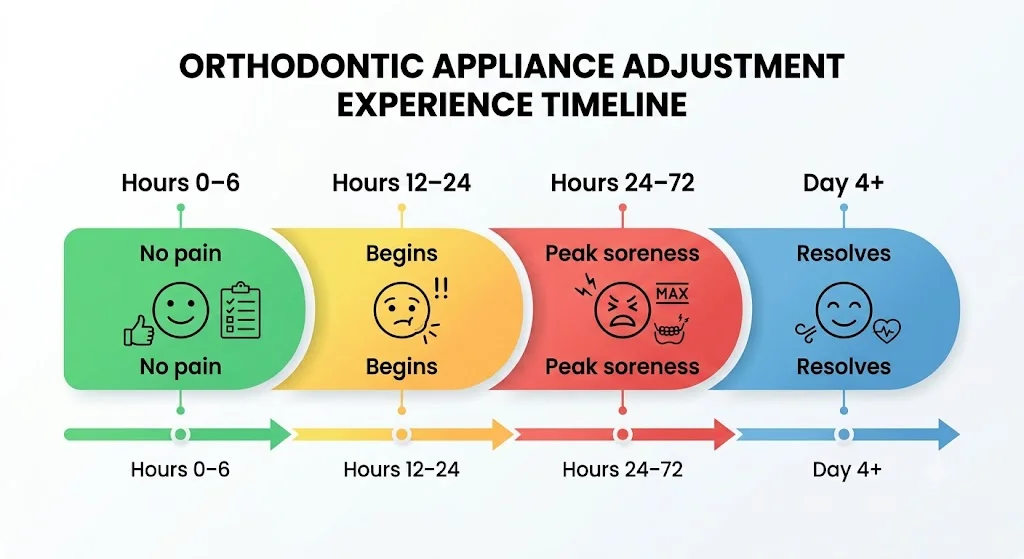
The biological cause is specific. Sustained mechanical pressure on the PDL triggers the release of prostaglandins and interleukin-1β — inflammatory signaling molecules that sensitize the nerve endings around each tooth root. This is the same pathway ibuprofen blocks, which is why it works meaningfully better than acetaminophen for post-tightening soreness. Acetaminophen reduces the pain signal. Ibuprofen interrupts the inflammatory process generating it.
Plan your meals around day 2 and day 3 — not the day of the appointment. Most patients eat a full meal right after their adjustment (no soreness yet), then wake up the next morning unable to bite into anything comfortably. The yogurt days are day two and three, not the day of.
How Many Adjustment Appointments Do Braces Require?
Total appointments depend on treatment length. For a typical 18-month case with 6-week intervals:
18 months ÷ 6 weeks = approximately 12 adjustment appointments
Plus the initial bonding appointment and the debonding appointment at the end, most patients have 14 to 16 total orthodontic chair visits from start to finish.
Shorter 12-month cases at 4-week intervals can reach 13 appointments. Complex 30-month cases at 6-week intervals reach 20 or more.
What Happens If You Miss an Adjustment Appointment?
Missing one appointment is not catastrophic, but it carries a real cost most patients underestimate.
By week six your wire has largely deactivated. By week eight, teeth that were mid-movement may begin drifting slightly back — not fully, but the bone that filled in behind them is still young and minimally mineralized. There is nothing holding them in their new position once the wire force drops to zero.
Each missed 6-week appointment effectively pauses progress for that period and may add 4 to 6 weeks to total treatment time — not because the appointment itself takes long, but because the bone remodeling clock partially resets. In the finishing phase, when the orthodontist is chasing sub-millimeter corrections with detailing bends, missing a single appointment can push the debonding date back by 6 to 12 weeks.
Does the Tightening Get Worse Over Time?
Most patients report the opposite — adjustments later in treatment cause less soreness than early ones. There are two reasons.
First, the forces are not necessarily larger later in treatment. Early wires are thin and highly flexible — they generate substantial force across widely misaligned teeth. Later wires are stiffer, but teeth are much closer to their final position, so the deflection (and therefore force output) is actually smaller.
Second, there is evidence that the PDL adapts to sustained orthodontic loading over months of treatment. The inflammatory pain response at month 12 is typically milder than at month one — though this varies by patient.
Summary
Braces are adjusted every 4 to 8 weeks because that interval matches one complete bone remodeling cycle — not scheduling convenience. At each appointment, worn-out ligatures are replaced, the current wire is assessed and either upgraded or precisely bent, and elastic patterns are updated. Soreness peaks at 24 to 72 hours post-adjustment because bone inflammation takes time to build — plan soft meals for days 2 and 3, not the day of. Missing appointments does not just delay the next visit; it allows partial spring-back in mid-movement teeth and adds weeks to the overall treatment timeline.
Want to know how long your full treatment will take?
Use Our Free Timeline Estimator →Read How Are Braces Put On? to understand the full bonding appointment before your first tightening.
Or see How Long Do Braces Take? for the complete month-by-month biological timeline from bonding to debonding.