Do Braces Work Faster for Kids Than Adults? (2026)
Quick Answer
Yes, braces generally work faster in children and teens than in adults. The reason is bone biology: younger jaws have a higher rate of bone remodeling — the process by which bone around teeth breaks down and rebuilds as teeth move. Children's bone is less dense and more metabolically active, so teeth shift in response to orthodontic pressure more quickly. A case that takes 12 months in a 12-year-old may take 18–24 months in a 35-year-old with identical crowding. That said, adults get excellent results — the gap in speed is real but not dramatic for mild to moderate cases.
Part of our Demographics & Eligibility Master Guide.
The Science: How Bone Remodeling Works
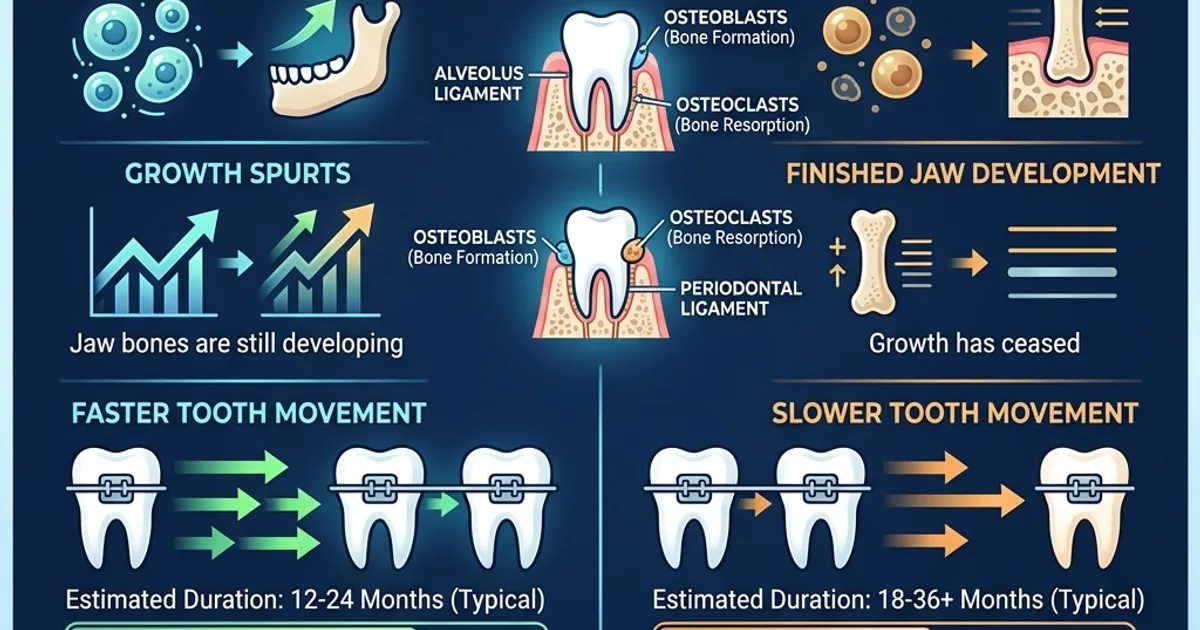
Bone remodeling drives tooth movement as osteoclasts dissolve bone on the pressure side and osteoblasts build bone on the tension side of archwire force.
Teeth move through a biological process called bone remodeling. Here is how it works:
- An archwire applies a gentle continuous force to the tooth
- The periodontal ligament (tissue between tooth and bone) transmits this force to the surrounding bone
- On the pressure side: specialized cells called osteoclasts dissolve bone
- On the tension side: osteoblasts build new bone to fill the space the tooth leaves behind
- The tooth moves into the dissolved-bone space
This cycle — bone resorption and deposition — is called bone remodeling. It happens constantly in everyone, but the rate varies dramatically by age.
Why Children's Bone Remodels Faster
Children experience faster bone remodeling due to active growth hormones, higher cellular turnover, and lower mineral bone density, making teeth move more rapidly.
Children and adolescents are in a period of active skeletal growth. Their bones have:
- Higher concentrations of osteoblasts (bone-building cells) and osteoclasts (bone-dissolving cells)
- Greater blood flow to bone tissue, delivering nutrients that fuel remodeling
- Less dense bone matrix — easier for cells to dissolve and rebuild
- Active growth hormone signaling that accelerates all skeletal processes
Kids vs. Adults: Treatment Time Comparison
Adult braces treatment takes 20% to 30% longer than teen treatment for equivalent alignment cases, adding roughly 4 to 6 months to total treatment timelines.
The table below outlines key comparison data and practical guidelines for do braces work faster for kids than adults?.
| Case Complexity | Teen (12–17) | Adult (25+) |
|---|---|---|
| Mild crowding | 10–14 months | 12–18 months |
| Moderate crowding | 14–18 months | 18–24 months |
| Severe crowding | 18–24 months | 24–36 months |
| Complex bite correction | 18–30 months | 24–36+ months |
Note: Data reflects typical clinical guidelines and average provider estimates across standard treatment plans.
How Adults Can Speed Up Treatment
Adults can optimize treatment speed through perfect rubber band compliance, punctual adjustment visits, immaculate gum hygiene, or acceleration devices like AcceleDent.
Frequently Asked Questions
Why do braces work faster in children than adults?
The key mechanism is bone remodeling rate. When an orthodontic wire applies pressure to a tooth, bone dissolves on the pressure side (resorption) and new bone forms on the tension side (apposition). In children, this cycle is faster because their bones are actively growing with higher cellular activity. Adult bone is denser and remodels more slowly.
How much longer do braces take for adults vs. kids?
On average, adults take 20–30% longer than teenagers for equivalent malocclusions. A teen with moderate crowding might finish in 14 months; the same correction in a 30-year-old often takes 18–22 months. Adults who are perfectly compliant with rubber bands and appointments often close this gap.
What is the best age to get braces?
The American Association of Orthodontists recommends an initial evaluation at age 7, though most children don't start treatment until 11–14. Starting at 12–14 is typically ideal because most permanent teeth are in and bone remodeling is at its fastest. However, best age depends on the specific problem.
Can adults get the same results as kids with braces?
Yes — in terms of final outcome, adults achieve the same quality of tooth alignment and bite correction as children. The difference is time, not result. Some problems that would be corrected with growth modification in a child require surgical intervention in adults, but for straightening teeth, the end results are comparable.
Does adult compliance make up for slower bone remodeling?
Partially. Adults are generally more compliant with rubber band wear and keeping appointments, which can offset some of the biological slowdown. However, compliance cannot fully compensate for the slower bone remodeling rate of adult bone — biology sets the ceiling.