Why Do Braces Hurt So Much? (The Real Biology Behind the Pain)
Quick Answer
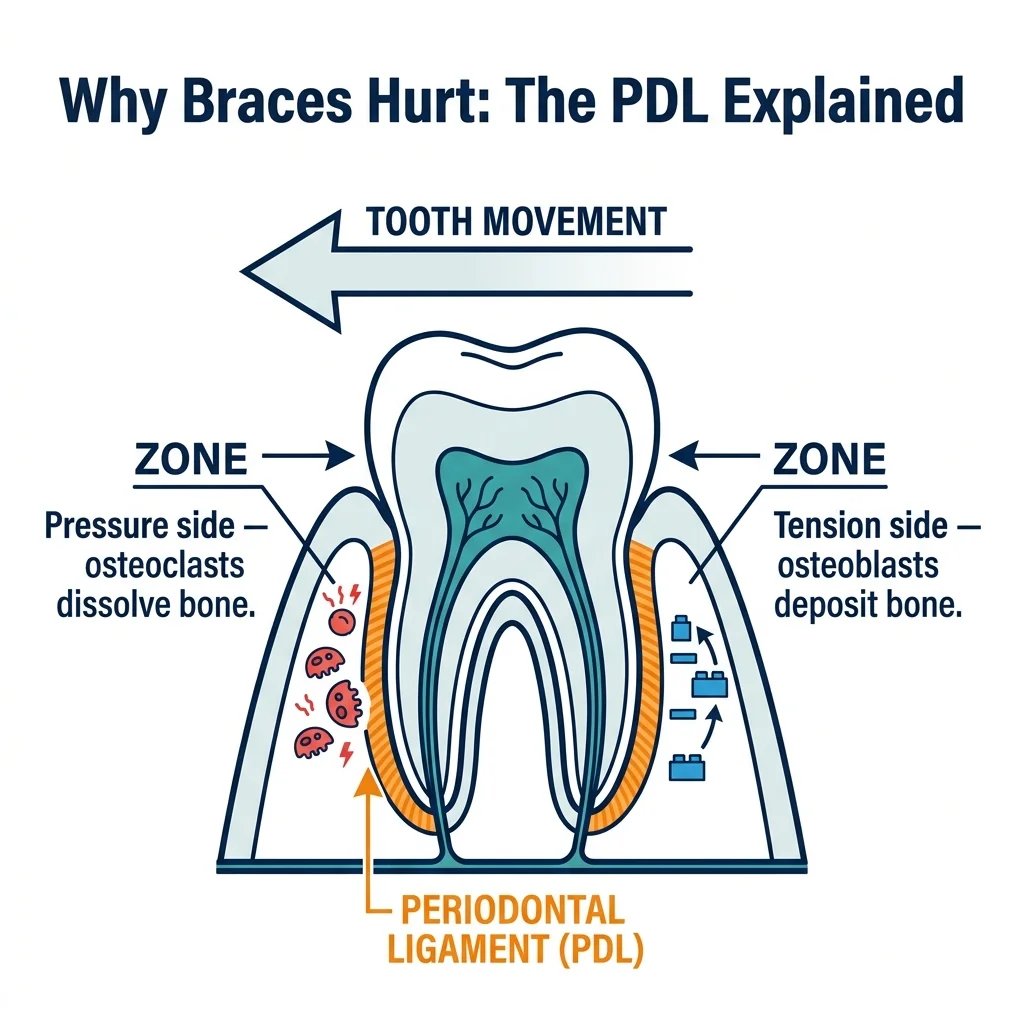
Braces hurt because the arch wire puts mechanical pressure on the periodontal ligament (PDL) — the connective tissue that holds each tooth in its socket. This pressure triggers real inflammation: osteoclasts dissolve bone, and prostaglandins collect inside the ligament. Pain is a spinoff of the same biological process that actually works your teeth. It's not repulsive — it's far more important. Pain peaks 24–72 hours after adjustment and resolves in 3–5 days. Ibuprofen (an anti-inflammatory) is more potent than acetaminophen because it targets the precise inflammatory mechanism.
The Biology: What's Actually Happening
Braces cause pain through localized inflammation in the periodontal ligament (PDL) as continuous mechanical pressure compresses collagen fibers on one side of the root and stretches them on the other. This process releases prostaglandins and triggers osteoclasts to dissolve bone.
Each tooth is anchored in its bony socket by the periodontal ligament — a network of collagen fibers that both holds the tooth and acts as a shock absorber. When the archwire exerts directional force:
- PDL fibers are compressed
- Inflammatory response triggered
- Osteoclasts dissolve bone ahead
- This is the source of soreness
- PDL fibers are stretched
- Blood flow increases
- Osteoblasts deposit new bone
- Fills the space left behind
Why Ibuprofen Works Better Than Tylenol
Ibuprofen reduces braces pain more effectively than Tylenol because it is a nonsteroidal anti-inflammatory drug (NSAID) that directly inhibits COX enzymes and prostaglandin production in the periodontal ligament. Tylenol only blocks central pain signals without reducing ligament swelling.
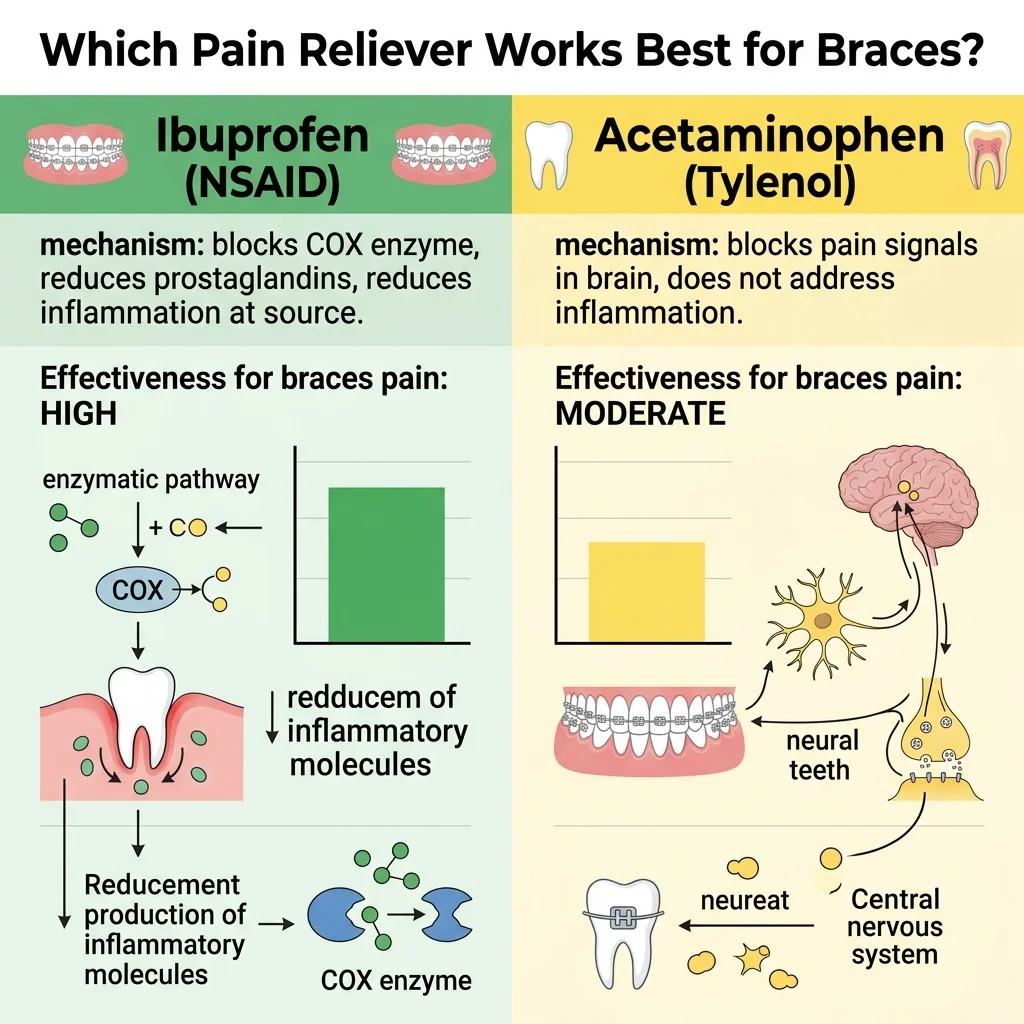
Acetaminophen (Tylenol) blocks pain signals within the central thinking apparatus and no longer copes with the underlying infection. Ibuprofen is an NSAID — it inhibits the COX enzyme that produces prostaglandins, immediately targeting the inflammatory cascade that causes braces pain. That's why ibuprofen (pre-dose) taken before adjustment dramatically reduces headaches: it suppresses the inflammatory response before it fully builds, rather than following it after the fact.
Note: Some dentists avoid ibuprofen because prostaglandins also have concerns within tooth movement patterns. Most clinical evidence suggests that short-term use (2–3 days after adjustment) does not widely affect treatment speed.
When to Call Your Orthodontist
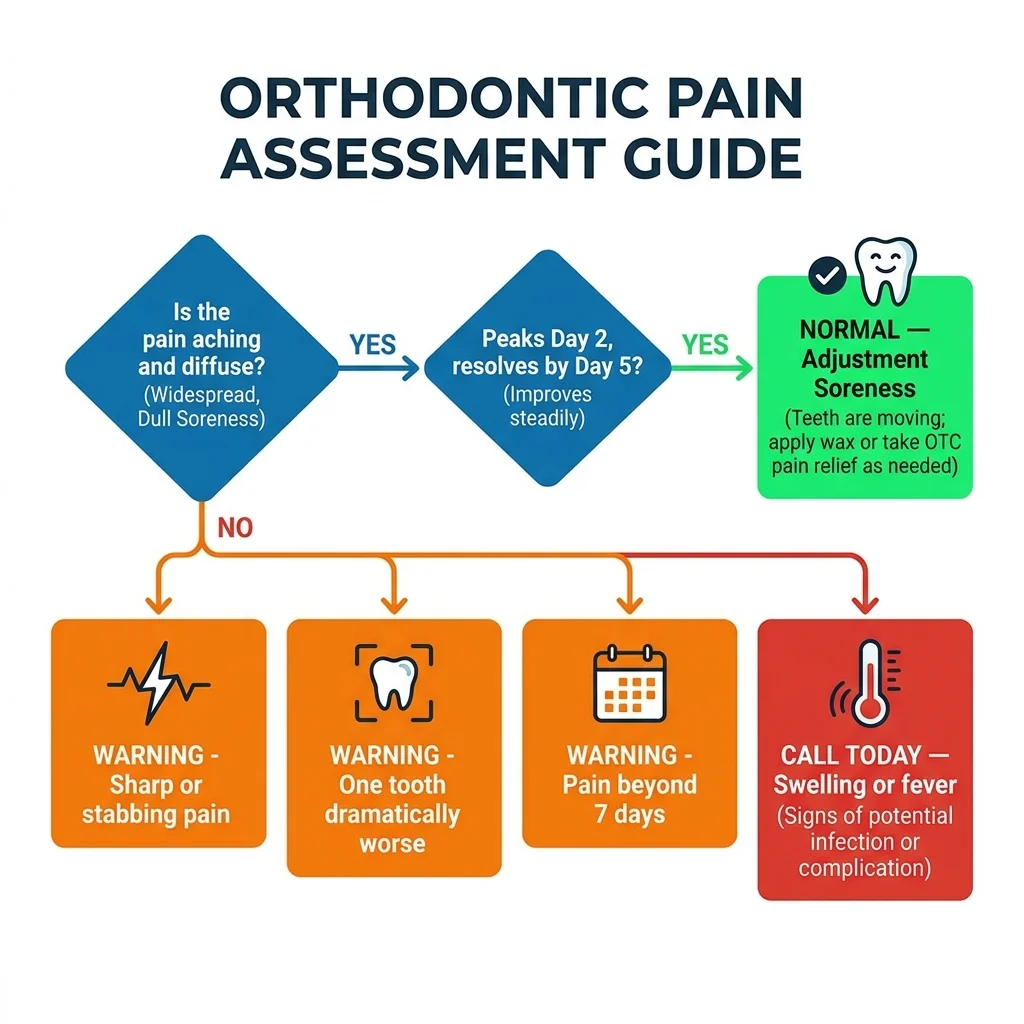
You should call your orthodontist if braces pain persists beyond 7 days, affects a single isolated tooth with sharp stabbing pain, or is accompanied by gum swelling, fever, or a severe poked cheek wound.
Frequently Asked Questions
Why do braces hurt so much?
Brace pain comes from inflammation in the dental ligament (PDL) — the fibrous connective tissue that anchors each tooth root to the surrounding bone. When the arch wire presses against the bracket, it compresses the PDL on the stress side and stretches it on the other. The compressed side triggers an inflammatory cascade: blood vessels dilate, inflammatory mediators accumulate, and osteoclasts begin dissolving bone to allow tooth movement. This infection is what causes the throbbing, aching pain.
Is braces pain normal?
Yes — discomfort after adjustment is a reliable indication that the wire is doing its job. Patients who document no pain at all after adjustment may not receive adequate strength from their archwire. Moderate discomfort (peaks Day 2, resolves by Day 4–5) is common. Intense, sharp, or stabbing pain that does not clear up after 5–7 days warrants calling the orthodontist.
Do braces ever stop hurting?
Yes — the soreness peaks at each adjustment and resolves 3–5 days later. After the initial bonding, many patients report their worst soreness. Early adjustments are often more uncomfortable because the wires are moving teeth the greatest distances. As teeth approach their final positions later in treatment, adjustment soreness decreases significantly — many patients in their final months report only mild sensitivity for 24 hours.
Why do braces hurt more some times than others?
Several factors: switching to a thicker wire applies more force; adding a power chain puts both archwire force and closing force simultaneously on teeth; elastics add bite-correction force on top; longer gaps between appointments mean more work needed at each visit; starting a new stage involves force mechanics the teeth haven't yet adapted to.
Does braces pain ever mean something is wrong?
Normal soreness is diffuse — general achiness across multiple teeth, peaking Day 2, resolving by Day 4–5. Warning signs: a single tooth dramatically more painful than the others, sharp stabbing pain rather than aching, pain that does not resolve after 7 days, or swelling and fever. These require evaluation.