Do Braces Fix an Underbite? (When They Work and When Surgery Is Needed)
Quick Answer
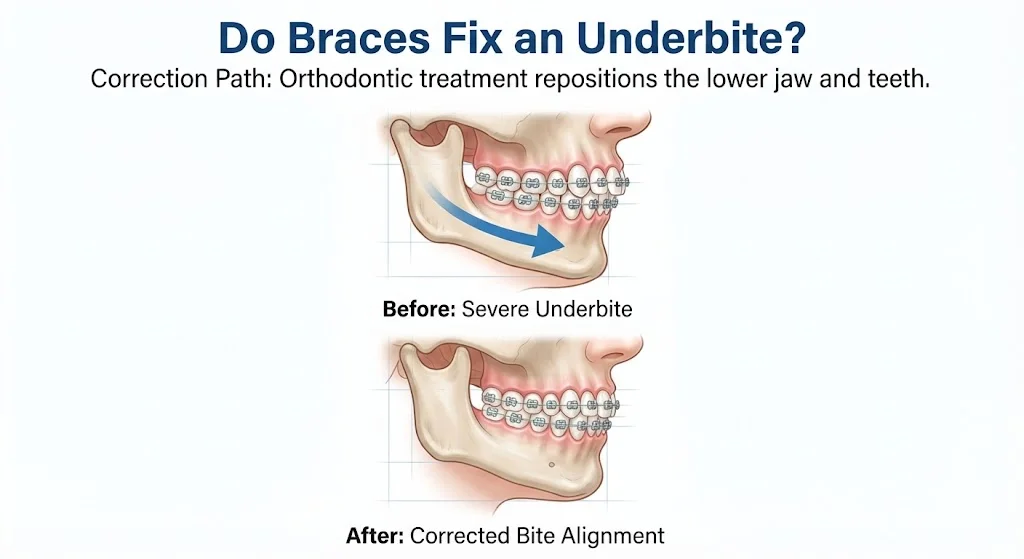
Braces can fix mild dental underbites where the lower front teeth sit in front of the upper front teeth due to tooth positioning. Moderate to severe underbites — especially those caused by a lower jaw that has grown too large or an upper jaw that is too small — are much harder to treat with braces alone. In children and adolescents, growth modification appliances (reverse pull headgear, palatal expanders) can redirect jaw growth. In adults with significant skeletal underbites, orthognathic surgery is usually required for full correction. Underbites are among the most difficult bite problems to treat — and the earlier they are caught, the better the outcome.
Part of our Results & Facial Changes Guide. Also see: Do Braces Fix an Overbite?
What Is an Underbite?
An underbite (Class III malocclusion) occurs when lower front teeth overlap in front of upper front teeth upon closure. Dental underbites stem from misaligned teeth, while skeletal underbites involve a larger lower jaw bone.
An underbite (Class III malocclusion) occurs when the lower front teeth sit in front of the upper front teeth when the mouth is closed. In a normal bite, the upper teeth slightly overlap the lower front teeth. In an underbite, this relationship is reversed.
- Mild: Only a few millimeters of reverse overlap; often dental in origin
- Moderate: More significant reverse overlap; may be dental or skeletal
- Severe: Significant jaw size discrepancy; typically skeletal; visible as a prominent lower jaw in the facial profile
Why Underbites Are Harder to Fix Than Overbites
Underbites are harder to correct because the lower jaw continues to grow longer than the upper jaw throughout puberty. Moving teeth with braces cannot reshape an overdeveloped adult mandibular bone without surgery.
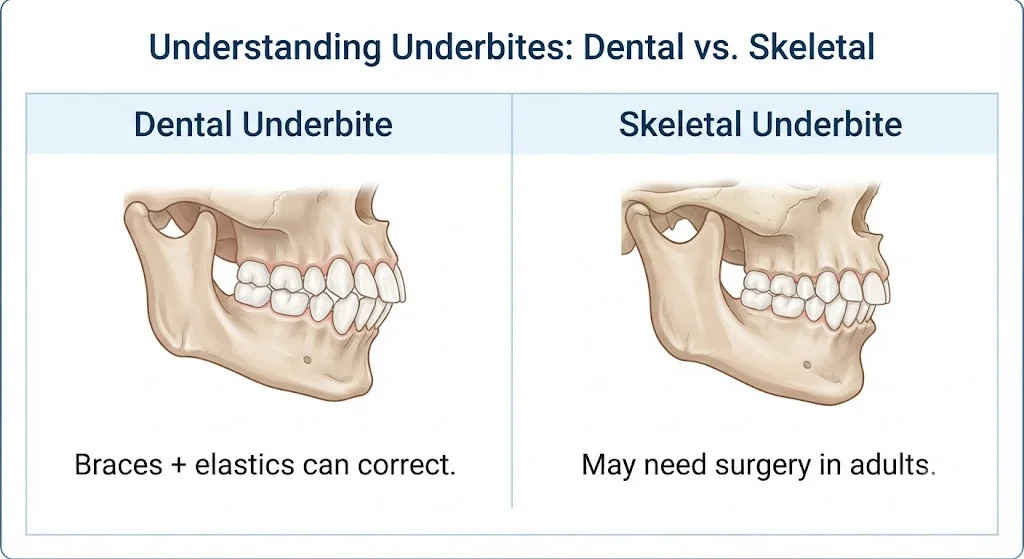
Underbites are more challenging to treat than overbites for two main reasons:
- The skeletal component is more common: Many underbites have a significant skeletal issue — the lower jaw has grown larger than the upper jaw. Braces move teeth, not bone.
- The lower jaw continues to grow: The mandible (lower jaw) grows later and longer than the maxilla (upper jaw). An underbite that appears manageable at age 12 can worsen considerably as the lower jaw continues growing until age 16–18.
Treatment for Growing Patients
Early underbite intervention in growing children uses reverse-pull headgear and palatal expanders to pull the upper jaw forward. Growth modification harnesses active sutures to correct skeletal discrepancies before age 10.
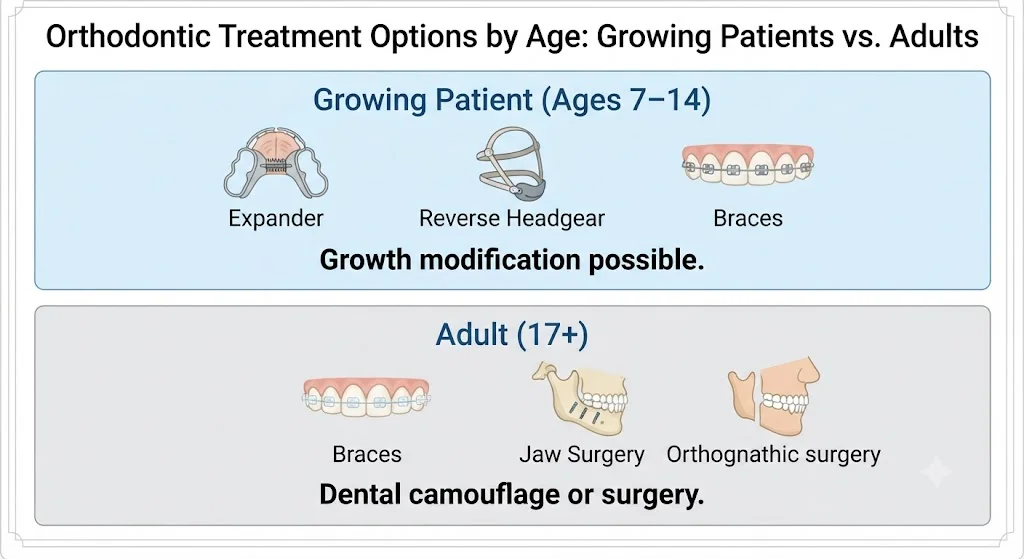
In growing patients (roughly ages 7–14), the skeletal component of an underbite can sometimes be addressed non-surgically:
- Palatal expander: Widens the upper jaw by gradually separating the palatal suture. Most effective in younger patients before the suture fuses (typically mid-teens).
- Reverse Pull (Protraction) Headgear: A face mask with hooks that connect to braces and pull the upper jaw forward while restraining the lower jaw. Most effective under age 10.
- Class III elastics: Rubber bands pulling the upper arch forward and the lower arch backward. Used alongside full braces to address mild jaw discrepancy.
Treatment for Adults
Adult underbite treatment relies on dental camouflage (tipping front teeth into alignment) for mild cases or orthognathic surgery for severe skeletal jaw mismatch. Braces realign teeth before and after surgical jaw repositioning.
In adults, the bones of the jaw are fully fused and cannot be redirected with appliances. Options depend on severity:
Dental Camouflage
For mild to moderate skeletal underbites, the orthodontist tips the upper teeth forward and the lower teeth backward to compensate for the jaw discrepancy. This has limits — tooth positions have a finite range before stability is compromised.
Orthognathic Surgery
For significant skeletal underbites, jaw surgery repositions the lower jaw (setback), upper jaw (advancement), or both. Braces are worn 12–18 months before surgery to prepare teeth for their post-surgical positions, then 6–12 months after for final finishing.
Frequently Asked Questions
Can braces fix an underbite?
Braces can fix mild dental underbites — where the lower teeth sit in front of upper teeth due to tooth angulation rather than jaw size. For moderate to severe skeletal underbites, braces alone are not sufficient. Growing patients benefit from palatal expanders and reverse-pull headgear to redirect jaw growth. Adults with jaw discrepancies typically need jaw surgery.
At what age should an underbite be treated?
Early treatment gives the best outcomes. Phase 1 treatment can begin as early as age 7–9 for skeletal underbites — when the palatal suture is still open and the jaw is still growing and can be redirected. Untreated underbites worsen as the lower jaw continues growing through adolescence.
What causes an underbite?
Two causes: (1) Dental — the lower front teeth are angled too far forward, or the upper front teeth tilt backward; braces can correct this. (2) Skeletal — the lower jaw has grown disproportionately large relative to the upper jaw, or the upper jaw is too small. Skeletal underbites are largely genetic and associated with a prominent lower jaw and a concave facial profile.
Do rubber bands fix underbites?
Class III elastics can help correct mild to moderate underbites by pulling the upper arch forward and the lower arch backward. They work best in growing patients and for dental underbites. They are not sufficient for significant skeletal underbites in adults, where jaw surgery is needed to change the underlying jaw positions.
Can adults fix an underbite without surgery?
For mild dental underbites, yes — braces with Class III elastics can achieve meaningful correction at any age. For moderate cases, dental camouflage can mask the discrepancy. For severe skeletal underbites causing functional problems like difficulty chewing or facial imbalance, orthognathic surgery is the most effective long-term solution.