Do Braces Fix a Crossbite? (Anterior and Posterior — What Treatment Looks Like)
Quick Answer
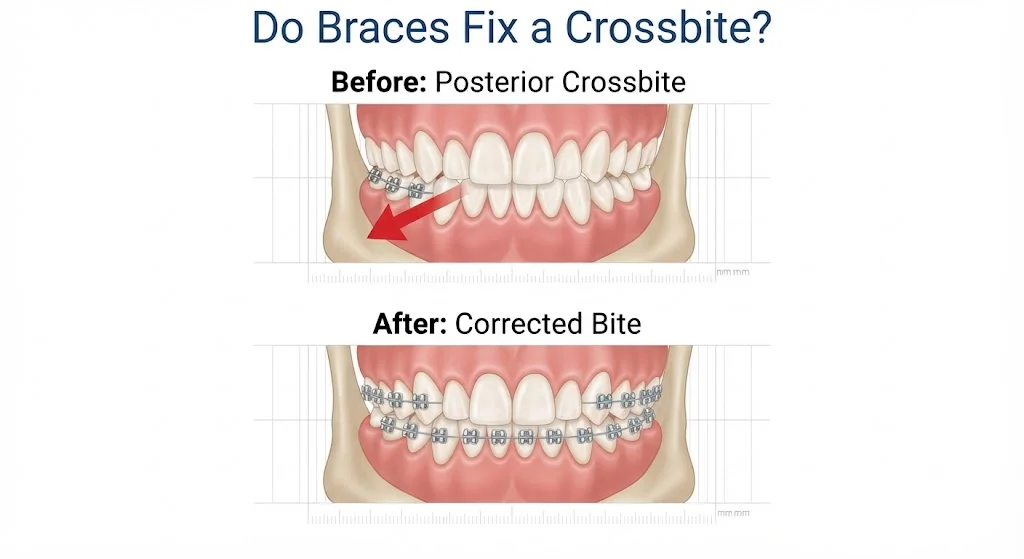
Yes — braces can fix most crossbites. A posterior crossbite (where upper back teeth bite inside the lower back teeth) almost always requires a palatal expander first to widen the upper arch, followed by braces for final tooth positioning. An anterior crossbite (where front teeth are reversed) can often be corrected with braces alone, especially in children. Crossbites must be treated — they do not resolve on their own and worsen over time, causing jaw asymmetry, TMJ damage, and gum recession if left untreated.
Part of our Results & Facial Changes Guide. Also see: What Age Should Kids Get Braces?
What Is a Crossbite?
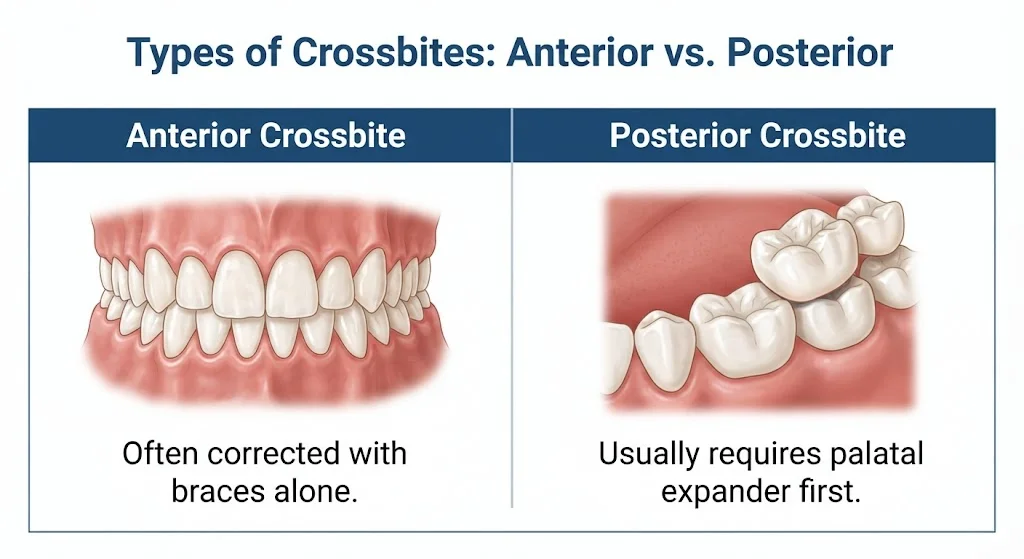
A crossbite is a bite misalignment where upper teeth sit inside the lower teeth rather than overlapping outside. Posterior crossbites affect back teeth, while anterior crossbites affect front teeth.
A crossbite is a bite misalignment where upper teeth fit inside (rather than outside) the lower teeth. In a correct bite, the upper teeth slightly overlap the lower teeth all the way around. In a crossbite, this relationship is reversed for one or more teeth.
Posterior Crossbite
Upper back teeth (premolars and/or molars) bite inside the lower back teeth. Usually caused by a narrow upper arch. Can be unilateral (one side) or bilateral (both sides). Almost always requires a palatal expander.
Anterior Crossbite
Front teeth (incisors) sit behind the lower front teeth when biting. May be dental (teeth angled incorrectly) or skeletal (lower jaw too far forward). Often correctable with braces alone when caught early.
Why Crossbites Must Be Treated Early
Crossbites require early treatment to prevent permanent facial asymmetry caused by habitual jaw shifting. Untreated crossbites also cause uneven enamel wear and localized gum recession.
Crossbites are among the bite problems that orthodontists most strongly recommend treating in children, often as an early Phase 1 intervention. Two consequences drive this urgency:
- Jaw shift and asymmetry: With a unilateral posterior crossbite, the jaw habitually shifts to one side to find a comfortable bite position. Over time, this repeated shifting causes the jaw musculature and joints to adapt asymmetrically. In developing patients, one side of the jaw can grow more than the other — creating visible facial asymmetry. Early correction prevents this.
- Progressive gum damage: Teeth in crossbite experience abnormal lateral forces. Over time, these forces wear enamel and cause gum tissue to recede on the affected teeth. This damage accumulates for as long as the crossbite persists and cannot be reversed.
Posterior Crossbite: The Role of the Palatal Expander
Posterior crossbites require palatal expanders in children to widen the narrow upper jaw suture before full braces are applied. Expanding the palate before suture fusion resolves crossbites non-surgically.
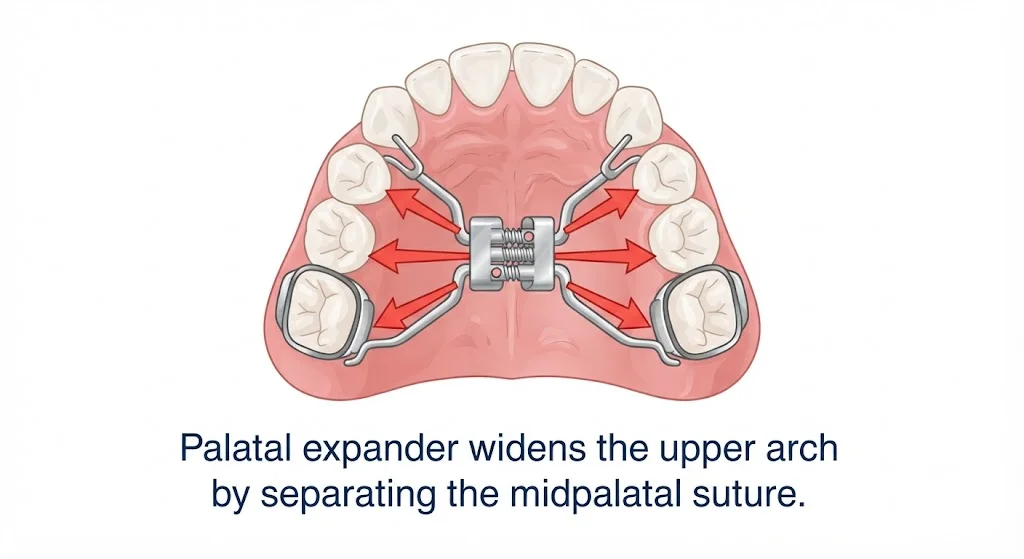
A palatal expander widens the upper jaw by gradually separating the two halves of the palate along the midpalatal suture. Two bands are cemented to the upper back teeth, and a screw mechanism sits in the center of the palate. The patient or parent turns the screw a small increment each day, applying gentle continuous force that separates the suture.
Why timing matters: In children, the midpalatal suture is not yet fused and separates readily. As patients approach the late teens (typically ages 14–16 for girls, 16–18 for boys), the suture calcifies and fuses. Once fully fused, conventional expansion is not possible without surgical assistance.
The expansion process:
- Active expansion (2–3 months): Screw is turned daily until the arch is wide enough to correct the crossbite
- Retention (3–6 months): Expander remains in place while new bone fills in the separated suture gap
- Braces: After the expander is removed, full braces complete alignment and bite correction
A common visible sign that expansion is working: a small gap opens between the two upper front teeth as the midpalatal suture separates. This closes on its own once expansion stops and is not a cause for concern.
Anterior Crossbite Treatment
Anterior crossbites affecting front teeth are corrected using archwire torque and elastics to push upper front teeth forward over lower teeth. Early intervention prevents chipped incisors and jaw strain.
An anterior crossbite affecting one or two front teeth is often straightforward to correct with braces alone. If the crossbite is dental in origin (specific teeth angled incorrectly), the orthodontist applies torque through the archwire to tip that tooth forward into correct position. This often resolves within the first few months of treatment.
A more significant anterior crossbite with a skeletal component is treated like an underbite — with functional appliances in growing patients or jaw surgery in adults with severe discrepancies.
Frequently Asked Questions
Can braces fix a crossbite?
Yes — braces are part of treatment for most crossbites. Anterior crossbites (front teeth in crossbite) can often be corrected with braces using reverse torque through the archwire. Posterior crossbites (back teeth in crossbite due to a narrow upper arch) usually require a palatal expander before or alongside braces. Adults with skeletal crossbites may need surgical assistance, though dental camouflage is sometimes possible.
What happens if a crossbite is left untreated?
Crossbites do not resolve on their own — they get worse. Consequences include: (1) Facial asymmetry from habitual jaw shifting. (2) TMJ problems from abnormal bite forces. (3) Progressive gum recession and enamel wear on teeth in crossbite. Early treatment prevents all of these.
What is the difference between an anterior and posterior crossbite?
An anterior crossbite occurs at the front of the mouth — upper front teeth sit behind the lower front teeth. A posterior crossbite occurs at the back — upper back teeth (molars or premolars) bite inside the lower back teeth, usually due to a narrow upper arch. Both require treatment but use different approaches.
Does fixing a crossbite require surgery?
For most patients, no. Children and adolescents can have posterior crossbites corrected with a palatal expander and braces without surgery. Adults with fully fused palatal sutures may require MARPE (miniscrew-assisted rapid palatal expansion) or surgical expansion (SARPE). Anterior crossbites rarely require surgery unless there is a significant skeletal discrepancy.
How long does crossbite correction take?
A palatal expander is typically worn for 6–12 months — active expansion followed by retention for bone to fill in. Full braces treatment then takes 18–24 months. Anterior crossbite correction with braces alone is often accomplished within the normal treatment timeline without adding significant additional time.