
Do Braces Close Gaps in Teeth? (Which Gaps Close and How Long It Takes)
Quick Answer
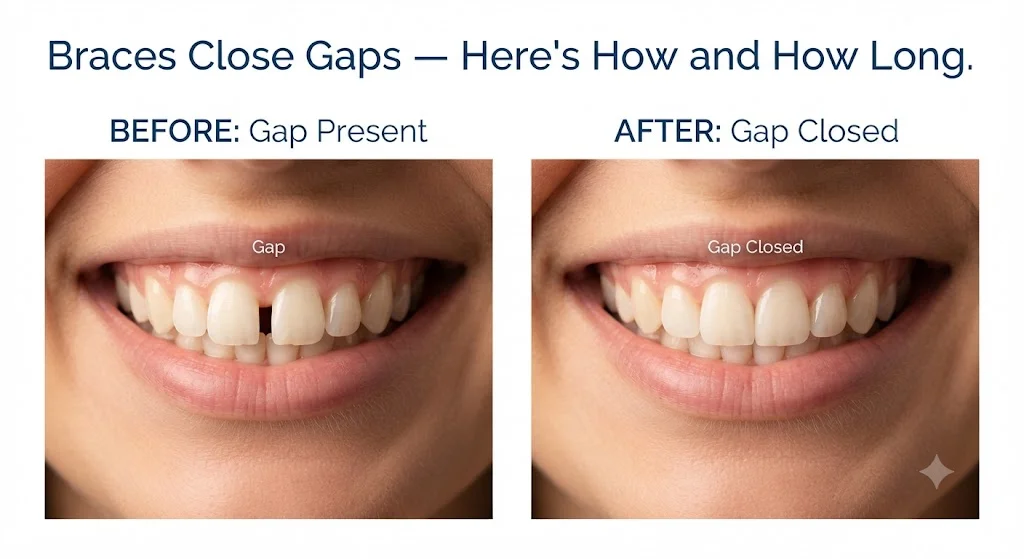
Yes — braces are very effective at closing gaps in teeth (diastemas). The archwire applies continuous closing force to spaces between teeth, sliding them together over time. Small gaps (1–2 mm) usually close within 6–9 months. Larger gaps, or gaps due to a prominent labial frenum (tissue connecting upper lip and gum between front teeth), take longer and may require minor surgery (frenectomy) to prevent reopening. Gaps from missing teeth are handled differently — the space is either closed by moving adjacent teeth together, or held open for a future dental implant.
Part of our Results & Facial Changes Guide. Also see: What Happens If You Stop Wearing Your Retainer?
How Braces Close Gaps
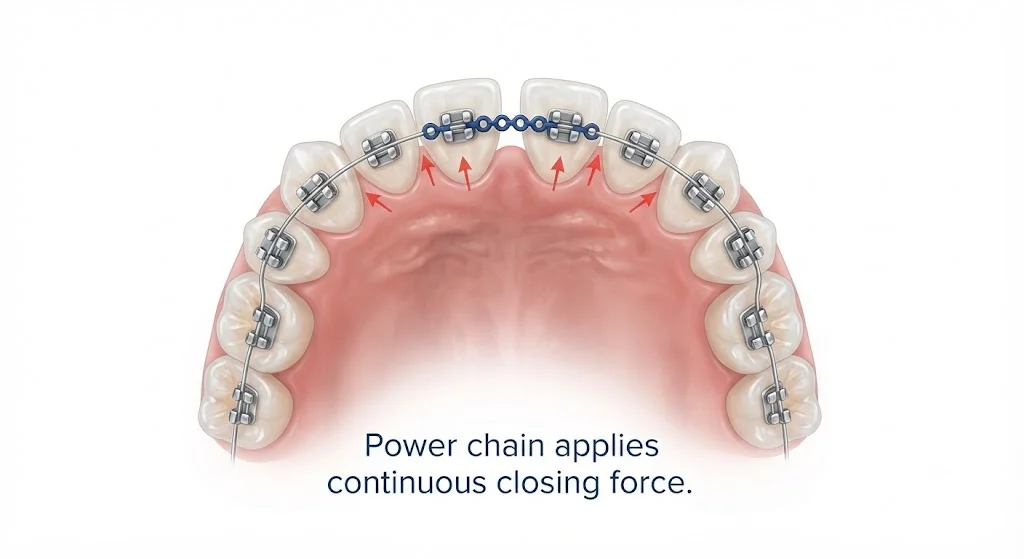
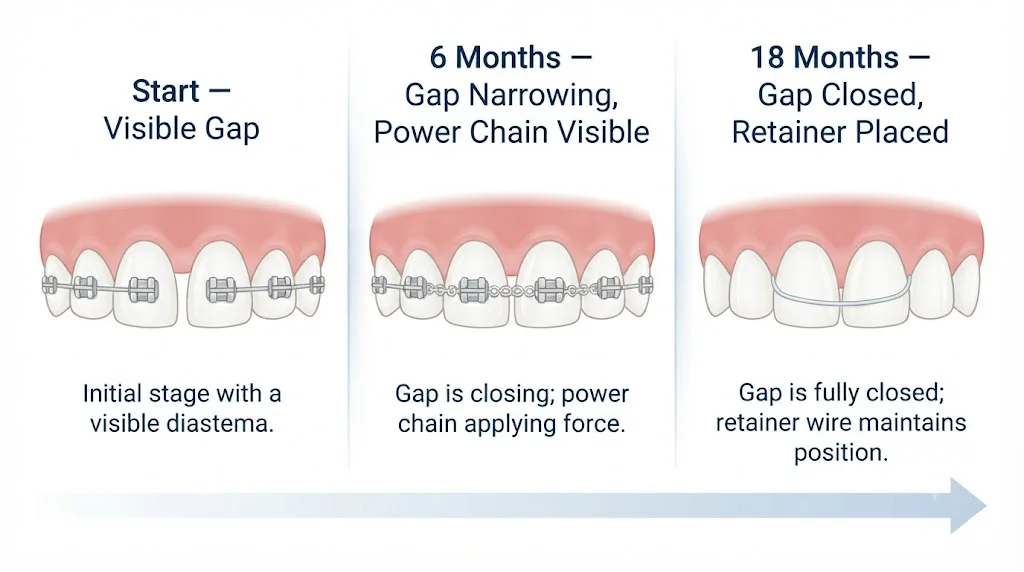
Braces close dental gaps by guiding teeth along the archwire using power chains or closing loops. Continuous elastic tension slides adjacent teeth together over a 6-to-18-month timeframe.
The archwire in braces acts as a track. Each bracket has a slot the wire threads through. As the wire engages the brackets, it applies force to slide each tooth into alignment. For gap closure, orthodontists use two primary tools:
Power Chains
Continuous elastic links that stretch across a gap and apply constant closing force between brackets. The most common tool for closing spaces — replaced at each adjustment appointment as they lose elasticity and force.
Closing Loops
Bends in the archwire itself that act as springs, generating closing force directly in the wire without relying on elastics. Used for more precise gap closure in complex cases where controlled force is critical.
Types of Gaps and How They Close
Midline diastemas, generalized spacing, and extraction spaces close predictably using targeted orthodontic mechanics. Large gaps or space created by missing teeth may require space maintenance for implants.
- Midline diastema (gap between upper front teeth): Very common and closes predictably with braces. The main consideration is the labial frenum — if it inserts deep between the teeth, a frenectomy may be needed to prevent relapse.
- Spacing throughout the arch: Some patients have small gaps between many teeth due to naturally smaller teeth relative to jaw size. Braces distribute the spacing evenly, then close all spaces simultaneously.
- Post-extraction spaces: When teeth are extracted to create space for front tooth retraction, the resulting gap is deliberately closed by sliding adjacent teeth together.
- Space from missing teeth: Requires coordination with a restorative dentist. The decision to close or maintain the space depends on which tooth is missing and the size of adjacent teeth.
The Labial Frenum and Midline Gaps
Midline front tooth gaps caused by a prominent labial frenum require gap closure with braces followed by a minor frenectomy. Performing the frenectomy after gap closure prevents scar tissue from blocking tooth movement.
A prominent labial frenum can physically hold the two front teeth apart. Braces close the gap, but if the frenum is not addressed, it can reopen. The standard approach:
- Close the gap with braces first
- After the gap is nearly closed, perform a frenectomy
- Complete final stages of treatment
- Wear a fixed retainer behind the front teeth indefinitely to maintain closure
The frenectomy is done after gap closure — not before — because operating first can create scar tissue that makes tooth movement harder.
Frequently Asked Questions
Can braces close gaps between teeth?
Yes — closing gaps is one of the most straightforward things braces do. The archwire acts as a track, and with power chains or closing loops the orthodontist slides teeth together to close each space. Small gaps (less than 2 mm) close quickly. Larger gaps or gaps associated with a prominent frenum may take the full treatment length and may require a frenectomy for stable long-term closure.
How long does it take for braces to close a gap?
Small gaps (1–2 mm) are generally closed within 6–9 months. Larger gaps — 3 mm or more — usually take the full 18–24 month treatment period. Gap closure speed depends on the size of the gap, bone density, and the tools used. Power chains close gaps faster than standard archwire alone.
Do braces close a gap between front teeth (diastema)?
Yes — midline diastema (the gap between the two upper front teeth) closes very predictably with braces. The key consideration is the labial frenum. If it inserts deeply between the teeth, it can cause the gap to reopen after braces. A frenectomy is typically done after gap closure to prevent this.
Can braces close a gap from a missing tooth?
It depends on the treatment plan. Option 1: Space closure — adjacent teeth are slid into the gap. Works best when a premolar or canine is missing. Option 2: Space maintenance — the gap is held open while awaiting a dental implant or bridge. Preferred for missing front teeth where adjacent teeth are correctly sized. Your orthodontist and general dentist coordinate which approach fits your anatomy.
Will gaps come back after braces?
They can, if retainers are not worn consistently. Teeth have a natural tendency to drift back toward their original positions without retainer support. Most orthodontists recommend a permanent retainer bonded behind the front teeth after gap closure — especially for large or frenum-related gaps — to maintain the result long-term.