Do Braces Fix an Overbite? (What to Expect and How Long It Takes)
Quick Answer
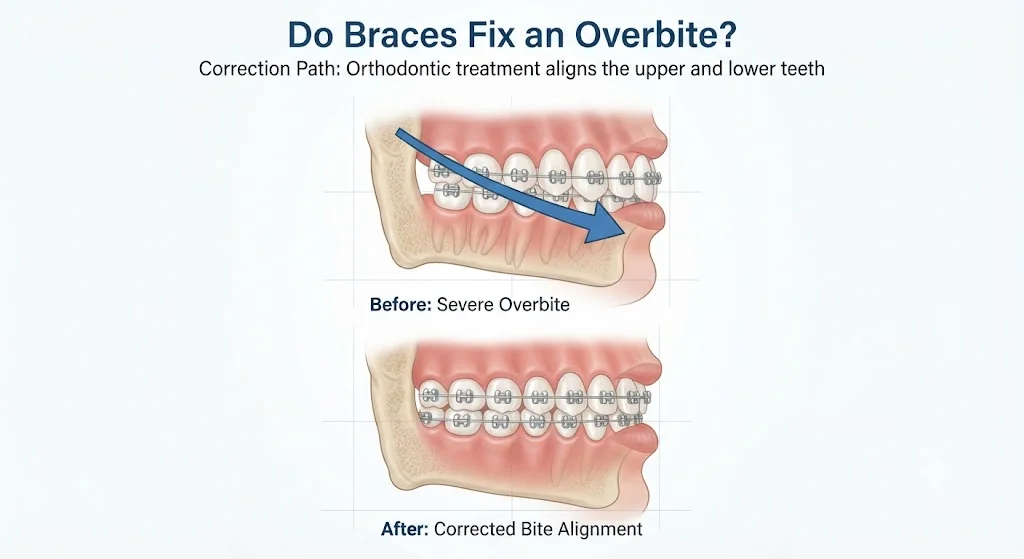
Yes — braces can fix most overbites. A dental overbite (where the upper front teeth stick out due to tooth positioning) is corrected very effectively with braces alone, usually within the normal treatment timeline of 18–24 months. A skeletal overbite (where the upper jaw is too large or the lower jaw is too small) requires additional appliances — rubber bands, a Herbst appliance, or in severe adult cases, jaw surgery — alongside the braces. An overbite of 1–3 mm is normal. Most orthodontists treat overbites over 4–5 mm.
Part of our Results & Facial Changes Guide. Also see: Do Braces Change Your Face Shape?
What Is an Overbite?
An overbite is the vertical overlap of upper front teeth over lower front teeth, with normal overlap measuring 1 to 3 mm. Overbites exceeding 4 mm alter bite function and profile aesthetics, requiring orthodontic intervention.
An overbite is the vertical overlap between the upper and lower front teeth. When you close your mouth normally, the upper front teeth should slightly overlap the lower front teeth — this is normal and necessary for proper biting function. The problem is when this overlap is excessive.
Overbite is measured as a percentage of vertical coverage or in millimeters:
- Normal: 1–3 mm (upper teeth cover about 10–20% of lower teeth)
- Mild: 4–5 mm
- Moderate: 5–7 mm
- Severe/Deep: 7+ mm, or 50–100% vertical coverage of lower teeth
Dental vs. Skeletal Overbite
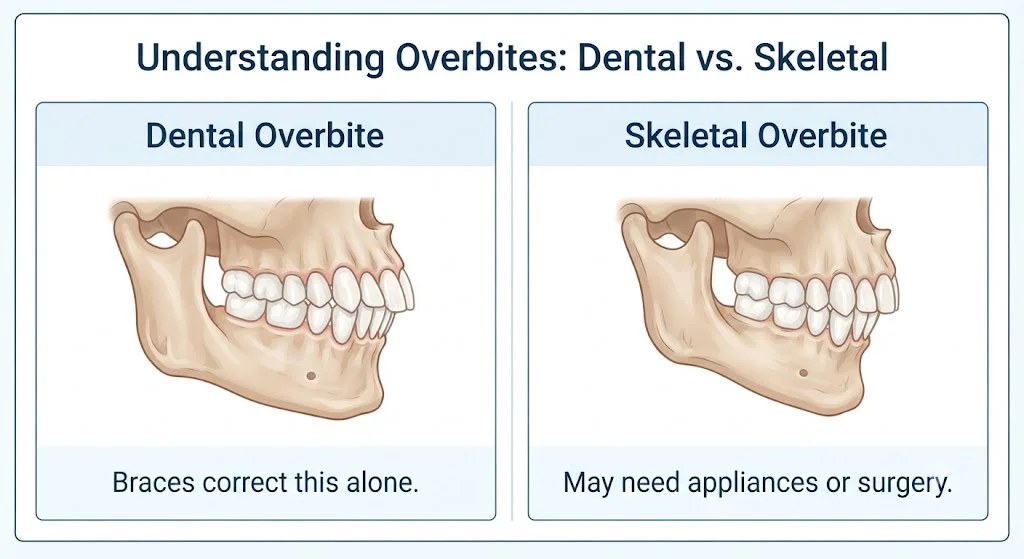
A dental overbite stems from misaligned front teeth and is fully corrected by braces alone. A skeletal overbite is caused by mismatched jaw sizes and requires growth modification appliances in children or surgery in adults.
This distinction determines the entire treatment plan.
Dental Overbite
The jaw bones are normal in size and position, but the teeth themselves are in the wrong place — typically the upper front teeth are tilted (proclined) forward. Braces correct this entirely on their own.
Skeletal Overbite
The jawbone itself is the problem — typically an upper jaw that protrudes too far forward or a lower jaw that is too short or set back. Braces move teeth, not bone. Growing patients may benefit from functional appliances; adults with severe cases may need jaw surgery.
Your orthodontist determines which type you have using a cephalometric X-ray — a side-view head X-ray that shows the positions of each jawbone relative to the other.
How Braces Correct an Overbite
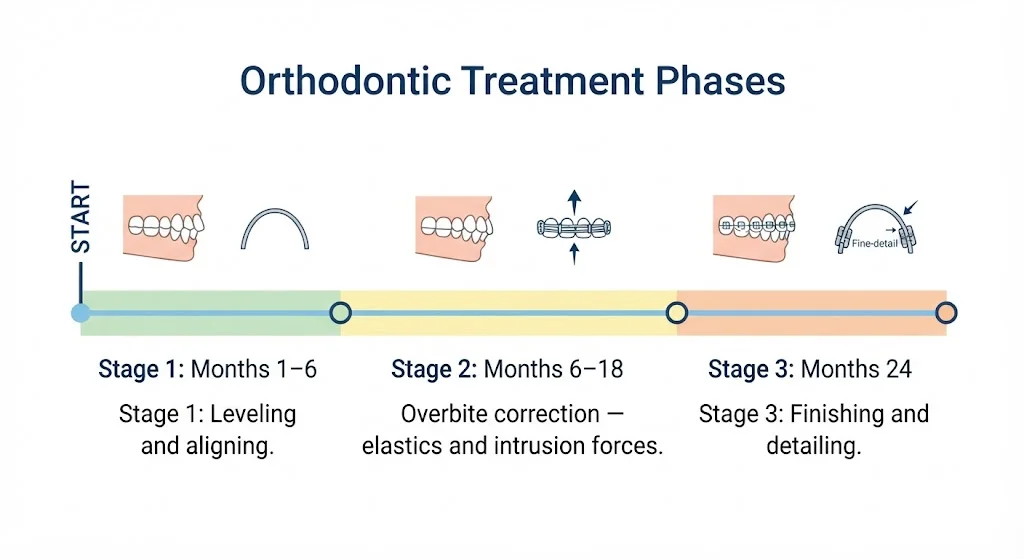
Braces fix overbites during Stage 2 space closure by applying upper front tooth intrusion and Class II elastic forces. Rubber bands pull the upper arch backward while advancing the lower arch into proper alignment.
Overbite correction in braces typically happens in Stage 2 of treatment — after the initial leveling and aligning phase is complete and the archwire is fully engaged.
The main tools used for overbite correction:
- Intrusion and torque: The archwire applies forces that push the upper front teeth backward (retraction) and upward (intrusion) while pulling the lower front teeth forward
- Class II elastics: Rubber bands connecting upper molars to lower canines pull the upper arch backward and the lower arch forward simultaneously
- Bite turbos: Small acrylic pads bonded to the inner surfaces of the upper front teeth that prevent the back teeth from biting together, allowing the back teeth to erupt to their full height — which reduces the deep bite
When Braces Alone Are Not Enough
Braces alone are insufficient for severe adult skeletal overbites, requiring orthognathic surgery to advance the lower jawbone. In growing children, functional appliances like the Herbst or Forsus guide natural jaw development.
For growing patients with moderate skeletal overbites, orthodontists often use functional appliances alongside braces:
- Herbst appliance: A fixed device that holds the lower jaw forward continuously, stimulating forward growth of the lower jaw
- Forsus springs: A fixed spring device connecting upper and lower arches
- Class II elastics: Removable rubber bands (require consistent patient wear)
For adults with severe skeletal overbites, orthognathic surgery (jaw surgery) is the most reliable correction. The lower jaw is surgically advanced into proper position. Braces are worn for 12–18 months before surgery to align teeth to their post-surgical positions, and for 6–12 months after surgery for final finishing.
Frequently Asked Questions
Can braces fix an overbite?
Yes — braces are the primary treatment for dental overbites, where the upper front teeth are in the wrong position rather than the jaw itself being the wrong size. Brackets and wires retract the upper front teeth while the lower teeth advance simultaneously. For skeletal overbites in growing patients, growth modification devices (elastics, Herbst appliance) are used alongside braces. Adults with severe skeletal overbites may require jaw surgery.
How long does it take for braces to fix an overbite?
Overbite correction happens as part of the full treatment timeline — not as a separate phase. Mild dental overbites may show visible improvement within 6–9 months. More significant overbites requiring rubber bands or appliances take the full 18–24 month treatment duration. Overbite correction is typically addressed during Stage 2 (space closure), after initial alignment is complete.
What is considered a severe overbite?
An overbite of 1–3 mm is normal. An overbite of 4–6 mm is mild to moderate and usually treated with braces alone. An overbite greater than 6 mm — where the upper teeth cover more than 50% of the lower teeth — is considered significant. Deep overbites where the upper teeth completely cover the lower teeth are the most difficult to treat and often require additional appliances.
Do rubber bands fix overbites?
Yes — Class II rubber bands (elastics) are the most common tool for overbite correction. They connect from a hook on the upper molar bracket to a hook on the lower canine bracket, applying backward pressure on the upper arch and forward pressure on the lower arch simultaneously. Wearing them as prescribed (22 hours/day) is critical — inconsistent wear is the most common reason overbite correction extends beyond the original timeline.
Can adults get their overbite corrected with braces?
Yes, but with limitations. Adults can correct dental overbites with braces at any age — teeth move in response to sustained force regardless of age. Skeletal overbites are more complicated: growth modification appliances (Herbst, Forsus) only work in growing patients. Adults with significant skeletal overbites may need orthognathic (jaw) surgery to fully correct the discrepancy, with braces worn before and after surgery.