Can You Speed Up Braces Treatment? (What Actually Works)
Quick Answer
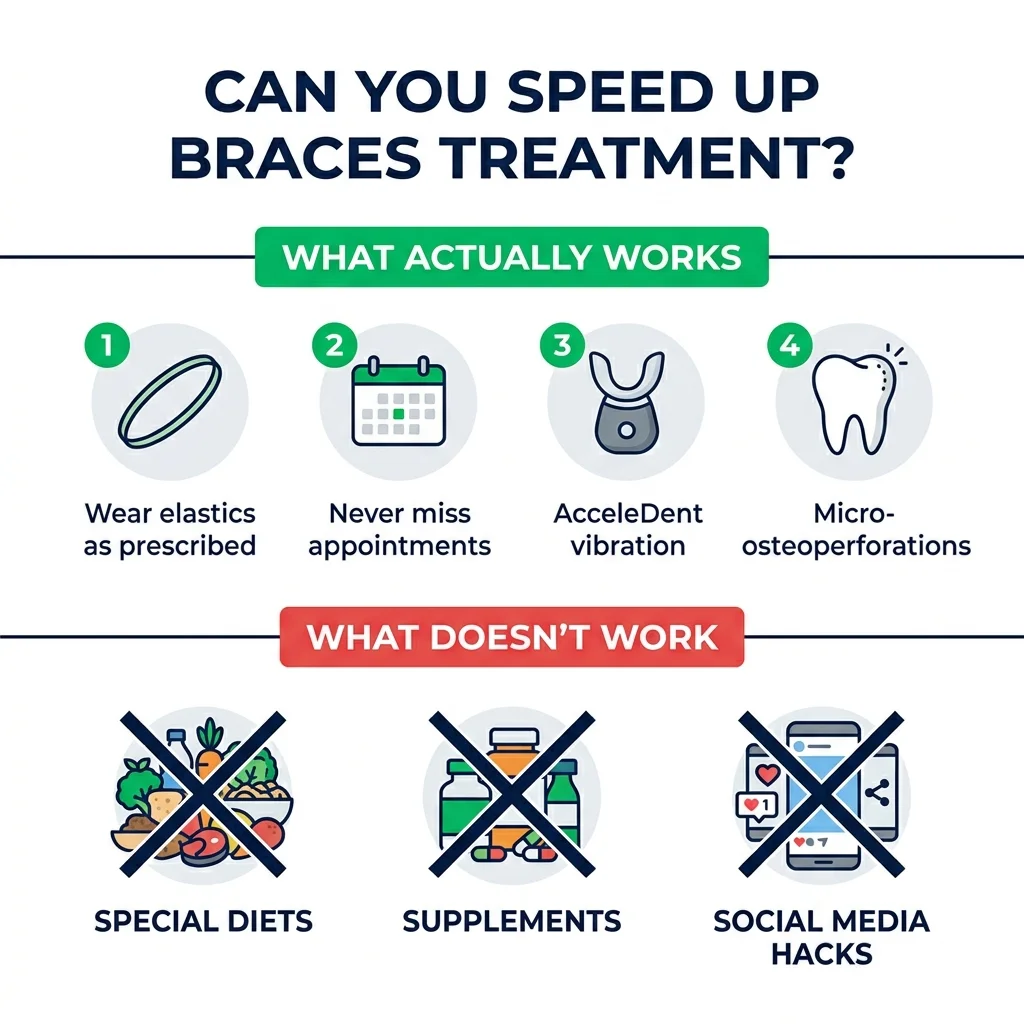
Yes — the approach can be meaningfully shortened, but from weeks to months, no longer using a reduction time in half. Methods with real clinical proof: AcceleDent (vibrating device, reduces treatment time by ~30% in some studies), Propel/micro-osteoperforations (small punctures in bone boost-up rework), and LAPT/low-level laser measures (promising of low-static proportions). One element that each patient completely controls: Sporting elastics as prescribed. Non-compliance of elastic is the single most common purpose treatment is run over the designed timeline. Gimmicks without proof: special diets, dietary supplements, oil pulling, or "signals" on social media.
Part of our Timeline & Process Guide. Also see: How Long Do Braces Take?
The Biology Behind Treatment Speed
Orthodontic tooth movement is limited by bone remodeling — a two-step process where osteoclasts dissolve bone ahead of the moving tooth, and osteoblasts deposit new bone behind it. This process has a natural rate that cannot be pushed infinitely without causing harm (root resorption, bone loss, or relapse). Average safe movement: approximately 1 mm per month.
Acceleration methods work by increasing bone turnover locally — stimulating more osteoclast and osteoblast activity in the area, which allows teeth to move through bone faster without compromising root or bone health.
What Actually Works
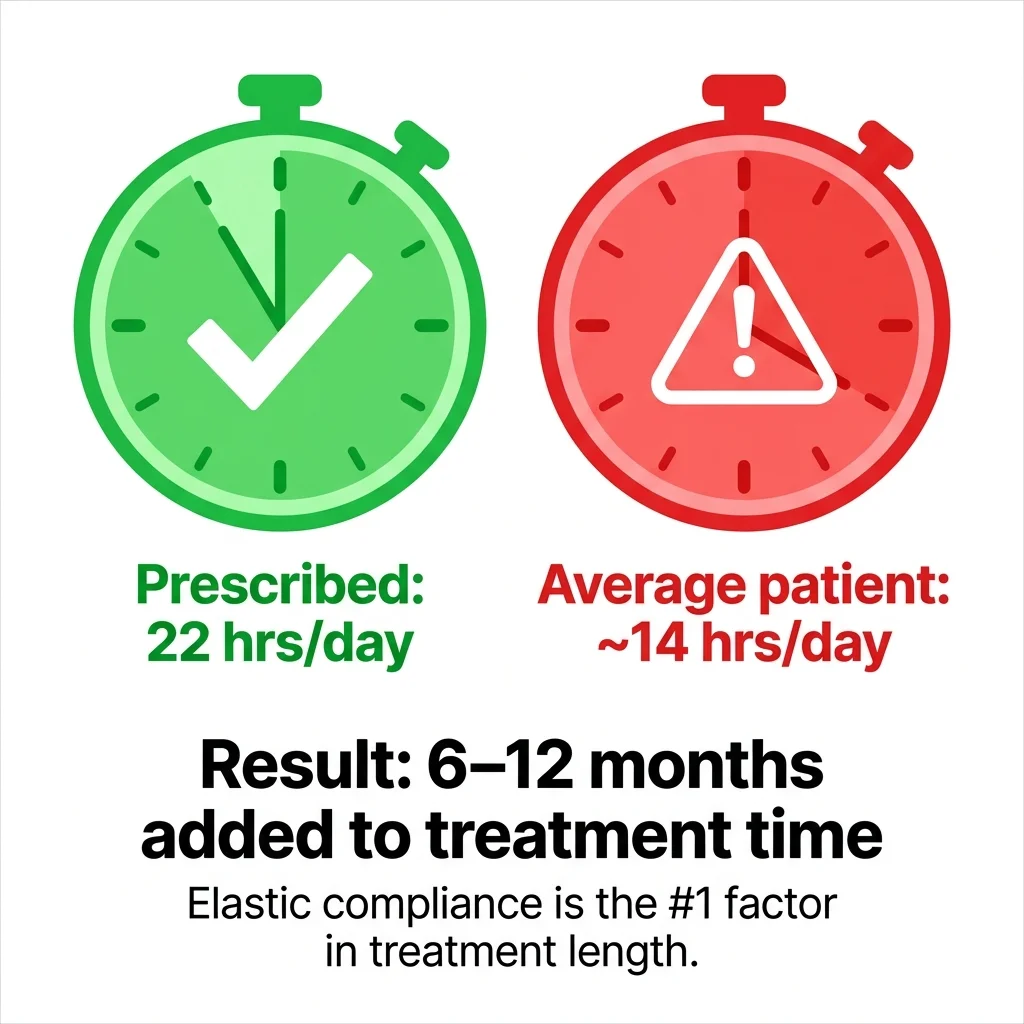
The average patient wearing Class II elastics wears them about 14 hours per day instead of the prescribed 22. This single factor is the most common reason treatment runs 6–12 months over the original estimate. Wearing elastics exactly as prescribed — every hour, every day — is the single most reliable way to stay on or ahead of the treatment timeline.
Each appointment is typically spaced 6–8 weeks apart. Missing one means 6–8 extra weeks before the next wire change. Over an 18-month treatment course, two missed appointments add 3–4 months to total treatment time.
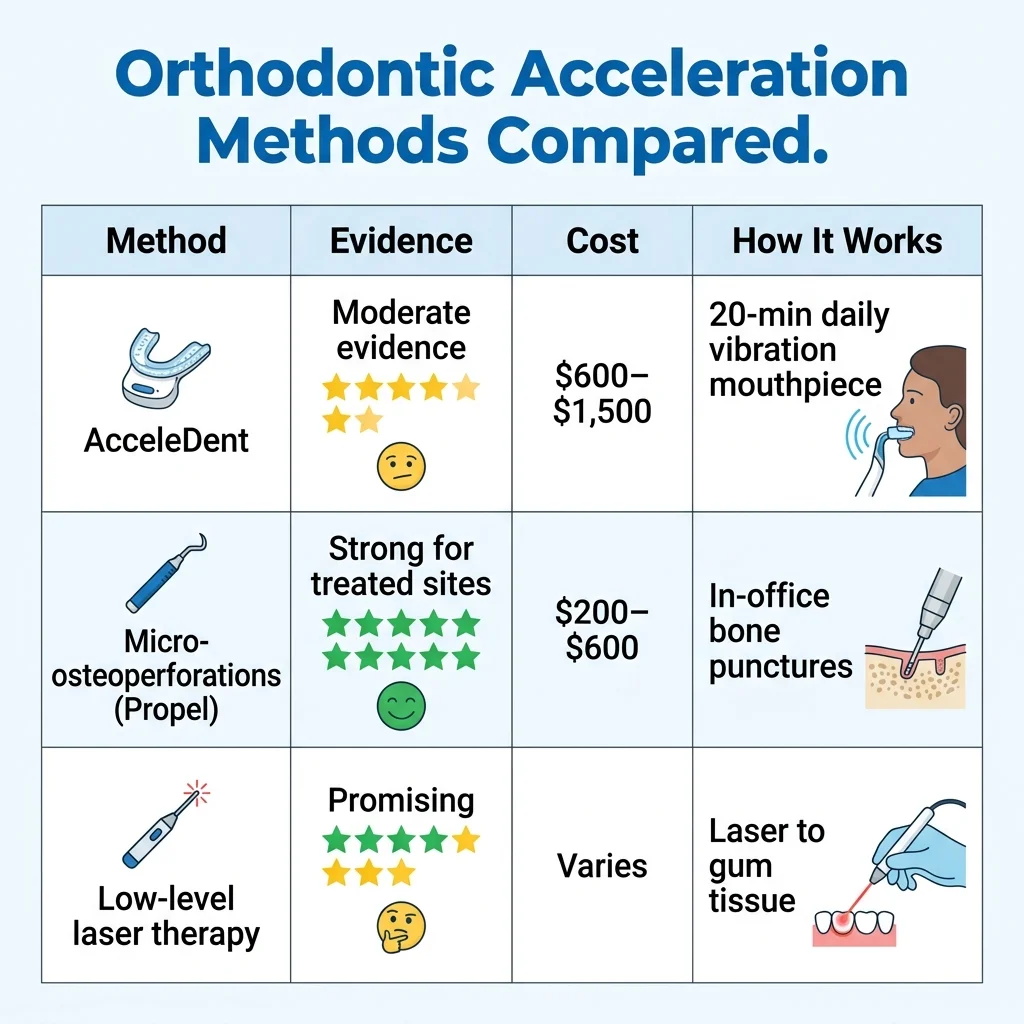
A vibrational mouthpiece worn 20 minutes daily. FDA-cleared, evidence is positive but mixed. Most useful for patients in the active tooth movement phase. Costs $600–$1,500.
Small punctures in bone done in-office, stimulate bone remodeling via regional acceleratory phenomenon. Strongest evidence for acceleration. Best used for specific teeth that are moving slowly. Cost $200–$600 per session.
Laser light applied to the gum tissue overlying moving teeth. Evidence is promising but less consistent than MOPs or AcceleDent. Not widely offered.
Elastic Compliance — The Numbers
What Does Not Work
- Special diets (beyond protecting brackets)
- Supplements claiming to accelerate bone remodeling
- Oil pulling or oral "detox" routines
- Chewing harder to "force" teeth to move faster
- Social media "hacks" involving biting on things or self-adjusting
These have no clinical evidence and some (self-adjusting) actively risk harm.
Frequently Asked Questions
Can you speed up braces treatment?
Yes, to a limited degree. The bone remodeling cycle — which controls how fast teeth can safely move — can be stimulated with certain adjunctive treatments (AcceleDent vibration, micro-osteoperforations, low-level laser therapy). These strategies have been proven in research to reduce treatment time by 20–40% in certain cases. The most reliable acceleration, however, is patient compliance: carrying elastics as prescribed, attending each adjustment appointment on schedule, and skipping bracket fractures from forbidden foods.
Does AcceleDent really work?
AcceleDent is an oral appliance that provides light vibration (SoftPulse era, 0.25 N at 30 Hz) of the enamel for 20 minutes to suit the day. The vibration is supposed to stimulate bone regeneration and accelerate tooth movement. Clinical research shows combined yet generally beneficial results — a few randomized managed trials demonstrate a 30–40% reduction in remedy time; Others do not show statistically detailed differences. It's cleared by the FDA and considered safe. It costs $600–$1,500 and is not included with coverage.
What slows braces treatment down the most?
Three principal reasons: (1) Elastic compliance — Class II or Class III elastics are prescribed for bite correction; skipping or inconsistent wear means the bite does not alternate, and the dentist cannot go through the finishing stage. This is the most common reason treatment runs 6–12 months over the estimate. (2) Broken brackets — each bracket breakage resets treatment progress on that tooth and adds 4–8 weeks. (3) Missed appointments — every missed adjustment appointment is 4–8 weeks of lost treatment time.
Does eating soft foods speed up braces?
No — diet does not speed up treatment. Soft foods are recommended to protect brackets and wires from damage, not to accelerate tooth movement. Eating hard foods risks breaking brackets, which slows treatment down. The diet restriction is about not slowing treatment down, not about speeding it up.
Can micro-osteoperforations (Propel) really shorten treatment?
Micro-osteoperforations (MOPs) are small punctures made in the bone adjacent to specific teeth using a device like Propel. The minor trauma stimulates a regional acceleratory phenomenon (RAP) — an increased bone turnover response in the surrounding area — which temporarily accelerates the rate of tooth movement at that location. Several clinical studies show 30–50% acceleration in tooth movement at treated sites. The procedure is done in the orthodontist's office, takes 5–10 minutes, causes mild soreness for 1–3 days, and costs $200–$600.