
What Is a Power Chain on Braces? (What It Does and Why It Hurts)
Quick Answer
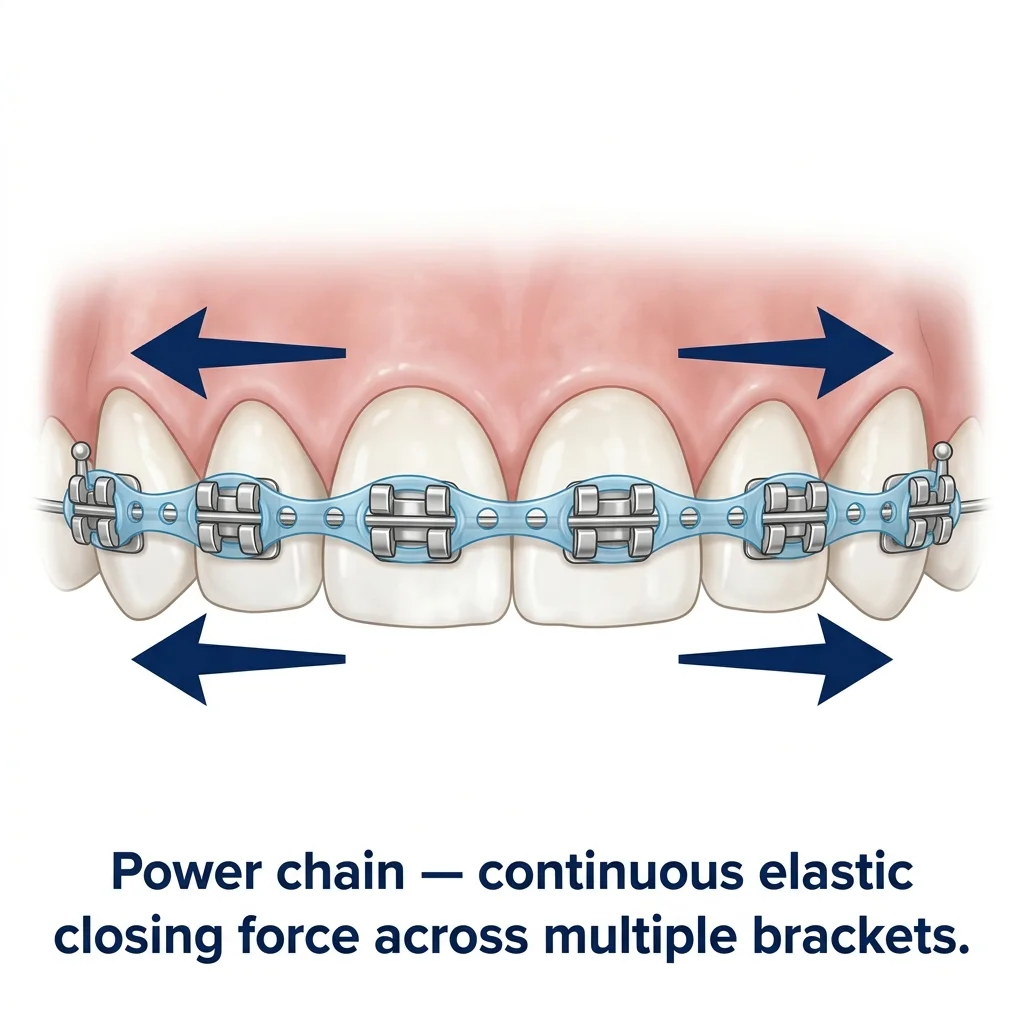
A power chain is a continuous elastic strip — a series of connected rings — that threads across multiple brackets on the archwire. Unlike individual ligature ties (the small colored rings on each bracket), a power chain connects brackets to each other, applying a continuous closing force between them. Power chains are used primarily to close gaps, correct spacing, and rotate teeth that individual wire tension cannot address efficiently. They cause more soreness than regular ligatures because they apply additional closing force on top of the archwire tension. Power chains are replaced at every adjustment appointment because they lose elasticity and force over 4–6 weeks.
Part of our Timeline & Process Guide. Also see: Do Braces Close Gaps in Teeth?
What a Power Chain Looks Like
A power chain is a strip of connected elastic loops — each loop looks like a small ring, and the loops link together in a chain. When placed on braces, each loop sits over one bracket, and the chain pulls the brackets toward each other.
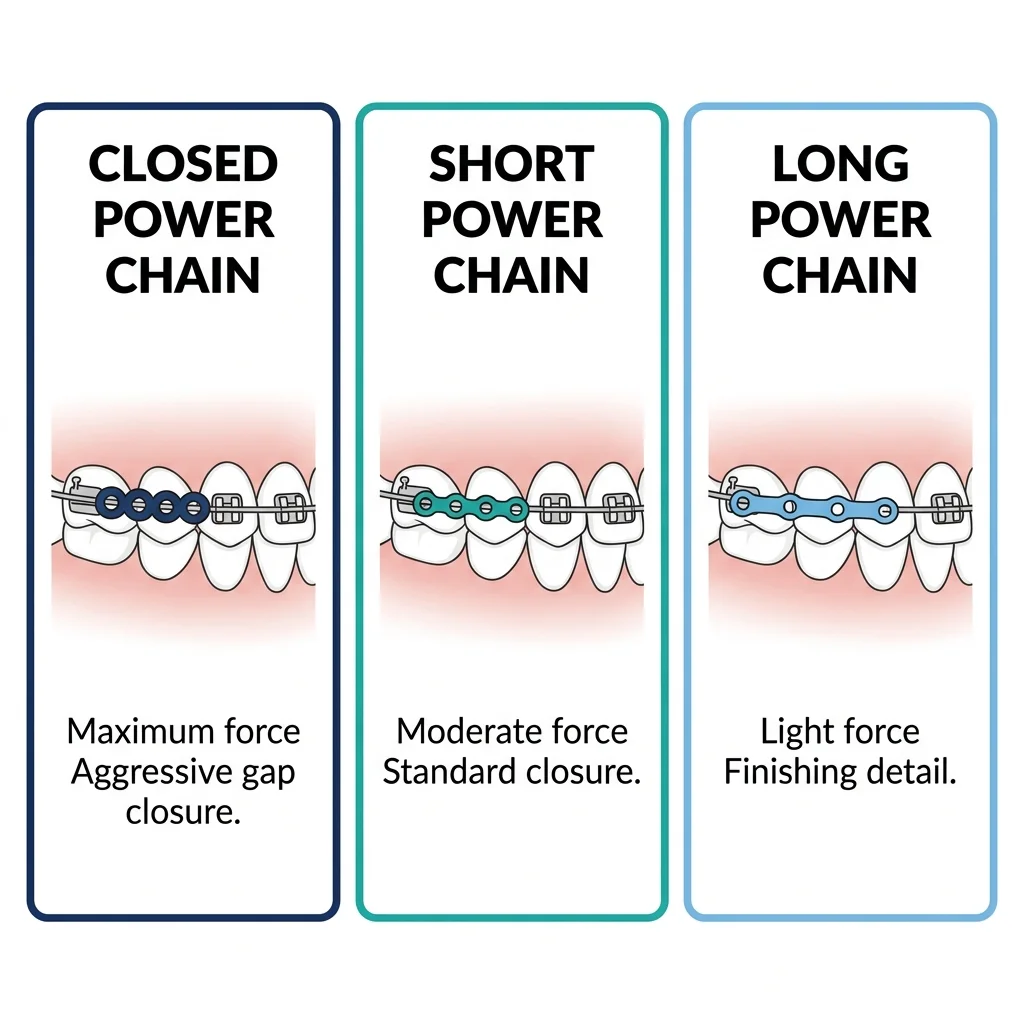
Loops touching — maximum closing force, used for aggressive gap closure
Small gap between loops — moderate force for standard closure
Larger gap between loops — lighter force for fine finishing
How a Power Chain Closes Gaps
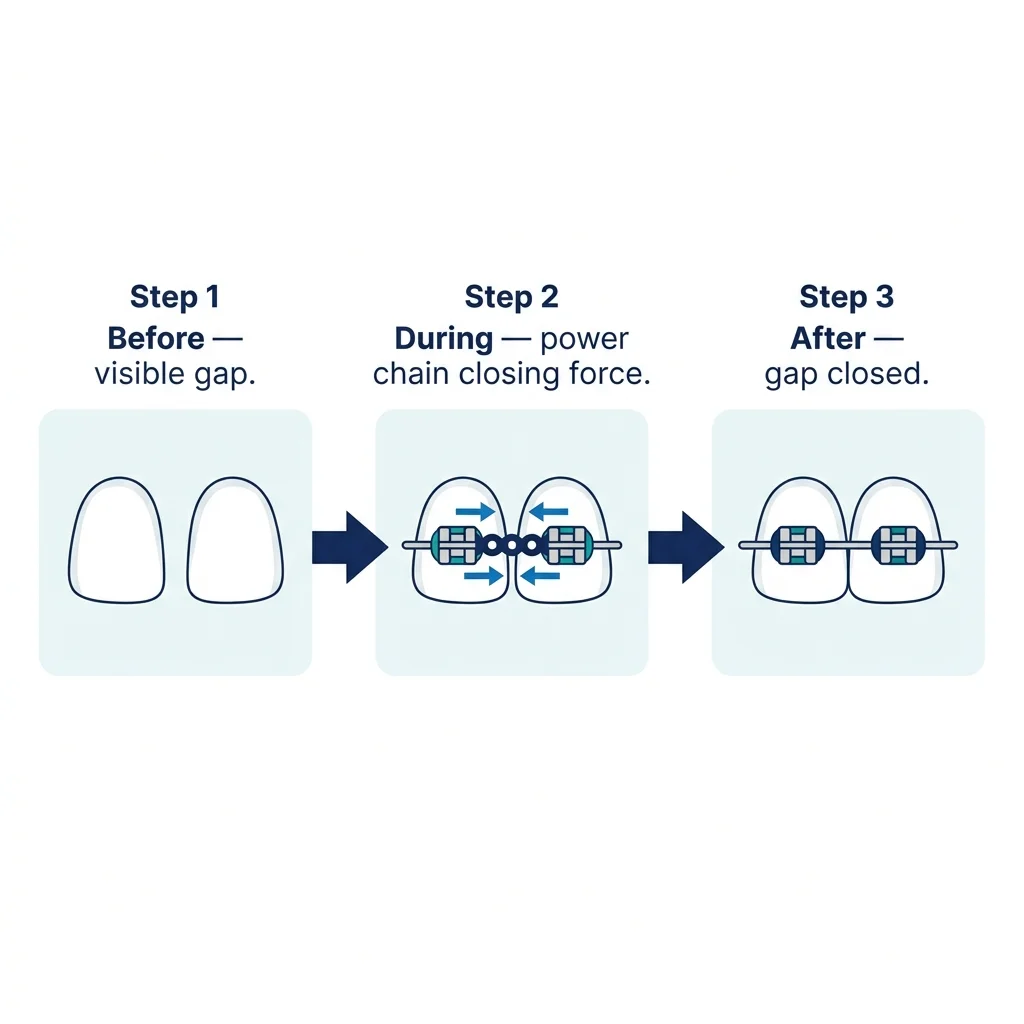
The archwire acts as the track that teeth slide along. The power chain applies the closing force that actually moves the teeth along that track. As each loop of the chain contracts (elastic memory), it pulls adjacent brackets toward each other, sliding the teeth together. As teeth move closer, the chain loops relax slightly and lose force — which is why they are replaced at each appointment with a new chain at full tension.
Why Power Chains Hurt
Two forces are now acting on the teeth simultaneously: the archwire's force (leveling and positioning) and the power chain's force (closing and rotating). More total force means more osteoclast activity in the bone ahead of the moving teeth — which triggers the inflammatory response that causes orthodontic soreness.
The pain pattern:
- Immediately after placement: Mild pressure
- Hours 4–24: Increasing soreness as inflammation builds
- Hours 24–72: Peak soreness (teeth feel tender to bite on)
- Day 4–5: Soreness resolves as the acute inflammatory response settles
Over-the-counter ibuprofen (400–600 mg, 1 hour before the appointment) is the most effective preemptive pain management. Cold foods and drinks help during the acute phase.
Power Chain vs. Ligature Tie
The table below outlines key comparison data and practical guidelines for what is a power chain on braces? (what it does and why it hurts).
| Ligature Tie | Power Chain | |
|---|---|---|
| Connects | Wire to one bracket | Multiple brackets together |
| Primary function | Holds wire in slot | Closes gaps, rotates teeth |
| Force direction | Inward to bracket slot | Horizontal (closing) |
| Replaced | Every adjustment | Every adjustment |
| Soreness | Mild | Moderate to significant |
Note: Data reflects typical clinical guidelines and average provider estimates across standard treatment plans.
Frequently Asked Questions
What does a power chain do on braces?
A power chain applies continuous closing force between brackets. Where a standard ligature tie holds the archwire to one bracket, a power chain links multiple brackets together in a chain, pulling them toward each other. This closing force slides teeth together along the archwire — closing gaps, correcting spacing, and rotating teeth.
When do orthodontists use power chains?
Power chains are typically introduced in the second or third stage of treatment — after the teeth have been leveled and aligned and the archwire is heavy enough to hold position while the chain applies force. Common uses: closing extraction spaces, closing a midline diastema (gap between front teeth), consolidating small residual spaces after alignment, and finishing space closure before debonding.
Do power chains hurt more than regular braces?
Yes — power chains typically cause more soreness than regular adjustment appointments. They add an extra force vector (closing pressure) on top of the normal archwire tension. The soreness peaks at 24–72 hours after placement and resolves by day 4–5. Ibuprofen taken 1 hour before the appointment helps pre-empt the peak.
How long do you wear a power chain?
Power chains are worn continuously until the next adjustment appointment — typically 4–8 weeks. They are replaced at each appointment because elastic material loses force significantly after 3–4 weeks of wear. You may wear power chains for several consecutive appointments if you have significant spacing to close.
Do power chains change color or stain?
Yes — power chains are elastic material and stain from food and drinks in the same way as individual elastic ligatures, just more visibly because they span multiple teeth. Clear and white power chains stain most noticeably. Darker colors stain least. They are replaced at every adjustment appointment, so staining resets every 4–8 weeks.