How Long Do Braces Take? The Real Month-by-Month Timeline (2026 Guide)
Quick Answer
Braces take 18 to 24 months on average for teens and 24 to 36 months for adults. The timeline is set by bone biology — bone remodels at the same rate regardless of bracket type. Broken brackets, missed elastics, and skipped appointments are the most common reasons treatment runs longer than expected.
Part of our Complete Braces Timeline & Process Guide.
You just got your braces on. You stare into the bathroom mirror, run your tongue across the brackets, and immediately pull out your phone to Google: “How long do braces take?”You get the same answer from every website: “12 to 24 months, depending on severity.” Then you close the tab, no smarter than when you opened it.
Here is what those articles never tell you: braces treatment does notmove your teeth at a steady, predictable rate. The biology of bone remodeling means your teeth follow a specific velocity curve — nearly invisible movement in the first two weeks, a steep acceleration through the middle of treatment, then an agonizingly slow finishing phase at the end that most patients completely misinterpret as “something going wrong.”
This guide breaks down the real mechanics behind that curve, reveals the over-correction secret your orthodontist doesn't mention during the consultation, and gives you a month-by-month map of what is physically happening inside your jaw — so you stop panicking and start understanding your own treatment.
The Short Answer (And Why It's Misleading)
Braces treatment takes between 12 and 30 months on average, depending on bite complexity, skeletal alignment, patient age, and elastic compliance. Minor alignment issues take 6 to 12 months, while severe overbites or surgical cases require 24 to 36 months.
Most braces treatment runs 12 to 30 months. Here is a quick reference by case complexity:
But these ranges mean nothing without understanding whytreatment takes that long. The real driver is not your orthodontist's skill — it is the speed limit set by your own bone biology, and that limit has a shape most people have never seen.
The Hyalinization Silence: Why Nothing Seems to Happen in Week 1–2
In the first 10 to 14 days of braces treatment, tooth movement appears nonexistent due to a biological phenomenon called hyalinization. Compressed blood vessels in the periodontal ligament temporarily pause tooth movement until macrophages clear cellular debris and osteoclasts begin bone resorption.
The day your braces go on, the archwire starts applying a continuous gentle force to each tooth. That force compresses the periodontal ligament (PDL) — the soft tissue cushion between your tooth root and the surrounding bone — on one side, while stretching it on the other.
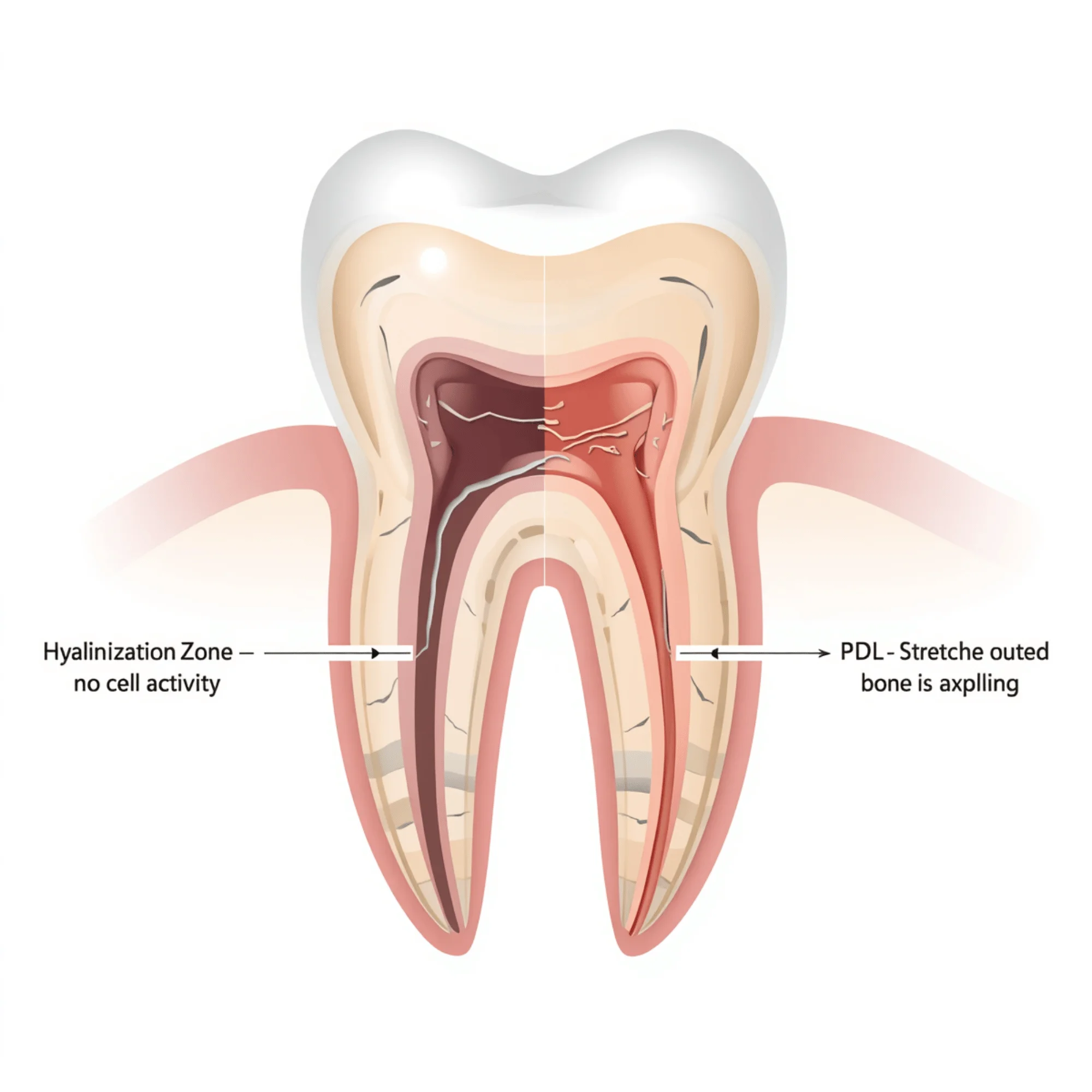
Here is what no one tells you: under sustained compression, the blood vessels inside the compressed PDL zone collapse. A small area of tissue dies from lack of oxygen — orthodontists call this a “hyalinization zone.” It looks like a patch of glassy, cell-free tissue under a microscope. While this zone exists, no osteoclasts (the cells that dissolve bone to make room for tooth movement) can operate there. The tooth is essentially frozen in place.
This is why your teeth barely move at all in the first 10 to 14 days. It is not a malfunction. It is your body's predictable first response to sustained mechanical pressure. During this window, your immune system sends macrophages to clean up the dead tissue. Only after the hyalinization zone is fully cleared do osteoclasts flood back in and begin dissolving bone — which is when real movement begins.
Practical takeaway:If you look in the mirror after your first two weeks and think “nothing has changed,” you are correct — and it is completely normal. You are not behind schedule. You are waiting for your immune system to finish its cleanup job before bone remodeling can begin.
The Bone Remodeling Velocity Curve
Once the hyalinization zone clears, your teeth begin moving at a rate most patients never expect. Dental research consistently shows that tooth movement follows a bell-shaped velocity curve across the full duration of treatment — not a flat, steady line.
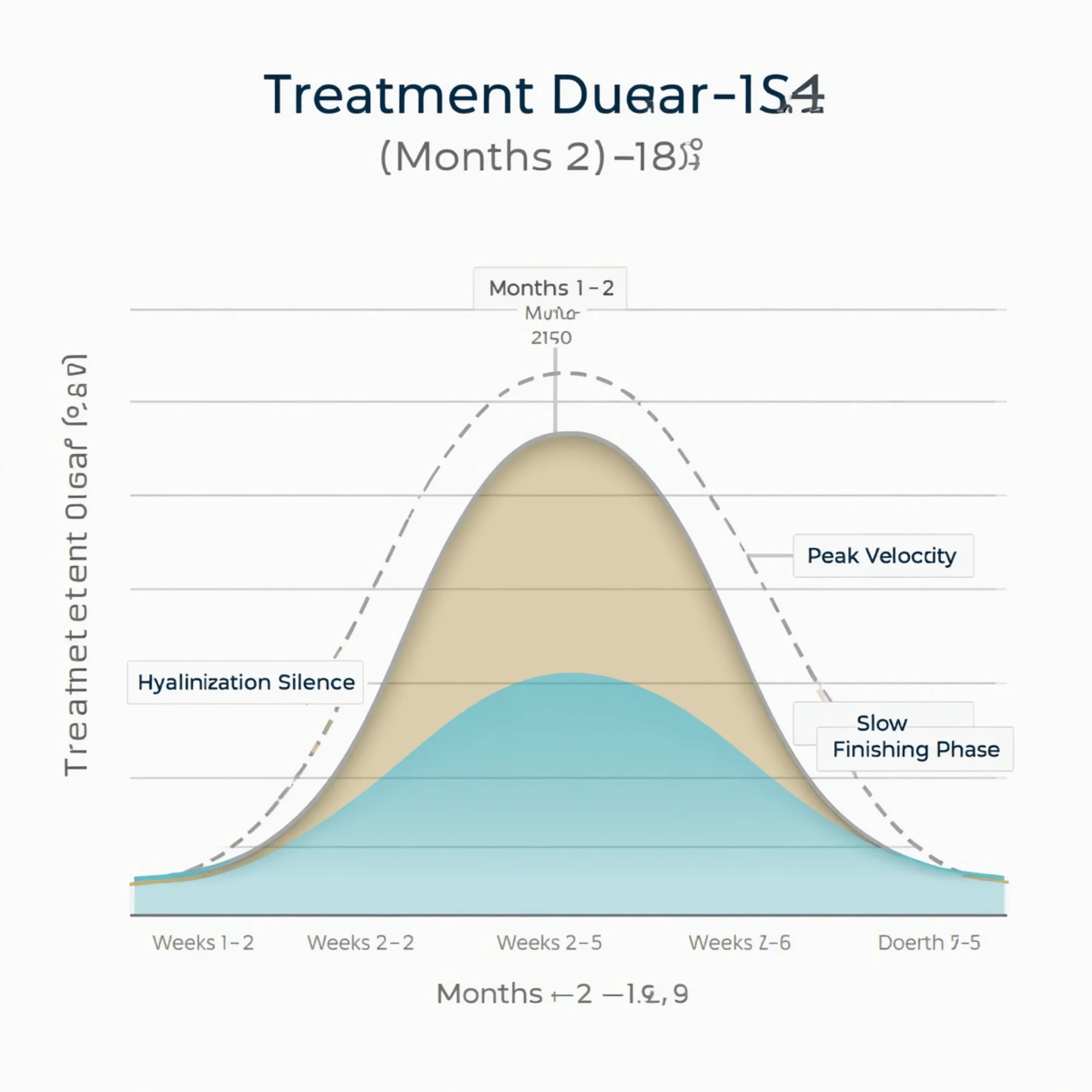
Hyalinization zone forms. Immune cleanup begins. No meaningful tooth movement.
Osteoclasts activate. Bone dissolves on the pressure side. Teeth begin visibly shifting. Soreness peaks during this window.
Full osteoclastic and osteoblastic activity. This is the "leveling and aligning" phase — the dramatic changes friends notice. Archwire progresses from thin flexible to thicker rigid wires.
If teeth were extracted or gaps exist, this is when they close. Heavier forces are needed, but biological limits slow movement slightly. Progress feels slower even though the work is harder.
Subtle changes in tooth angle, torque, and bite contact. Teeth look "done" to most patients but the orthodontist is chasing millimeter-level perfection. This phase frustrates people the most.
The Over-Correction Secret Orthodontists Never Announce
Here is something that is true for virtually every braces patient but almost never gets explained during the consultation: your orthodontist intentionally moves your teeth past their final target position.
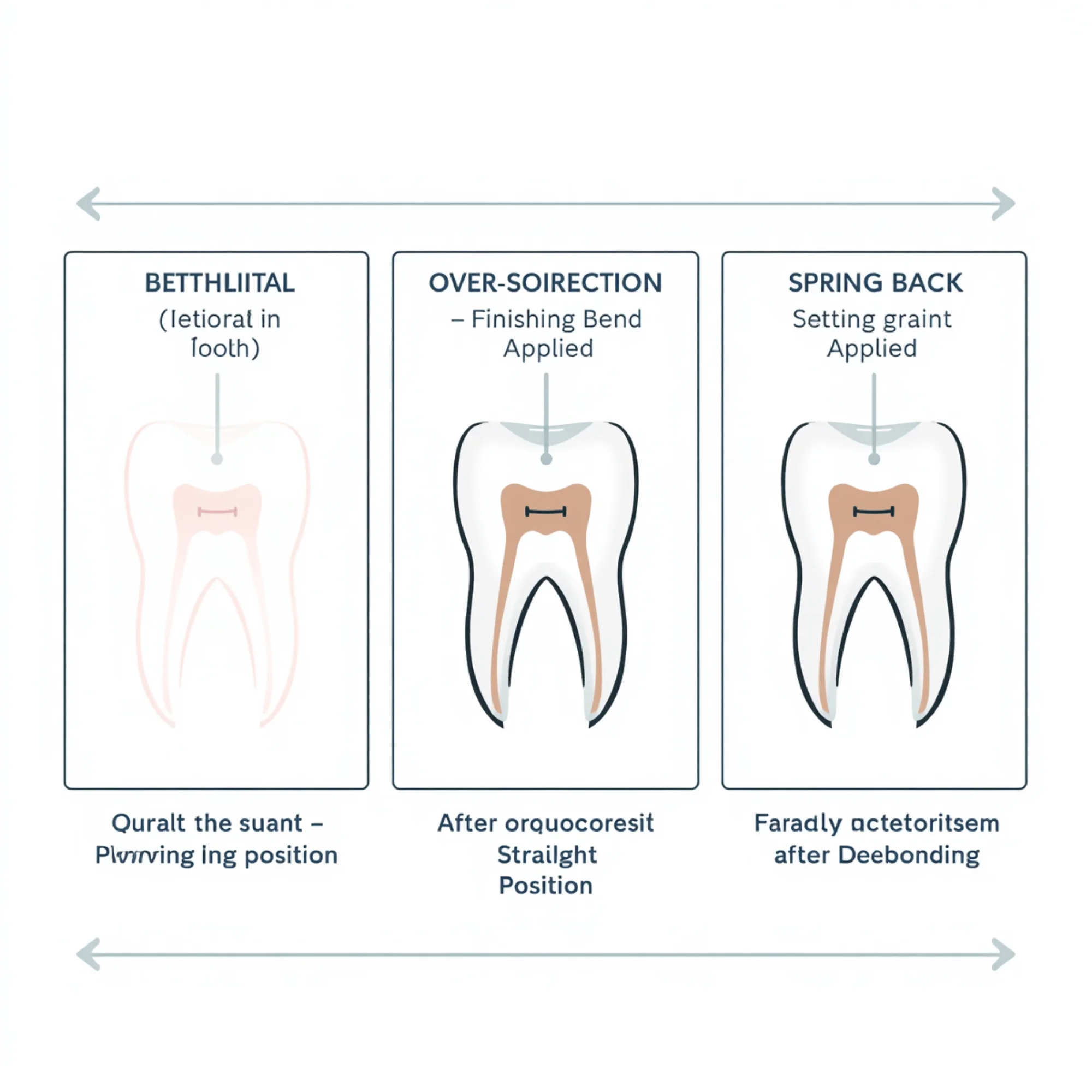
This over-correction is built into every treatment plan for two reasons. First, bone has a small elastic “spring-back” — when sustained pressure is removed, newly formed bone in the tension zone can rebound by 5 to 12 percent. Second, the gingival fibers (collagen fibers embedded in your gums that hold each tooth in place) have a structural memory built up over years. After braces close a gap or straighten a rotated tooth, those fibers are stretched into a new configuration. For months after debonding, they quietly try to pull the tooth back toward its original position. This is literally why you have to wear a retainer for life.
The over-correction happens subtly during the finishing phase. Your orthodontist bends the archwire in precise ways — called “finishing bends”or “artistic bends” — that push certain teeth slightly beyond ideal alignment. When the wire is removed at debonding, the spring-back brings each tooth exactly to the correct final position.
What this means for your timeline:The finishing phase runs longer than most patients expect because the orthodontist is dialing in the over-correction with high precision. If your orthodontist says “just a few more months” when you already feel done, they are in this phase. Do not negotiate for early removal — teeth removed before over-correction is complete relapse faster and more severely.
Month-by-Month: What Actually Changes (Typical 18-Month Case)
Here is what a typical 18-month treatment looks like for a moderate crowding case, measured in visible changes and what is happening biologically:
The 5 Things That Add Months to Your Treatment
Each debonded bracket pauses movement on that tooth for the entire time until the next appointment — typically 4 to 8 weeks. Two broken brackets per month across a 20-month treatment is the difference between finishing on time and adding 4+ months.
Skipping even a single day partially resets the progress from the previous 3 to 4 days. Patients who wear elastics "when they remember" add an average of 3 to 6 months to treatment.
Each appointment applies the next stage of force. If you reschedule three weeks out because it "didn't feel urgent," you lose those weeks of active treatment and potentially allow spring-back in teeth that were mid-move. Braces are tightened every 4–8 weeks for a biological reason — that interval matches one bone remodeling cycle.
White spots around brackets indicate enamel damage. Severe cases require orthodontists to slow down treatment to minimize further damage, or even remove braces temporarily for fluoride treatment.
Hard and sticky foods can distort archwires, delivering uneven forces across the arch and creating unintended movements that your orthodontist has to spend time correcting at the next appointment.
Does Invisalign Take Longer Than Metal Braces?
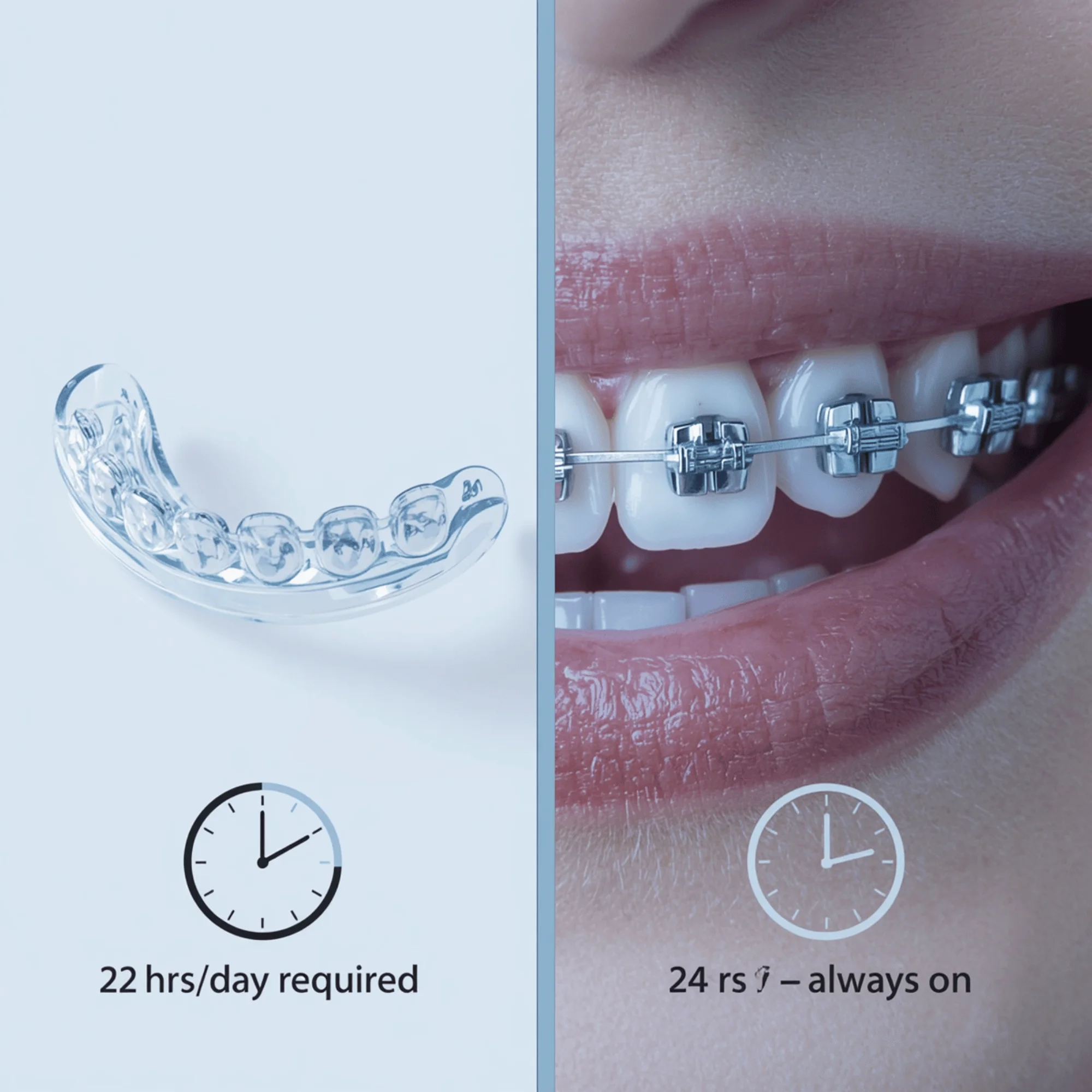
For mild to moderate cases: Roughly the same time. Average Invisalign for mild cases runs 6 to 18 months.
For complex cases: Metal braces are generally faster. Braces apply continuous force 24 hours a day. Aligners only apply force when worn — most patients realistically wear them 20 to 21 hours per day, not the required 22.
The compliance penalty: Research shows that Invisalign patients who wear aligners under 20 hours per day extend their treatment by an average of 2 to 4 months compared to their prescribed timeline.
Summary
Braces take 12 to 30 months because that is how fast bone biology works — no technology or more frequent tightening changes the cellular speed limit. The hyalinization zone clears in its own time. Osteoclasts move at their own pace. Gingival fibers stretch according to your collagen metabolism.
What you control is everything that happens between the biology: wearing your elastics without exception, avoiding foods that break brackets, showing up to every adjustment on schedule, and trusting the finishing phase even when your teeth look done to the naked eye. Patients who do those four things reliably finish at the low end of their estimated range.
Not sure how long your specific case will take?
Use Our Free Timeline Estimator →Want to understand what actually happens at each of those adjustment appointments? Read How Often Are Braces Tightened? — including the exact biology behind the 4–8 week interval and why soreness peaks 48 hours later, not the day of.
Curious what happens once they come off? Read our Life After Braces & Retainers Guide to understand why the work is not over at debonding — and how to protect everything you just waited for.