
What Are the Stages of Braces? Every Phase Explained (2026 Guide)
Quick Answer
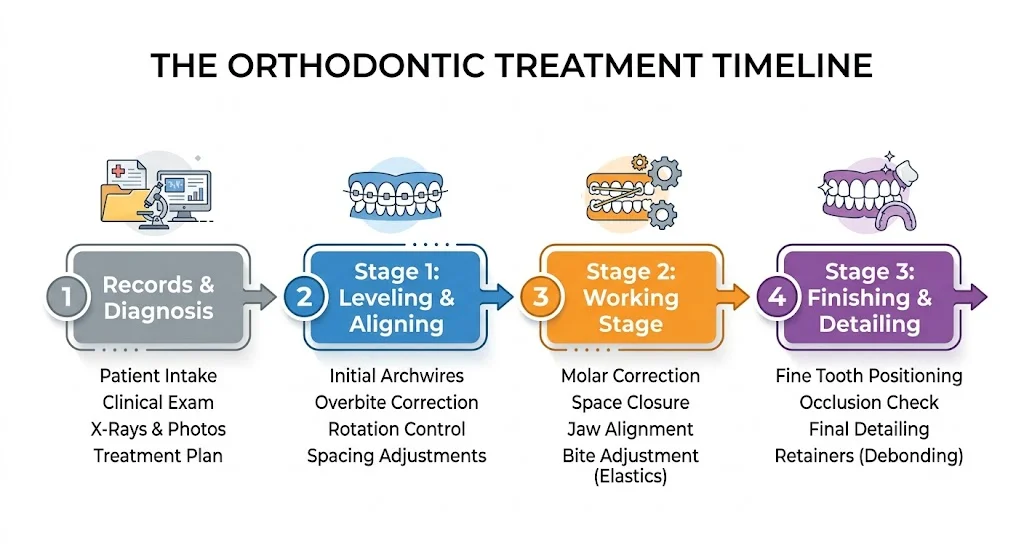
Braces treatment has four clinical stages: leveling and aligning (months 1–4), working stage with torque and bite correction (months 4–10), space closure for extraction cases (months 5–12), and finishing and detailing (month 10 to end). Each stage uses a different wire type with a different biological goal.
Part of our Complete Braces Timeline & Process Guide.
Your orthodontist hands you a treatment plan that says “18 to 22 months” and then sends you home. Nobody draws you a map. Nobody explains that those months are not one continuous blur of gradual movement — they are four distinct clinical stages, each with a different biological goal, a different wire, and a completely different type of work happening inside your jaw.
Understanding the stages matters because each one has a minimum duration that cannot be compressed. The reason braces take as long as they do is not a mystery. It is four sequential biological processes, each of which has to finish before the next one can start.
Before the Braces Go On: The Records Stage
Most people do not count this as a stage, but it is — and it is the one that determines everything that follows.
Before any bracket touches your tooth, your orthodontist collects a full set of diagnostic records: panoramic and cephalometric X-rays, intraoral photographs, digital 3D scans or physical impressions, and a clinical examination. These records are analyzed to produce your treatment plan — which teeth need to move, how far, in which direction, and whether any extractions are needed to create space.
This is also where the bracket prescription is selected (MBT, Roth, or Andrews — different systems that pre-program different torque and angulation values into the bracket slots), and where indirect bonding trays are fabricated if your practice uses them.
The records stage typically spans one to three appointments over two to four weeks before your bonding date. Skipping thorough records is one of the most common causes of treatment extending beyond the original estimate — the orthodontist is correcting for things they did not anticipate at the start.
Stage 1: Leveling and Aligning (Months 1–4)
This is the stage most people associate with braces — the dramatic early changes where crooked teeth visibly straighten.
The clinical goal is simple to state and biologically demanding to achieve: get all teeth to the same vertical level and eliminate rotations, so the archwire sits passively in every bracket slot with no deflection remaining.
When your braces first go on, the wire is deflected wildly by misaligned brackets — it is fighting the positions of every tooth simultaneously. As teeth move, the wire gradually straightens. At each adjustment, a new, slightly stiffer wire is introduced.
Wire progression in Stage 1:
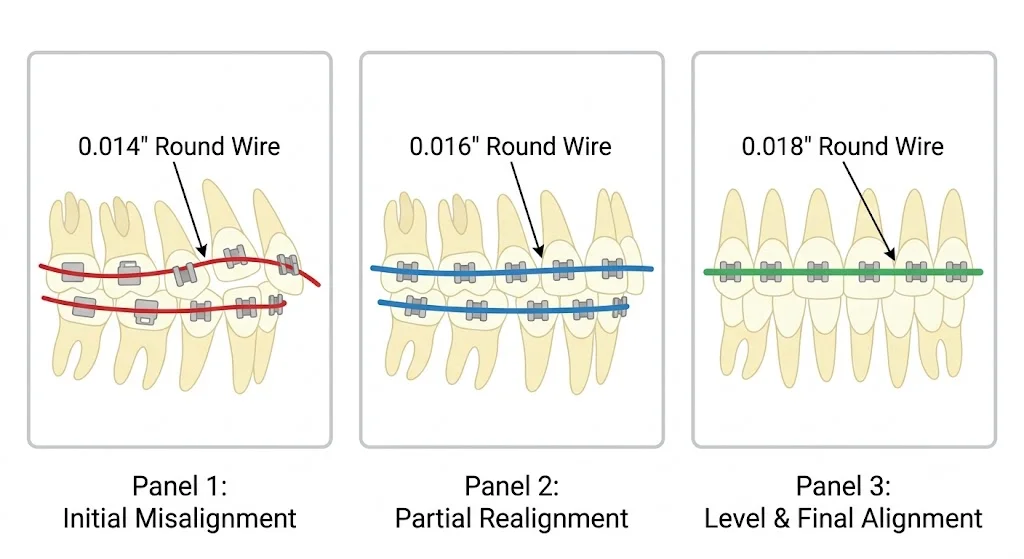
Why round wires cannot be skipped:
Round wires move teeth in two dimensions — level and align — but cannot control the angle of the tooth root (torque). Torque control requires a rectangular wire that fills the bracket slot. If a rectangular wire is introduced before leveling is complete, it generates forces on unevenly placed brackets that can cause permanent root damage. Stage 1 has a non-negotiable minimum.
What you see: Rotated teeth derotating, crowded teeth spreading, and sometimes a slight gap opening between previously touching front teeth in the first few weeks — this is the wire leveling the arch vertically and is completely normal.
Stage 2: Working Stage — Torque, Angulation, and Bite Correction (Months 4–10)
Once leveling is substantially complete, the archwire upgrades to rectangular cross-sections. This is the most mechanically significant wire change of your entire treatment.
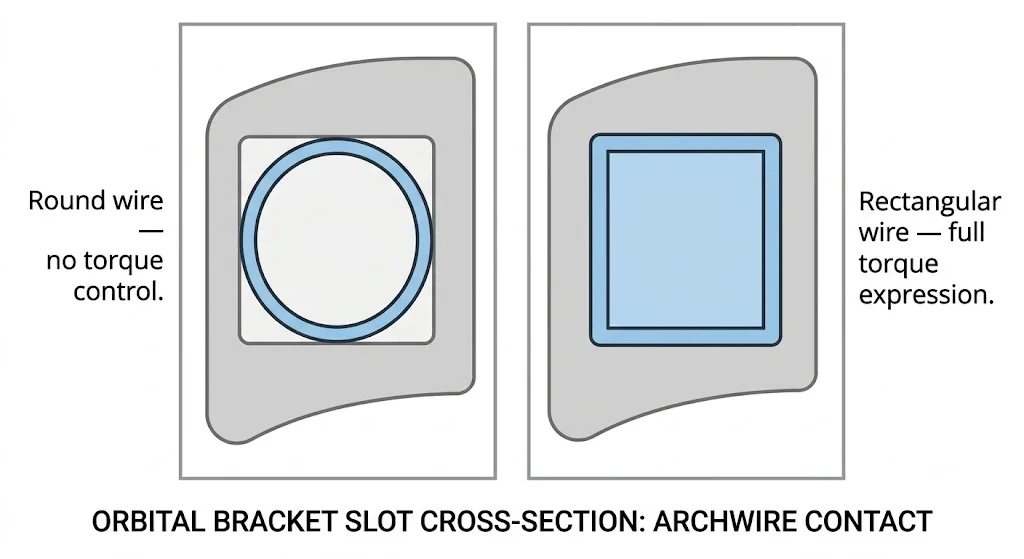
A rectangular wire engages all four walls of the bracket slot. This means the wire now controls not just the position of the tooth crown, but the angulation of the root — this is called torque expression. The pre-programmed torque values machined into your bracket prescription can only activate once a rectangular wire is engaged. Before this point, those bracket values were entirely dormant.
This is also the stage where inter-arch elastics (rubber bands hooked between upper and lower brackets) are introduced. The wire controls teeth within each arch individually. Elastics apply forces across both arches, correcting the bite relationship — overbite, underbite, crossbite — in ways no wire can achieve alone.
Missing elastic wear during Stage 2 is the single most common cause of treatment running longer than planned. Elastics only work when worn. Every day skipped partially reverses the previous 3 to 4 days of bite correction progress.
What you see:Teeth look substantially straight to outside observers. But your orthodontist is now working on root positions and bite relationships that are largely invisible in the mirror — which is why many patients feel “stuck” in this stage even though the most complex work of the treatment is happening.
Stage 2b: Space Closure (Months 5–12, Extraction Cases Only)
If your treatment plan involved extracting teeth to create space — typically upper or lower first premolars — a distinct space closure phase is embedded within the working stage.
After extractions, gaps remain in the arch. These gaps are closed by retracting the canine teeth backward into the extraction space, then moving the front teeth backward as a unit. This is achieved with power chains — continuous elastic chains linking adjacent brackets — or coil springs — compressed nickel-titanium springs that push or pull teeth with sustained force.
Canine retraction through dense alveolar bone is biologically rate-limited to approximately 1 millimeter per month under ideal conditions. A 6mm extraction space takes a minimum of six months to close — assuming zero broken brackets, perfect elastic wear, and no missed appointments.
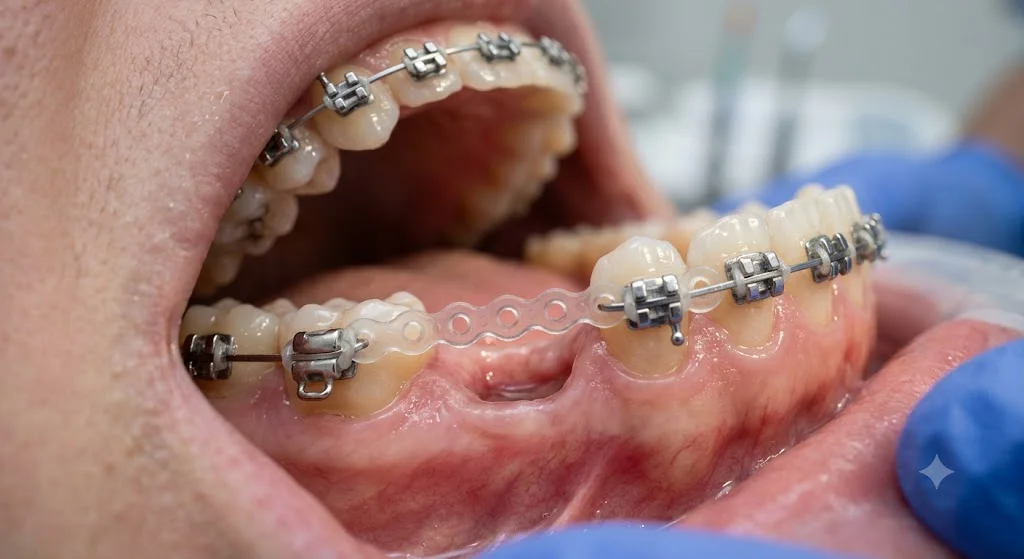
What you see: The gap where the tooth was extracted visibly closes over months. This is one of the most satisfying visible changes in treatment — and one of the most frustrating to wait for.
Stage 3: Finishing and Detailing (Month 10 to End)
This is the stage that confuses patients the most, because their teeth already look straight. The orthodontist keeps saying “a few more months.” Nothing seems to be happening.
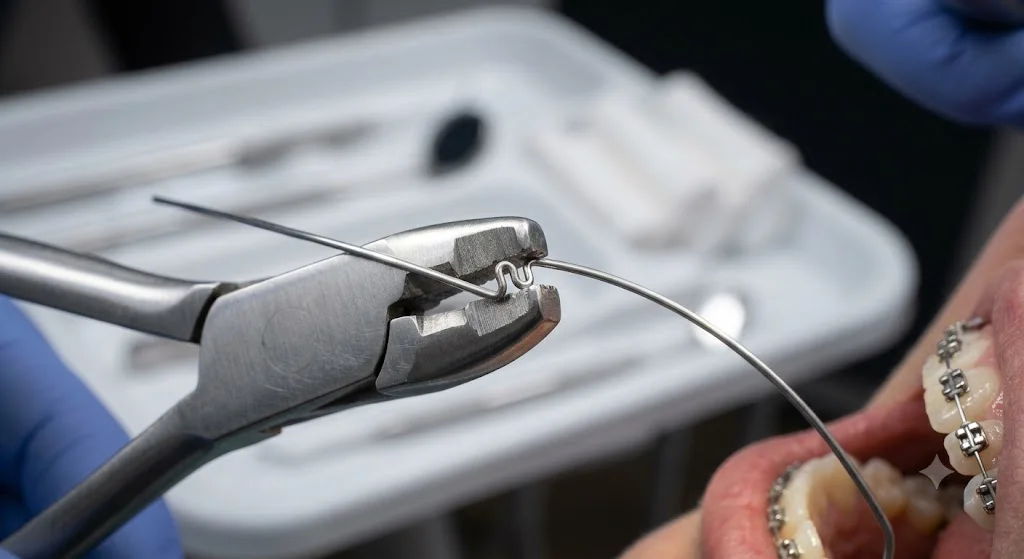
Here is what is actually happening: your orthodontist is chasing millimeter-level corrections invisible in the mirror but that determine whether your result lasts or relapses within a year of debonding.
The finishing stage involves detailing bends — precise small bends placed into the archwire with specialized pliers. A first-order bend corrects the mesial-distal position of a tooth in the arch. A second-order bend corrects tip or in-out position. A third-order bend adjusts root torque. These are placed one at a time, appointment by appointment, until every tooth sits in its intended three-dimensional position.
The over-correction buffer: Your orthodontist intentionally moves certain teeth slightly past their ideal position during this stage. Gingival collagen fibers will pull teeth back a small amount after debonding — the finishing stage builds in that expected spring-back. Patients debonded before over-correction is complete relapse faster than those who complete the full finishing stage.
What you see: Almost nothing changing in the mirror. But the bite contact pattern on articulating paper (the thin blue marking paper your orthodontist has you bite on) changes significantly at each appointment — that is what the orthodontist is tracking, not what you see at home.
Why Braces Take as Long as They Do
Every stage has a biological minimum that no technique or technology can compress:
Orthodontists who promise very short treatment times are either selecting very simple cases or applying forces that risk root resorption — permanent shortening of tooth roots that appears on X-rays years later. The biological timeline is not a limitation of skill or technology. It is the speed limit of human bone.
Summary
Braces treatment runs through four sequential stages: records and diagnosis, leveling and aligning with round wires (months 1–4), the working stage with rectangular wires and inter-arch elastics (months 4–10), and finishing and detailing with precise archwire bends and over-correction (month 10 to end). Extraction cases add a space closure phase embedded in the working stage, rate-limited to 1mm of movement per month. Each stage has a biological minimum duration — the total treatment time is the sum of four non-compressible processes, not a scheduling choice.
Want to estimate how long your specific case will take?
Use Our Free Timeline Estimator →For a month-by-month breakdown of what changes visibly at each stage, read How Long Do Braces Take?
To understand what your orthodontist is doing at each adjustment appointment between stages, read How Often Are Braces Tightened?
And when the last stage is finally done, read How Are Braces Removed? so you know exactly what happens at the debonding appointment.