What Happens If You Never Wear Your Retainer? (2026)
Quick Answer
If you stop wearing your retainer, your teeth will shift — it is not a matter of if, but how much and how fast. In the first 3–6 months without a retainer, teeth can shift noticeably, especially the lower front teeth. After years without wearing one, many people find their teeth have returned to near their pre-treatment positions. If you stopped recently, restart immediately — there is still time to minimize damage. If it has been years, you likely need orthodontic retreatment.
Part of our Alternatives & Aftercare Master Guide.
The Relapse Timeline
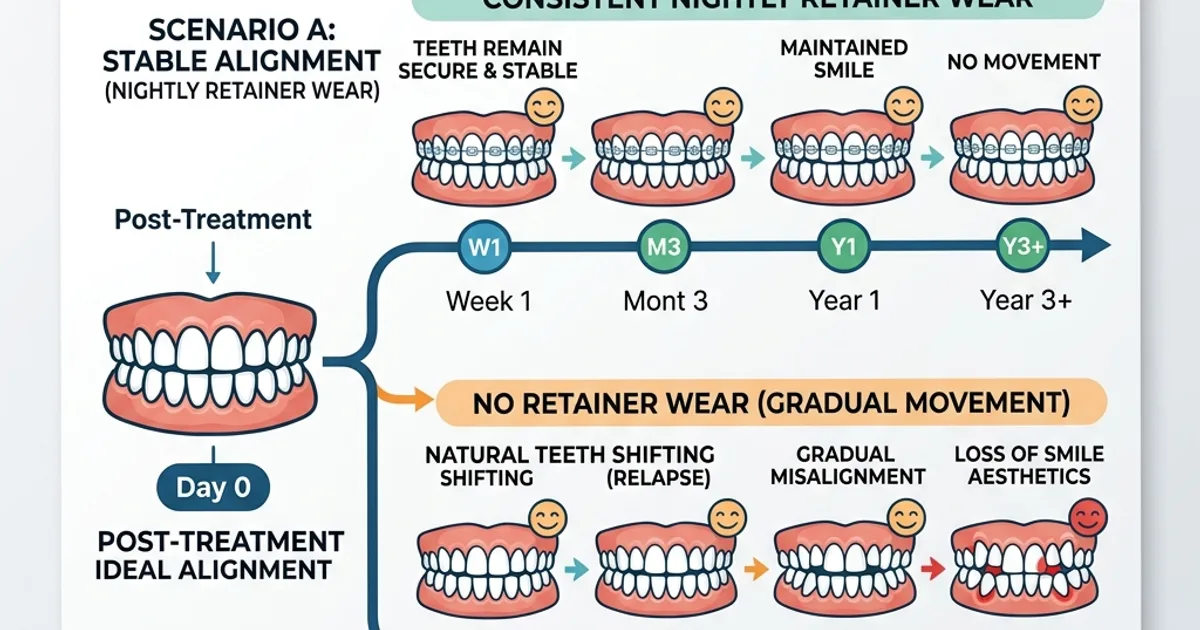
Relapse following complete retainer abandonment progresses from invisible periodontal ligament recoil in days to full alignment collapse over 3 to 5 years.
The table below outlines key comparison data and practical guidelines for what happens if you never wear your retainer?.
| Time Without Retainer | What's Happening | What to Do |
|---|---|---|
| Days to 1 week | Microscopic shift — PDL beginning to recoil. You won't notice anything. | Resume wearing immediately — no damage done. |
| 1–3 months | Minor visible changes starting, especially lower front teeth. Retainer may feel tight. | Try your retainer — if it fits snugly, wear it consistently. May resolve. |
| 3–6 months | Noticeable crowding returning. Retainer may not fully seat. | Orthodontic consultation needed. New retainer or short-course aligners likely. |
| 1–3 years | Moderate relapse. Teeth approaching pre-treatment positions. | Short-course Invisalign (6–12 months) typically required. |
| 3+ years | Significant or near-complete relapse for patients with original crowding. | Full orthodontic retreatment likely needed. |
Note: Data reflects typical clinical guidelines and average provider estimates across standard treatment plans.
Why Teeth Shift After Braces
Teeth shift because periodontal ligament fibers maintain elastic memory and continuous soft tissue forces from tongue and lips move unrestrained tooth roots.
The periodontal ligament (PDL) — the elastic tissue connecting each tooth root to the jaw bone — has a “memory.” After years of bracing, the ligament is stretched and remodeled, but residual tension still exists. When the retainer is removed permanently, the PDL recoils, pulling teeth back toward their original positions.
Additionally, oral forces (tongue pressure, cheek pressure, biting force, swallowing) continuously push teeth in subtle ways throughout the day. A retainer resists these forces. Without it, these forces win over time. Bone never fully “sets” — it remodels throughout life in response to pressure, which is why retainer wear must be lifelong to maintain results.
Frequently Asked Questions
How fast do teeth move without a retainer?
Teeth begin shifting within days of removing a retainer permanently. In the first week, the shift is microscopic. Within 1–3 months, minor visible changes can appear, especially in the lower front teeth. Within 6–12 months, moderate relapse is common for patients who had significant crowding before braces. Within several years, many patients see near-complete reversal of their treatment results.
What does orthodontic relapse look like?
The most common signs: lower front teeth begin crowding and overlapping (the most universal). Upper front teeth may develop a gap if you had one before braces. The overall dental arch may narrow. Your bite may begin shifting. Cosmetically, crowded lower front teeth is the first and most visible sign the majority of people notice.
Is orthodontic relapse permanent?
Relapse is permanent in the sense that teeth do not return to their corrected position on their own — they require intervention. However, relapse is treatable. Minor relapse can sometimes be addressed with a new retainer. Moderate relapse typically requires short-course Invisalign. Significant relapse may require full orthodontic retreatment. The earlier you address it, the less intervention needed.
Why do teeth shift after braces?
The periodontal ligament (PDL) has a "memory." After years of bracing, it is stretched and remodeled, but residual forces still exist. When the retainer is removed permanently, the PDL recoils, pulling teeth back toward original positions. Additionally, oral forces (tongue pressure, cheek pressure, biting force) continuously push teeth in subtle ways that a retainer resists. Without it, these forces win over time.
How long do you have to wear a retainer after braces?
Indefinitely. The old guidance (wear full time for 1 year, then nights only for a few years, then stop) has been updated by modern orthodontic research. The current consensus is: retainer wear should be lifelong — typically nightly indefinitely. Patients who commit to nightly retainer wear long-term do not experience significant relapse. Those who stop do.