Can You Get Braces with Gum Disease? (2026)
Quick Answer
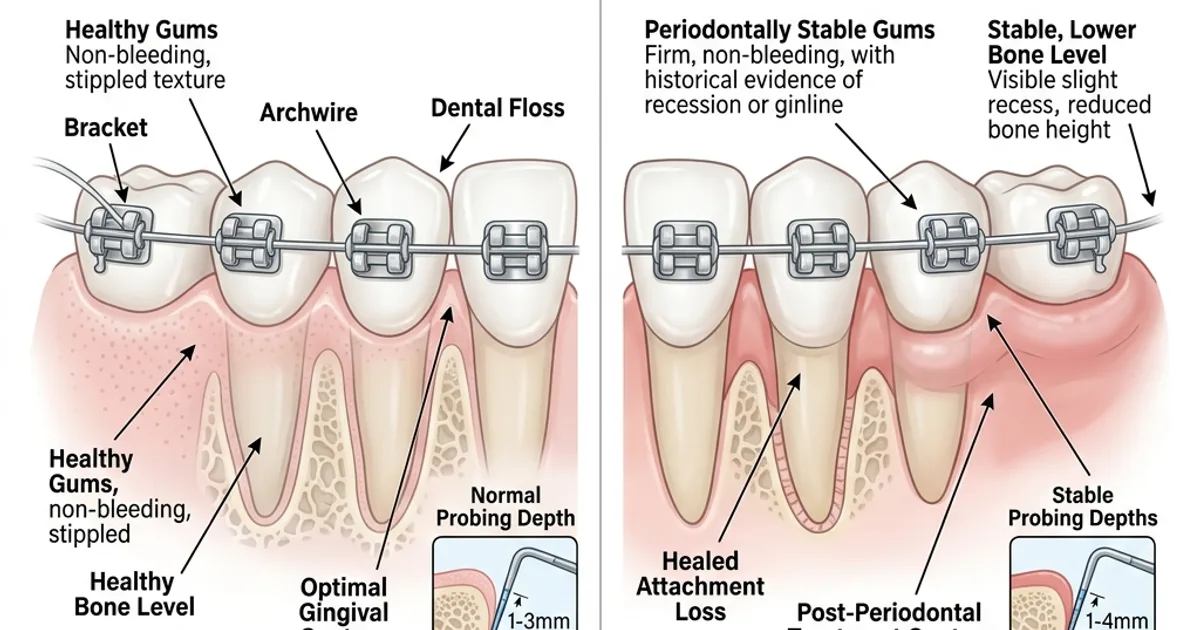
You cannot get braces with active gum disease (active periodontitis or uncontrolled gingivitis). Orthodontic forces applied to teeth with compromised bone support can accelerate bone loss, loosen teeth, and cause permanent damage. However, if your gum disease has been treated by a periodontist and is in a stable, controlled state, orthodontic treatment is often possible and can actually improve long-term gum healthby correcting crowding that makes cleaning difficult. The key word is “controlled” — stable gum disease is not a disqualifier. Active disease is.
Part of our Demographics & Eligibility Master Guide.
Why Active Gum Disease and Braces Are Incompatible
Active gum disease and braces are incompatible because orthodontic forces on inflamed bone accelerate periodontal bone loss and risk permanent tooth mobility or loss.
Orthodontic forces move teeth by stressing the periodontal ligament (PDL) and surrounding bone. In a healthy mouth, this triggers controlled bone resorption on one side and bone deposition on the other. In a mouth with active periodontitis, the bone is already infected, inflamed, and being destroyed by bacteria. Adding mechanical stress from orthodontic forces dramatically accelerates bone loss. Teeth with severely reduced bone support can become mobile (loose) and may be lost entirely during treatment.
Gum Disease Treatment Required Before Braces
Before starting braces, active periodontitis requires scaling, root planing, or surgery to achieve completely stable, non-bleeding periodontal tissue.
The table below outlines key comparison data and practical guidelines for can you get braces with gum disease?.
| Condition | Treatment Needed | Timeline Before Braces |
|---|---|---|
| Gingivitis | Professional cleaning + improved home hygiene | 2–4 weeks |
| Mild-moderate periodontitis | Scaling and root planing (deep cleaning) | 4–8 weeks post-treatment |
| Severe periodontitis | Periodontal surgery + stabilization | 3–6 months |
Note: Data reflects typical clinical guidelines and average provider estimates across standard treatment plans.
How Braces Are Modified for Periodontal Patients
Orthodontists adapt treatment for periodontal patients by using lighter wire forces, avoiding bone-extruding movements, and scheduling cleanings every 3 months.
Frequently Asked Questions
Can braces make gum disease worse?
Yes, if gum disease is active when braces are placed. Orthodontic forces move teeth by stressing the bone and periodontal ligament. In a mouth with active periodontitis, the bone is already compromised and inflamed — adding mechanical stress accelerates bone loss. This is why treating gum disease first is non-negotiable.
Can you get braces if you have had gum disease in the past?
Yes, with conditions. If your gum disease was treated and has been in a stable, maintained state — no active bleeding on probing, no progressive bone loss on X-rays, and professional cleanings every 3–4 months — orthodontic treatment is possible. Your periodontist and orthodontist will collaborate to monitor gum health throughout treatment.
What gum disease treatment is needed before braces?
For gingivitis: professional cleaning and improved home hygiene is usually sufficient. For mild-to-moderate periodontitis: scaling and root planing (deep cleaning under the gumline) followed by re-evaluation at 4–8 weeks. For severe periodontitis: periodontal surgery may be required, and stabilization can take 3–6 months before braces can begin.
How often do you need dental cleanings during braces with gum disease history?
More frequently than standard braces patients. Most orthodontists coordinate with the patient's periodontist to schedule professional cleanings every 3 months (rather than the standard 6 months) throughout treatment. Without this, braces can reactivate disease even in previously stable patients.
Can braces actually help gum disease?
In some cases, yes. Severe crowding creates areas where cleaning becomes virtually impossible, leading to localized bone loss. Moving crowded teeth apart through orthodontic treatment can improve access for brushing and flossing, reducing plaque in formerly inaccessible areas.