What Toothpaste Is Best for Braces? Fluoride, Whitening & More (2026)
Quick Answer
Use a standard fluoride toothpaste with braces. Fluoride is the only toothpaste ingredient with strong clinical evidence for preventing white spot lesions — the permanent enamel damage that appears around bracket sites. Avoid whitening toothpaste during active treatment: whitening agents lighten the area around the bracket but cannot reach under it, guaranteeing an uneven result when brackets come off.
Part of our Maintenance & Care Guide.
1. Why Toothpaste Matters More With Braces
Toothpaste choice is critical during braces treatment because brackets trap plaque and acid against enamel for extended periods. Regular fluoride toothpaste remineralizes enamel to prevent permanent white spot lesions.
Without braces, thorough brushing with any reasonable toothpaste protects enamel effectively for most patients. With braces, the geometry changes: brackets create multiple small recesses where plaque accumulates and is difficult to remove. That plaque produces acid continuously. The enamel directly adjacent to brackets is under near-constant acid attack if brushing is inconsistent.
The result: white spot lesions — areas of enamel demineralization that appear as dull white patches when brackets come off. They are permanent without professional treatment. Up to 50% of braces patients develop at least minor white spot lesions during treatment. Fluoride toothpaste is the primary prevention tool.
2. Fluoride Content: What to Look For
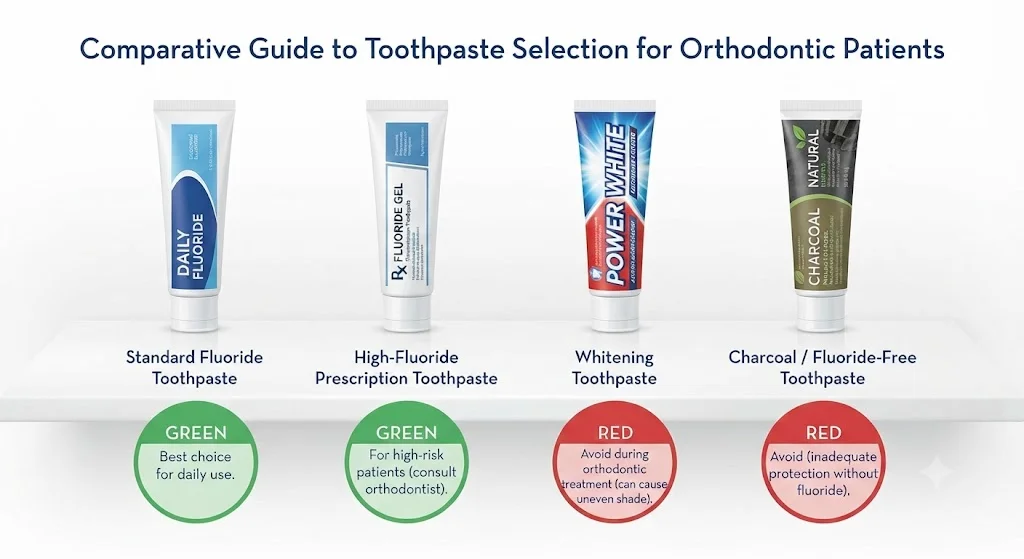
Standard fluoride toothpaste containing 1,000 to 1,450 ppm fluoride is optimal for daily braces hygiene. High-risk patients with early decalcification may require prescription 5,000 ppm fluoride toothpaste.
Standard toothpaste contains 1,000–1,450 ppm (parts per million) fluoride. This is appropriate for most braces patients. Any ADA-accepted fluoride toothpaste in this range works — the brand is far less important than using it consistently after every meal.
Who should use higher-fluoride toothpaste: patients with a history of cavities, dry mouth, poor plaque control, visible early white spot lesions at any point during treatment, or a diet high in sugar or acidic drinks. In these cases, an orthodontist may prescribe a 5,000 ppm prescription fluoride toothpaste (e.g., PreviDent) used once daily.
3. What to Avoid and Why
Whitening, charcoal, and fluoride-free natural toothpastes should be avoided during braces treatment. Whitening toothpastes leave dark unwhitened squares under brackets, while charcoal abrasives scratch ceramic components.
The table below outlines key comparison data and practical guidelines for what toothpaste is best for braces? fluoride, whitening & more.
Frequently Asked Questions
What toothpaste should you use with braces?
Any ADA-accepted fluoride toothpaste with 1,000–1,450 ppm fluoride. Brand matters less than consistent use after every meal. High-risk patients may need prescription 5,000 ppm fluoride — ask your orthodontist.
Can you use whitening toothpaste with braces?
Not recommended. It whitens the exposed enamel around brackets but can't reach under them. When brackets come off, you'll have a darker square where each bracket was surrounded by whitened enamel. Wait until after deband to whiten.
Is fluoride toothpaste safe for braces?
Yes — it is the single most important product for braces hygiene. Fluoride deposits into enamel and prevents the white spot lesions that affect up to 50% of braces patients. It does not harm brackets, wires, or adhesive.
What about charcoal or natural toothpaste with braces?
Avoid both. Charcoal is abrasive and scratches ceramic brackets. Most natural toothpastes have no fluoride — no fluoride means no white spot protection during the period when you need it most.
How much toothpaste should you use with braces?
Pea-sized amount. More creates foam that obscures bracket margins. Spit excess and rinse lightly — aggressive rinsing washes fluoride off enamel before it deposits.