
How to Remove White Spots After Braces: Treatment Options (2026)
Quick Answer
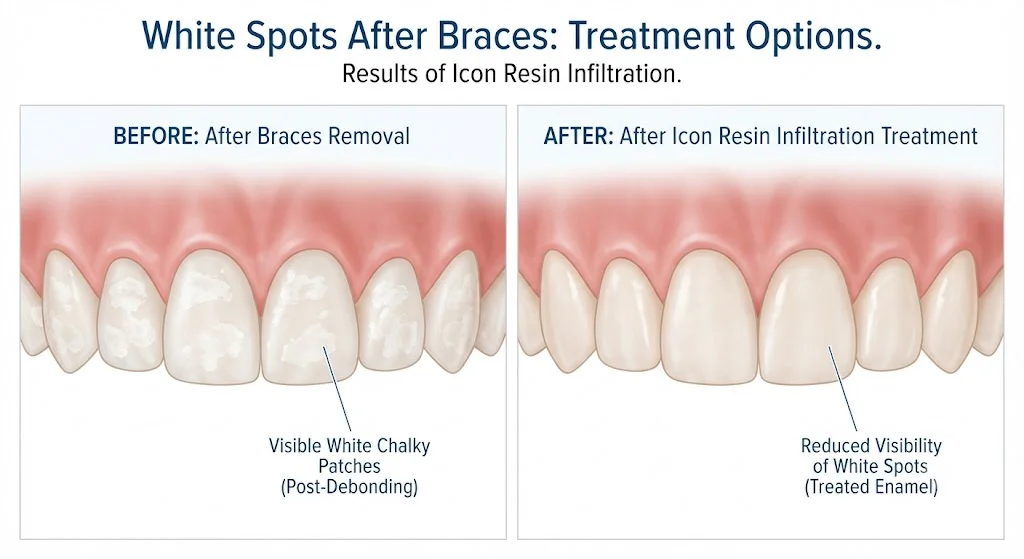
White spots after braces are permanent areas of enamel demineralization — they do not fade on their own. Several treatment options exist depending on severity: fluoride remineralization for mild early lesions, MI Paste (CPP-ACP) for early-stage spots, Icon resin infiltration (most effective for visible spots, results in one appointment), and microabrasion or veneers for severe cases. See your dentist promptly after deband if you notice white spots.
Part of our Maintenance & Care Guide.
1. What White Spots Are and Why They Form
White spot lesions are chalky enamel demineralization patches caused by bacterial plaque acid accumulating around bracket bases. Up to 50% of braces patients develop these permanent spots on exposed incisors and premolars.
White spot lesions (WSLs) are areas of subsurface enamel demineralization directly adjacent to bracket adhesive margins. Plaque accumulates at the bracket-enamel interface, producing acid continuously. That acid dissolves the calcium and phosphate in enamel, creating a porous subsurface layer that scatters light differently from healthy enamel — appearing as an opaque white or chalky patch.
Up to 50% of orthodontic patients develop at least minor white spot lesions during treatment. The upper lateral incisors and upper first premolars are most commonly affected because they are harder to clean around and receive more acid exposure from the oral environment.
2. Treatment Options by Severity
Treating white spots after braces ranges from high-fluoride remineralization pastes for mild spots to Icon resin infiltration for moderate lesions, while microabrasion or bonding addresses severe enamel loss.
- High-fluoride toothpaste (5,000 ppm prescription) used daily — deposits fluoride into porous enamel
- MI Paste (CPP-ACP) applied after brushing — delivers calcium and phosphate directly to the demineralized zone
- Fluoride varnish applied by your orthodontist at appointments
- These work best for very early lesions — established visible white spots at deband are unlikely to resolve fully with remineralization alone
- Icon resin infiltration (most effective): the porous enamel is dried, then a low-viscosity resin is infiltrated under vacuum, filling the pores and matching the refractive index of surrounding healthy enamel. Most spots dramatically reduced or eliminated in one appointment.
- Prescription fluoride remineralization — slower (6–12 months), works best for early-moderate lesions
- Microabrasion — a mildly acidic abrasive paste removes a thin enamel layer, reducing surface-level spots quickly
- Composite bonding — covers the affected area where infiltration is insufficient
- Veneers — final option for spots that cannot be adequately treated with any of the above
3. Icon Resin Infiltration: The Most Effective Option
Icon resin infiltration is a painless, drill-free procedure that fills porous white spot lesions with low-viscosity resin under vacuum. This matches light refraction to surrounding enamel in a single appointment.
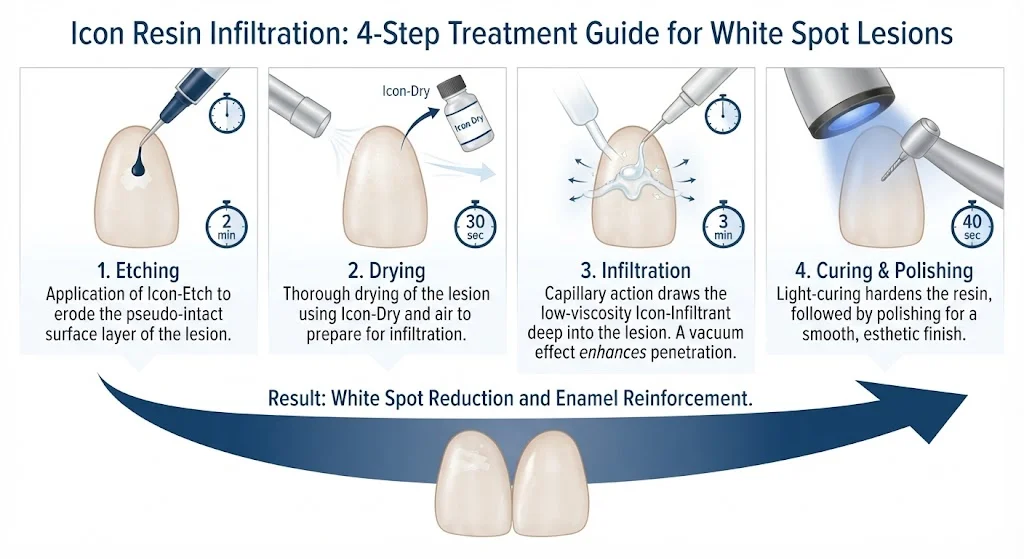
Icon (DMG America) is currently the gold-standard minimally invasive treatment for visible white spot lesions. The procedure:
- 1EtchA 15% hydrochloric acid gel is applied to open the surface pores of the demineralized enamel.
- 2DryEthanol desiccant dries the enamel, creating space for the resin to enter.
- 3InfiltrateLow-viscosity resin is applied and drawn into the porous lesion under capillary action for 3 minutes.
- 4Light cureThe resin is light-cured, locking into the enamel structure and restoring normal light refraction.
Most patients see dramatic improvement in one appointment. The procedure is painless, requires no drilling, and does not remove tooth structure.
4. Prevention Is Far Easier Than Treatment
Preventing white spots requires brushing after every meal with fluoride toothpaste and using interdental brushes along bracket edges. Limiting acidic drinks and applying professional fluoride varnish prevents demineralization.
White spots are almost entirely preventable with consistent oral hygiene during treatment. The habits that prevent them:
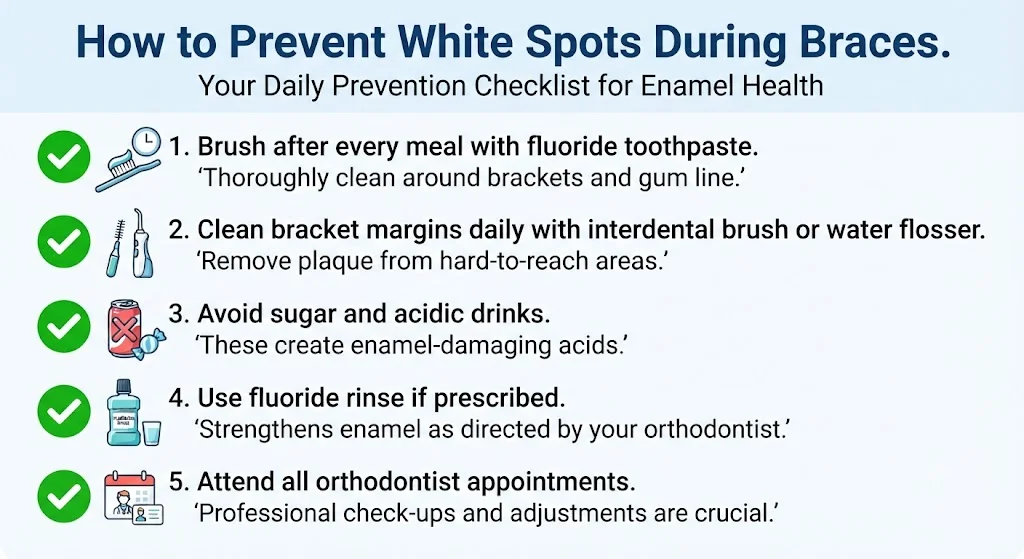
- ✓Brush after every meal with fluoride toothpaste — not just morning and night
- ✓Clean bracket margins daily with an interdental brush or water flosser
- ✓Eliminate or strictly limit sugar and acidic drinks (soda, juice, energy drinks, sparkling water)
- ✓Use a prescription fluoride rinse if your orthodontist recommends one
- ✓Attend all appointments — orthodontists monitor for early white spot formation and can apply fluoride varnish
Frequently Asked Questions
Do white spots after braces go away on their own?
No — established white spot lesions are permanent. Very early lesions caught during treatment can be partially reversed with high-fluoride products, but visible white spots at deband need professional treatment.
What is the best treatment for white spots after braces?
Icon resin infiltration — minimally invasive, no drilling, results in one appointment. The resin fills the porous demineralized enamel and matches the refractive index of healthy enamel, dramatically reducing the white spot appearance.
How long does it take for white spots to fade after braces?
Without treatment, never — they are permanent. With Icon infiltration, results are immediate. With prescription fluoride remineralization, mild lesions may improve over 6–12 months.
Can you prevent white spots during braces treatment?
Yes — they are almost entirely preventable. Brush after every meal with fluoride toothpaste, clean bracket margins daily, avoid sugar and acid, and use a fluoride rinse if prescribed. Prevention costs nothing; Icon infiltration costs $100–$300 per tooth.
Will whitening teeth remove white spots after braces?
Whitening does not remove white spots and can initially make them more visible by lightening surrounding enamel. Once complete, the reduced contrast may make spots less noticeable — but it's not a standalone treatment. Use Icon infiltration first, then whiten if needed.