How to Clean Braces with a Water Flosser: Technique & Best Settings (2026)
Quick Answer
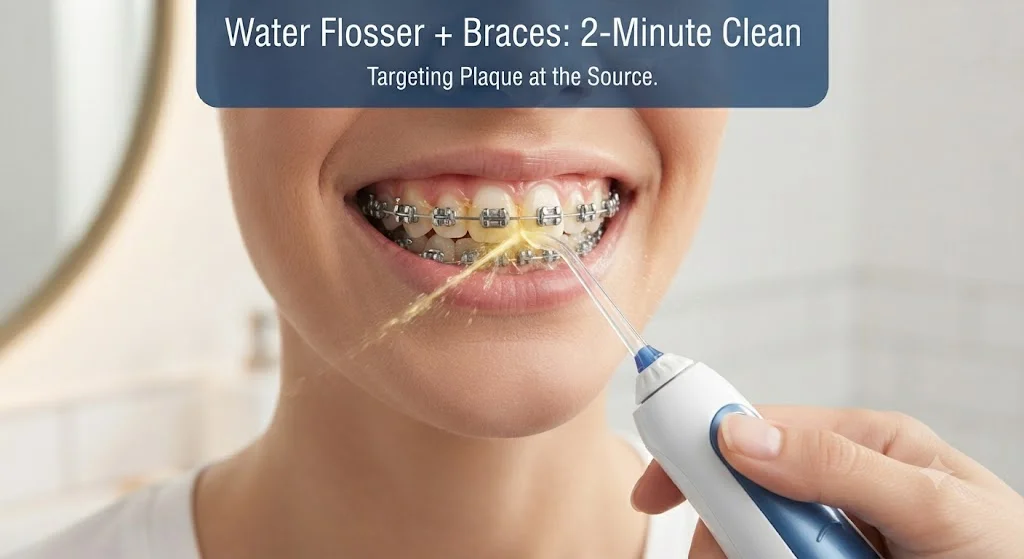
A water flosser is an excellent tool for cleaning braces — it flushes food debris and bacteria from around brackets, under wires, and into gum pockets faster than string flossing. Use it on medium pressure (setting 4–6) with an orthodontic tip, aimed at the gumline and each bracket margin. A water flosser does not fully replace string floss — used together, the combination is significantly more effective than either alone.
Part of our Maintenance & Care Guide.
1. Why Water Flossers Help More With Braces
Water flossers simplify braces hygiene by delivering pressurized water streams that bypass archwires without manual threaders. A full mouth session takes 2 to 3 minutes, dramatically boosting daily hygiene compliance.
Standard flossing without braces is straightforward: thread floss between two teeth, wrap in a C-shape, slide under the gumline, and repeat. With braces, the archwire blocks direct access — you must thread floss under the wire between each pair of teeth, which takes 10–20 minutes to do thoroughly. Many patients skip it entirely.
A water flosser bypasses this completely. You trace the gumline and brackets with the tip while the pulsating stream does the cleaning. A full session takes 2–3 minutes. This is why compliance with water flossers among braces patients is significantly higher than with string floss.
2. Step-by-Step Technique for Braces
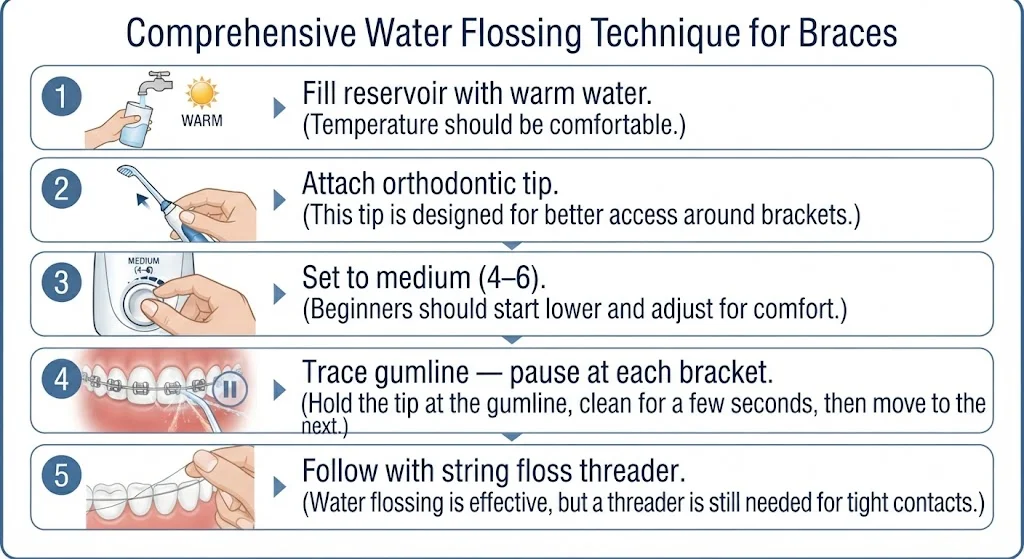
To water floss with braces, fill the reservoir with warm water, attach the specialized orthodontic tip, and set pressure to medium (4–6). Trace along the gumline and pause 1 to 2 seconds at every bracket.
- 1Fill the reservoir with warm waterNot cold — cold water on braces-adjacent gum tissue is uncomfortable, especially after adjustments.
- 2Attach the orthodontic tipThe thin tapered nozzle (not the standard flat tip) is designed for bracket margins and gets closer to the gumline.
- 3Lean over the sinkThe orthodontic tip does not seal in the mouth like a standard tip — the water exits freely. Lean forward to avoid mess.
- 4Set to medium pressure (4–6) and start upper leftWork systematically: upper arch first, then lower. Trace the gumline above the bracket row, then below it at the wire level.
- 5Pause 1–2 seconds at each bracketAngle the tip toward each bracket margin and hold briefly to flush the adhesive margin where plaque accumulates.
- 6Follow with string flossUse a floss threader for the most crowded or contact-heavy pairs of teeth to get the physical interproximal contact water alone cannot provide.
3. Water Flosser vs String Floss for Braces
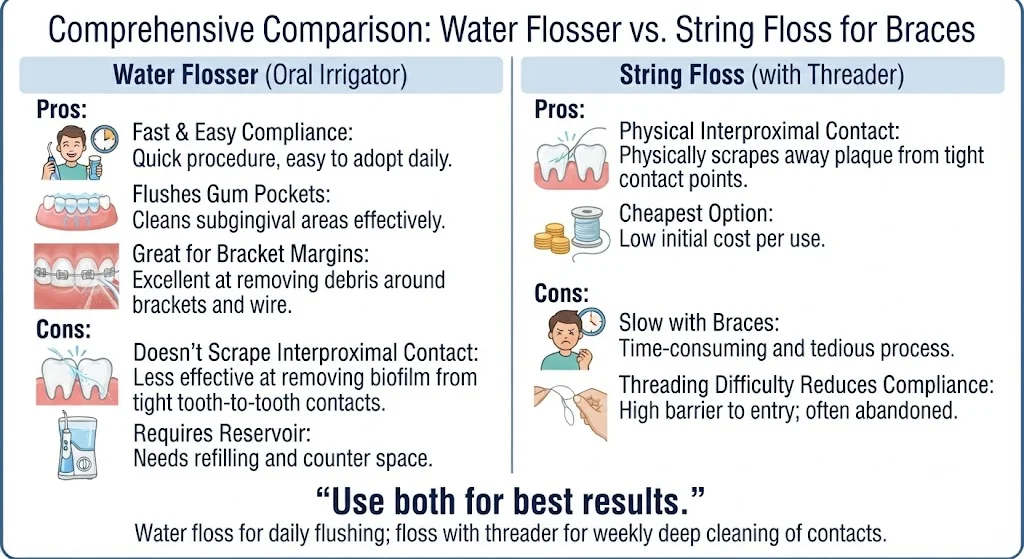
Water flossers excel at flushing plaque and food particles out of bracket crevices and subgingival pockets. However, string floss is still required to physically scrape adherent biofilm from tight tooth contacts.
Water flossers and string floss remove plaque through different mechanisms. Water pressure is excellent at flushing debris, bacteria, and inflammatory byproducts from gum pockets and bracket margins. String floss physically scrapes the curved surface between two adjacent teeth — a contact action water pressure cannot replicate.
For braces patients who find string flossing prohibitively difficult, a water flosser alone is far better than no interproximal cleaning at all. For optimal oral health, both should be used: water flosser first to flush debris, then string floss for interproximal contact on the most important spaces.
4. Pressure Settings Guide
Medium pressure (settings 4–6) is ideal for daily braces cleaning. Low settings (1–3) suit new users or sensitive gums after adjustments, while high settings (7–10) risk irritating gums or loosening brackets.
The table below outlines key comparison data and practical guidelines for how to clean braces with a water flosser: technique & best settings.
| Setting | Best For |
|---|---|
| 1–3 (Low) | First-time users, sensitive gums, early gingivitis, or right after an adjustment |
| 4–6 (Medium) | Most braces patients for daily cleaning — effective without causing discomfort |
| 7–10 (High) | Not needed for most braces patients — can irritate gums or dislodge loose brackets |
Note: Data reflects typical clinical guidelines and average provider estimates across standard treatment plans.
Frequently Asked Questions
Can you use a water flosser with braces?
Yes — widely recommended by orthodontists. The pulsating stream flushes bracket margins and gum pockets in 2–3 minutes. Use an orthodontic tip for best results.
What pressure setting should I use on a water flosser with braces?
Medium (4–6) for most patients. Start at low (1–3) if you have sensitive gums or are new to water flossing. Avoid high settings (7–10) — unnecessary and can irritate gums or stress loose brackets.
Does a water flosser replace string floss for braces?
No — it complements it. Water pressure flushes bracket margins and gum pockets; string floss physically scrapes between teeth. Use water flosser first, then string floss for interproximal contact.
Which water flosser is best for braces?
Waterpik has the most clinical research for orthodontic use. The Waterpik Orthodontic Tip (brush + water stream) is ideal. Other brands work too. Cordless models are convenient but require reservoir refills.
When should I use a water flosser — before or after brushing?
Before brushing. Flushing first removes loose debris so your toothbrush can reach enamel surfaces more effectively. Then brush with fluoride toothpaste, then string floss.