
How to Clean a Permanent Retainer: Flossing, Tools & Calculus Prevention (2026)
Quick Answer
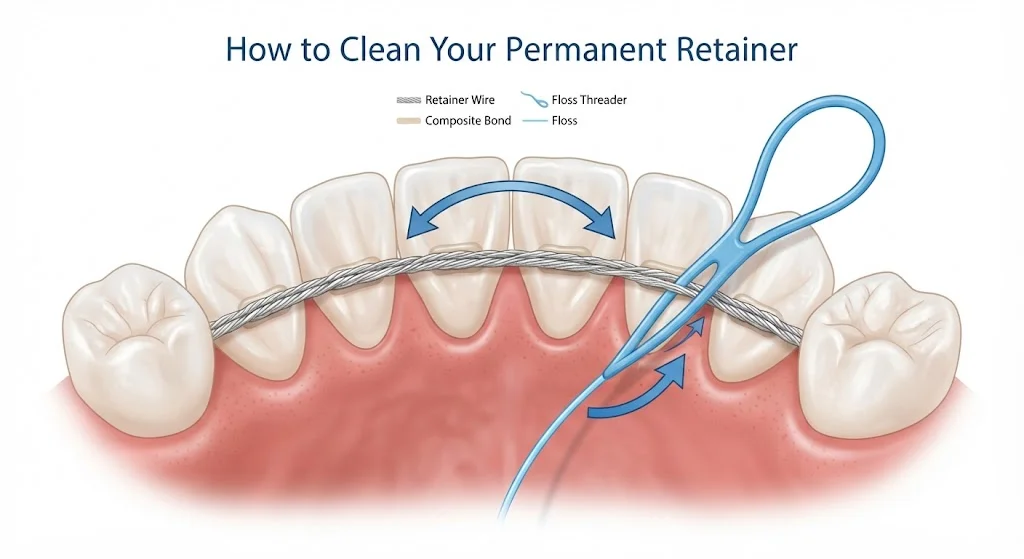
A permanent (bonded/lingual) retainer requires daily flossing under the wire using a floss threader or orthodontic flosser. Without it, plaque and calculus (hardened tartar) build up on the wire and lingual tooth surfaces. Once calculus forms, it cannot be removed at home — a hygienist must scale it off. Brush the wire twice daily and see your dentist every 6 months.
Part of our Maintenance & Care Guide. Also see: How Long Do You Have to Wear a Retainer?
1. Why Permanent Retainers Need Special Cleaning
Permanent retainers require dedicated daily cleaning because bonded lingual wires trap plaque where saliva flow naturally deposits calcium. Neglecting this hidden wire leads to rapid tartar formation and localized gum inflammation.
A permanent retainer is a thin wire bonded to the lingual (tongue-side) surfaces of the front 4–6 teeth. It holds teeth in position 24 hours a day — its main advantage. Its disadvantage: it creates a surface that plaque adheres to on the one side of the teeth most people never clean thoroughly.
Without consistent flossing under the wire, plaque accumulates along the wire and at the gumline behind the front teeth. Within weeks, plaque mineralizes into calculus. Calculus is porous and harbors bacteria, creating chronic gum inflammation that can progress to bone loss around the bonded teeth over years.
2. Flossing a Permanent Retainer: Step-by-Step
Cleaning behind a permanent retainer involves threading dental floss under the wire with a threader or SuperFloss, then scraping each tooth in a C-shape. Water flossers provide an excellent daily supplement to flush wire margins.
Option 1 — Floss Threader (most thorough)
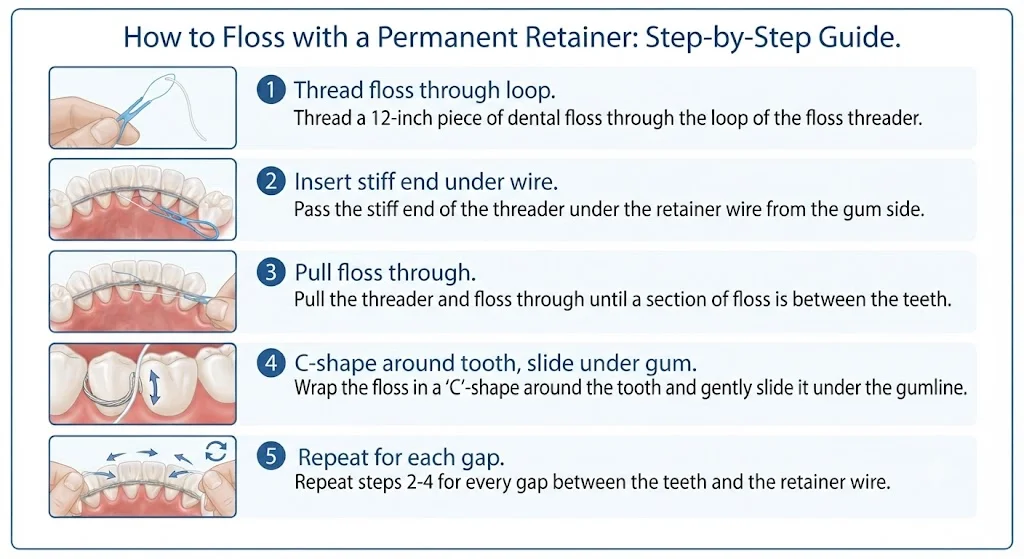
- 1Thread a piece of floss through the loop of the threader
- 2Insert the stiff end of the threader under the archwire between two teeth
- 3Pull through until the floss is positioned between the two teeth
- 4Wrap the floss in a C-shape around one tooth and slide gently under the gumline
- 5Repeat the C-shape on the adjacent tooth
- 6Pull the floss out and re-thread for the next pair of teeth
- 7Repeat for every space along the full bonded length
Time: 3–5 minutes. Do this before brushing each night.
Option 2 — Orthodontic Flosser (SuperFloss or Platypus)
Pre-threaded flossers have a stiff end that slides under the wire, a fluffy middle section for lingual surfaces, and regular floss for interdental contact. Faster than a threader but gives less control over the C-shape maneuver. Good for patients who struggle with the threader.
Option 3 — Water Flosser
Trace the gumline behind the front teeth and along the wire with an orthodontic tip. Excellent for flushing bacteria from gum pockets and wire margins. Must be combined with string floss for interproximal contact.
3. What a Calculus Bridge Is (and Why It Matters)
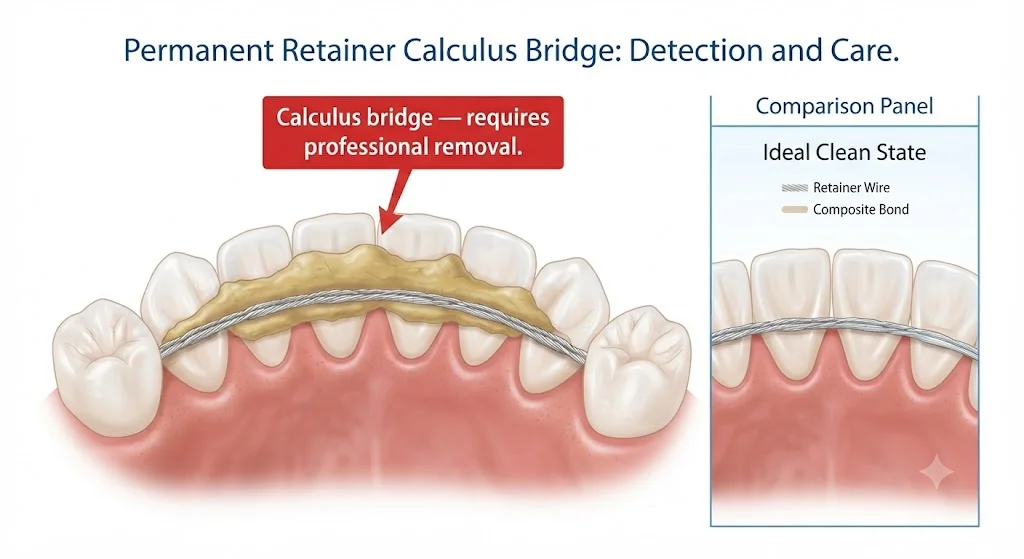
A calculus bridge is a calcified yellow-brown ridge of hardened tartar that forms across bonded retainer wires when plaque mineralizes. Removing this bridge requires professional dental scaling to prevent progressive bone loss.
A calculus bridge is a solid ridge of hardened tartar that forms when mineral-rich saliva deposits calcium and phosphate onto plaque on the retainer wire. It connects adjacent teeth across the wire, appearing as a yellow-brown calcified ridge running along and through the bonded section.
It cannot be removed at home. A hygienist must remove it with specialized scalers or ultrasonic instruments. Left untreated, a calculus bridge causes chronic gum inflammation and, over time, bone resorption around the bonded teeth — the same progression as periodontitis. This is the most serious long-term complication of poor permanent retainer hygiene.
4. Brushing the Wire and Lingual Surfaces
Brushing permanent retainer wires requires angling toothbrush bristles directly toward the tongue-side gumline to sweep away plaque film. Interdental brushes provide targeted cleaning around individual composite bonding spots.
After flossing, angle your toothbrush to clean the lingual surfaces of the bonded teeth and the wire itself. A small-headed toothbrush or an interdental brush gets bristles under and above the wire more effectively than a standard brush held flat. The lingual surfaces are where calculus builds most aggressively — thorough brushing with fluoride toothpaste here matters as much as flossing.
Frequently Asked Questions
How do you clean a permanent retainer?
Floss under the wire daily with a floss threader, brushing the lingual surfaces and wire twice daily. Use the C-shape technique at each tooth surface, sliding under the gumline. This prevents calculus buildup — the main long-term risk.
What happens if you don't clean your permanent retainer?
Calculus (hardened tartar) builds up on the wire. Once calcified, it can only be removed by a hygienist. Untreated calculus bridges cause gum inflammation and eventually bone loss around the bonded teeth.
Can you use a water flosser to clean a permanent retainer?
Yes — excellent tool for flushing bacteria from the wire and gum pockets. Use an orthodontic tip. It does not replace string floss for interproximal contact, but used together the combination is highly effective.
How often should you see a dentist if you have a permanent retainer?
Every 6 months minimum. Tell your hygienist about the retainer so they scale the lingual wire surfaces. Some patients benefit from 3–4 month intervals if calculus builds quickly.
What is a calculus bridge on a permanent retainer?
A solid ridge of hardened tartar bridging across the retainer wire. Yellow-brown, impossible to remove at home. Causes gum inflammation and bone loss if not professionally scaled off. The most serious consequence of skipping retainer cleaning.